


THE PRESIDENT must have learned a lot from the manner in which the Americans pulled an amazing stunt that caught Venezuela by surprise.
This comes as President Ferdinand Marcos Jr. ordered the Philippine Coast Guard to board and inspect all registry and AIS (automatic identification systems) of vessels operating within the Manila Bay reclamation sites following reports that a Chinese-made dredging ship – Kang Ling 539– has worked under six different country flags – the Philippines, Sierra Leone, China, São Tomé and Príncipe, and Panama, while doing dredging work.
THANKS TO POWELL
Taking cue from a January 5 article published by renowned security analyst Ray Powell, that the China-made vessel had used many different identities while travelling between Manila and a dredging site in Zambales for over two years.
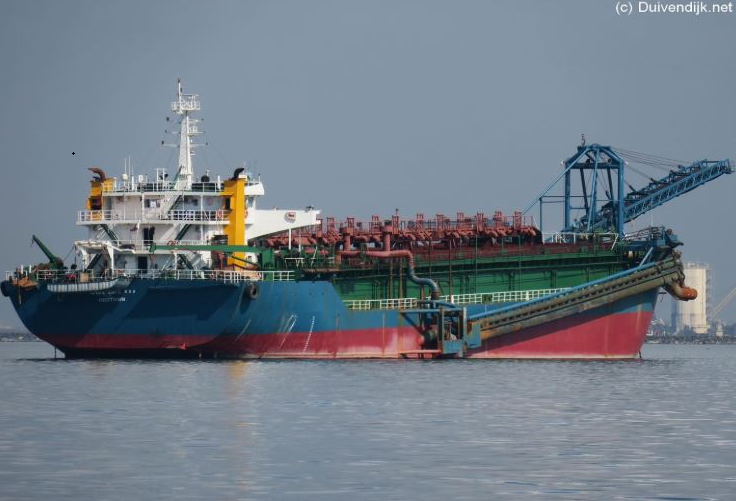
Citing a PCH statement, Palace Press Officer Claire Castro on Tuesday said the ship stopped showing its Philippine identity while it dredged four hours at the mouth of the Sto. Tomas River in Zambales.
After returning to Manila Bay, it reverted to its Philippine identity, Powell wrote.
Powell, director of Sealight, found the vessel simultaneously broadcasts multiple identities through its Automatic Identification System, switching between Philippine and Sierra Leone flags depending on its location.
PRESIDENTIAL ORDER
The presidential order came two days after Powell’s story was published showing how a single Chinese-origin dredger has broadcast at least 30 different identities while shuttling between Manila Bay and a dredging site in Zambales for over two years.
Last weekend, the ship dropped its Philippine identity while conducting a four-hour dredging operation at the mouth of Santo Tomas River, then reverted to its Philippine identity upon re-entering Manila Bay.
Philippine law requires dredgers moving sand between Philippine points to be at least 60% Filipino-owned, Philippine-flagged and registered, and crewed by Filipinos.
Foreign-owned or foreign-flagged dredgers cannot legally perform routine dredging operations unless reflagged and placed under qualified domestic ownership, the Philippine Star reported.
DREDGING OPERATIONS
To recall, last May Marcos ordered a probe of all dredging operations nationwide amid mounting environmental concerns and reports that Philippine sand was being diverted to Chinese land reclamation projects.
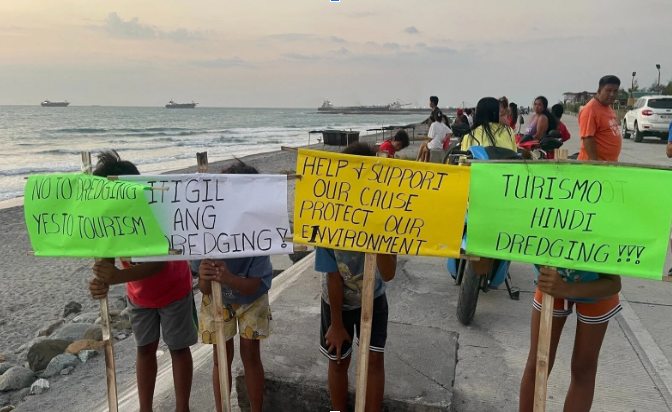
During World Fisheries Day in November 2025, fisherfolk and coastal residents from Zambales and Ilocos Sur marched to the Department of Environment and Natural Resources in Quezon City.
They demanded accountability for what they described as the “continued corporate plunder” of the country’s marine and aquatic resources through dredging and reclamation.
The protest, led by the Pambansang Lakas ng Kilusang Mamamalakaya ng Pilipinas (Pamalakaya), targeted dredging operations in Zambales and Ilocos Sur, which are reportedly supplying materials for the reclamation project in Manila Bay.
BAY UNDER THREAT
Manila Bay, which borders coastal cities in the National Capital Region as well as the provinces of Bataan, Pampanga, Bulacan in Region 3, and Cavite in Region 4, may be under threat from 21 land reclamation projects.
These activities cover an area almost twice as large as Metro Manila.
These data are based on the key findings from a study by the Marine Environment and Resources Foundation Inc. The study warned that these projects could result in massive flooding, water contamination, and the loss of fishing grounds.
MASSIVE EXTRACTION
Pamalakaya has also flagged an alleged massive sand extraction in the guise of a dredging project by a Chinese company on the shores of San Felipe, Zambales.
In a statement, the group alleged that the firm behind the dredging project is the China Harbour Engineering Company Ltd.
“This unregulated sands extraction has resulted in significant losses to daily income of coastal residents, and worsened the vulnerability of fishing communities to erosion, sea-level rise, among other geological hazards,” said Pamalakaya Secretary General Salvador France in a statement.
”The Chinese company, the local and provincial government, as well as government agencies that approved this project are accountable to the affected residents and the environment,” he added.
CHINESE DREDGERS
The Chinese firm in question is a subsidiary of state-owned China Communications Construction Coorporation (CCCC), which had been placed in the US Department of Commerce’s Entity List for its construction of artificial islands in the West Philippine Sea.
The fisherfolk group said that the dredged materials will be transported to Manila Bay in Pasay City.
Together with environmental group Zambales Ecological Network, Pamalakaya said that it will file a formal complaint at the House Committees on Natural Resources, and Aquatic and Fisheries Resources over the destructive activities.
The groups are seeking a probe into the environmental and socio-economic impacts of dredging.
IMMINENT DESTRUCTION
The United States National Oceanic and Atmospheric Administration earlier explained that dredging is the removal of sediments and debris from the bottom of water bodies.
Several circumstances necessitate dredging, including the maintenance of waterways for ships, as well as the cleaning of pollutants in bodies of water surrounding cities.
But environmental groups have flagged that excessive dredging can lead to environmental harm, particularly the destruction of marine life.
The Department of Environment and Natural Resources-Mines and Geosciences Bureau also said that dredging could lead to changes in water depth, thereby altering the strength of waves. This means that coastlines affected by dredging could experience higher waves over time.
RELATED ARTICLE: