Sunday, February 8, 2026
Home Blog Page 95

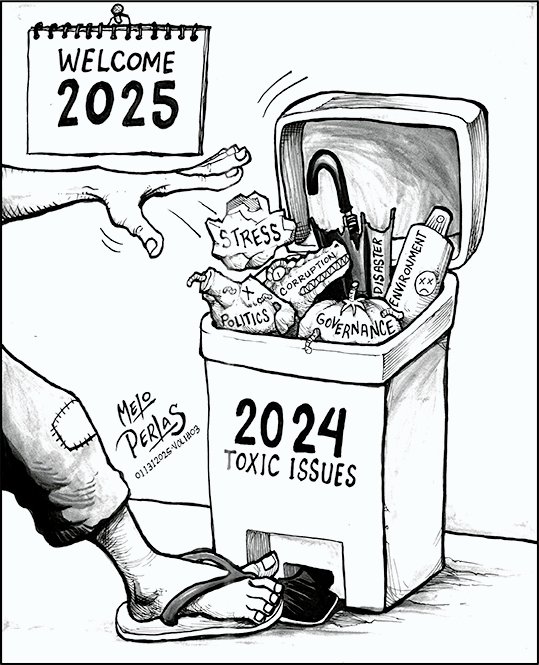
Hoping For A Less Toxic 2025

THE last 12 months have been a rollercoaster ride for the Philippines – from corruption, politics, environment, governance, corruption, disaster, and glory.

Politics and corruption topped the Philippine’s most significant stories, embarking on what appears more like a purge on the previous administration.

Former President Rodrigo Duterte made the opening salvo by hurling a direct accusation on his successor for allegedly continuously using illegal drugs. President Marcos, Jr. is not glorifying the tirade.

In the first quarter, the Department of Environment and Natural Resources took centerstage with the discovery of private resorts within a supposed protected area, the Chocolate Hills. Not one public official has been charged or penalized for negligence.

Before this quarter came to a close, dismissed Negros Oriental Rep. Arnolfo Teves, Jr., who has been evading arrest over a long list of cases arising from heinous crimes, was arrested in Timor-Leste. The government has yet to bring home the expelled solon.

The second quarter’s biggest news – the resignation of Vice President Sara Duterte as education secretary, congressional inquiries “in aid of legislation,” the much-awaited issuance of arrest warrants for former President Duterte and his minions over the bloody drug war that claimed lives of around 30,000 drug suspects and civilians. Did the ICC consummate the issuance of a warrants of arrest?

The second half of 2024 saw the Marcos-Duterte Unity tandem split. The Lower House formed the QuadCom to probe inter-connected issues on illegal Philippine offshore gambling operators, illegal drug trade, extrajudicial killings, and human rights violations in the course of former President’s bloody drug war. No criminal case has been filed in court despite the findings and recommendations of the investigating joint panel.

Amid strong public clamor, Marcos Jr. was compelled to ban POGOs during his third SONA last July. Interestingly, the Presidential Anti-Organized Crime Commission admitted that around a hundred POGOs have opted to go “underground.” 

Likewise, the year saw the abrupt ouster of Sen. Juan Miguel Zubiri as Senate President for what many believed was more of a betrayal embarking on politics of compromise, patronage and convenience. Come to think of it, betrayal has become a fixture in politics. 

Lest we forget, the continuing saga of the likes of former Bamban Mayor Alice Guo, former presidential spiritual adviser Pastor Quiboloy, and many others.

The last but certainly most damaging event of the year is the series of super typhoons that displaced millions of hapless Filipinos. And yes, lives perished, business activities slumped, infrastructures destroyed, hundreds of thousands rendered homeless.  

If there’s any consolation, that is the double gold haul of Pinoy gymnast Carlos Yulo at the 2024 Paris Olympics. This historic milestone was nearly spoiled by disparaging innuendos embarking on trivial spat between Carlos and his mom. 

Let’s just hope that in the coming year, we would be seeing less of toxic political play, wanton disregard of law, massive corruption, human rights abuses, etcetera, etcetera.

Why The Philippines Needs A Happiness Act

With the spate of reported loneliness, depression and suicide among the youth in the Philippines, how is the Government handling this?

Although the country ranks 163rd among 183 countries in World Health Organization’s 2019 statistics where suicide occurs for every 100,000 population, the local health department still has to come out with more focused solutions (or prescriptions) to quell this occurrence. In the early part of this year, there had been 3,413 listed suicides where 4.3 percent are male and two percent are women. No distinction as to age had been reported but the ages from 18 to 35 had the highest suicide incidence in constant testimonies. 

Statistics don’t lie.

Beyond Medicines, Policies

How about focusing on the total mental health state of citizens?

Evidently, the remedy is beyond medicines or current policies. An encompassing and long-term solution to address these must come together in finding rational, achievable and well-sustained well-being solutions. Coaching people towards a positive outlook for good relationships with family, friends and others and a healthy work-life balance.

Nations like United Arab Emirates, India and Nigeria already have their own Ministries of Happiness while Australia is in the process. 

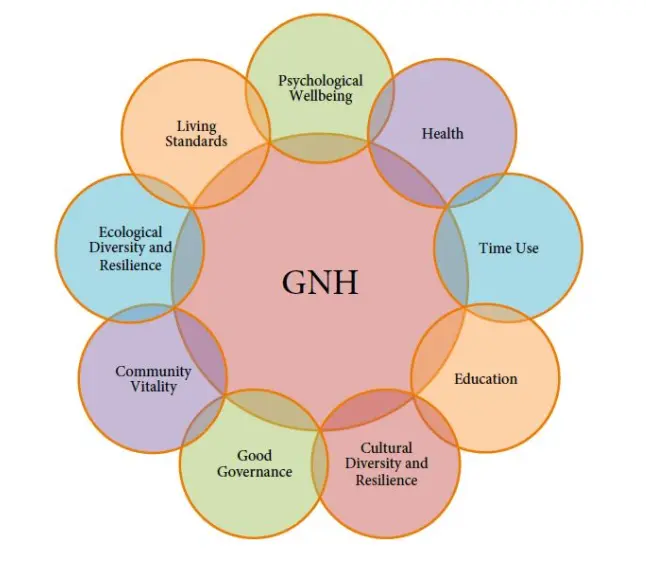
In 2008, a least developed landlocked Asian country, the Kingdom of Bhutan, began a worldwide movement to measure Gross National Happiness. That was the year when the world was facing a financial crisis. Bhutan sought alternatives.

Bhutan citizens were more focused on relationships, health, psychological wellbeing, good governance, next to economy and culture. Its government officials saw that contentment, control of mind and wants in life are main factors in having a positive mindset. For them, a compassionate society could be happier and more productive. 

In this Himalayan monarchy, where education and healthcare is totally free, its leaders target 2023 to be on equal footing with more developed country in the region as it faces natural and man-made challenges in the face of lack of decent infrastructure.

To create a society where Filipino’s happiness is paramount is doable. The end of this is a more cursory look at the Filipinos’ greater societal contentment that government must seriously initiate to address the most pressing issues of the time: Mental Health.

Potential Cure For Societal Ills

If the Philippines starts looking at its gross national happiness index as the potential cure-all for societal ills that had been bedeviling developed nations even the war on drugs could be addressed. 

A Department of Happiness – or a commission, to start with – could address the vast inequalities caused by this endless and futile drug war. This government office could challenge the entire philosophy behind this contentious and disappointing war on drugs.

A much-supported government office could probe why many Filipinos get depressed and lonely. Is it due to the dearth of family ties, the rising cost of living, education and health care support, more than poverty itself? Others may even look at a botched disability scheme or as far as renewable technologies.

Make the Balance Happen

There is a need to scrutinize the areas surrounding the youth and their future and their tolerance to stress and the environment. These could need reconsidering an administrative, economic and legislative system to make the balance happen. The formula is a development agenda based on core values led by youth and focused on a future in which everyone achieves happiness. 

To create a society where Filipino’s happiness is paramount is doable. 

The end of this is a more cursory look at the Filipinos’ greater societal contentment that government must seriously initiate to address the most pressing issues of the time: Mental Health.

Car Sales On The Slump

0

It’s a fact: Vehicle sales growth in the Philippines is slowing down! 

While this is really bad news for car firms that are still hoping sales will reach 500,000 units in 2024, car makers are optimistic that the next months will be better.

From January to October, automobile sales reached 84,310 units, or 8.9 percent more than the 352,971 logged in the same period last year, according to the Chamber of Automotive Manufacturers of the Philippines, Inc. (Campi) and the Truck Manufacturers Association. This was much lower than the 25.9-percent to 352,971 units from 280,300 units in the same period last year.

Campi president Rommel Gutierrez said that the January-to-October figure in vehicle sales is still a reason to be optimistic. 

“The increase can be attributed to good sales and good stock availability, neutralizing the effect of Typhoon Kristine on the operations of dealers nationwide last month,” Gutierrez said.

As the year ends, automakers are hopeful in hitting their aggregate target sales of 468,300 units for this year, or just 83,990 short for the period.

When it comes to monthly sales compared year-on-year, the sales increase of 4.9 percent in October to 40,003 units is much lower compared to the same period last year.

In October last year, unit sales reached 39,128 units, for a hefty 21.8-percent increase compared to the 32,145 units of the same month in 2022.

The Popular Choice

Even with the unbelievable low down payment promo, there were very limited takers. And if there were, low maintenance cost and reasonable price of spare parts are major considerations.

In industry ranking, Toyota Motor Philippines Corp. (TMP) sustained its dominance in the industry with 19,333 units sold in October, up 4.9 percent from 18,434 a month earlier. From January to October, TMP sales grew to 178,421 units, 10.0 percent higher year-on-year, cornering a 46.43-percent market share.

Mitsubishi Motors Philippines Corp. (MMPC) came in at second with October sales of 7,348 units or a 2.2-percent decline from the previous month. Year-to-date, MMPC sold 73,376 unit, or 12.6-percent higher compared to the same period of 2023. It’s market share stood at 19.09 percent.

Ford Motor Co. Philippines, Inc. ranked third followed by Nissan Philippines Inc., and Suzuki Philippines Inc.

Robust Economy

For its part, BMI, a unit of Fitch Solutions, sees vehicle sales in the Philippines to continue growing this year, supported by robust economic activities.

In a commentary released in September, BMI adjusted upward its growth projection for vehicle sales in the country from 1.6 percent last year to 8.5 percent this year, with total sales this year reaching 466,500 units.

The Fitch unit said the commercial vehicle (CV) segment will realize a 7-percent growth to 343,000 units, driven by demand from the construction and mining sectors.

“We project demand for CVs to be bolstered by robust growth in the construction sector, driven by substantial government expenditure and increases in fixed capital investment as businesses expand their operations. Additionally, the mining and quarrying sectors will contribute to the growth in medium and heavy truck sales,” it said.

However, BMI sees CV sales growth in 2025 slowing down to 1 percent.

Low Loan Interest

On the lowering of the Bangko Sentral ng Pilipinas (BSP) on policy rates, this is seen benefiting the vehicle industry as banks can start offering car loans with lower interest rates.

“For 2025, we anticipate that reduced borrowing costs will continue to support the growth of the passenger car segment, as households respond favorably to lower financing rates,” it added.

Recycling Filipino Gays In Cinemas

0

“Do not judge a book by its cover” must be an apt description of how entertainment scribe Art Tapalla commented on my sixth media studies publication, “SekSinema (Gender Images in Philippine Sex Cinema Enfolding Pandemia)” (2021, BVV Media Productions).

TH ang libro mo (Your book is Trying Hard),” exclaimed Tapalla one day sans reading it.

I took his impression, hook, line and sinker.

In showbiz lingo and context, though, TH—in contrast with the common goal and aspiration of a dreamer and a doer by trying one’s best to succeed—is a condescending expression which implies exploiting anything kitsch, shallow or puff just to get attention.

Hindi mo kasi tinalakay ang (Because you didn’t discuss) queer cinema,” stressed Art who, for crying out loud, hasn’t read, not even perused, the book.

In the book, I have a discussion on gay filmmaking, however, limited but anchored just the same on history and socio-political backdrop, particularly on sex assignments, battle of the sexes, gender equality and liberation.

It would take, of course, another time and material to research to come out with gay-themed movies not only from the conservative, oppressive and homophobic standpoint but the veracity and the whole gamut of historical even theological framework as well notwithstanding societal judgment.

As I write, I log on to Letterboxd blog, an online listing of films with sensibilities of LGBTQ — minus the added IA (Intersex, Asexual, Aromantic, Agender) as in LGBTQIA with the acronym’s plus (+) sign—edited by a certain Ian Casocot. It is titled “A Chronological Listing of Filipino Films with LGBTQ Representation.” According to the intro of the menu, it is a compendium of entries that have gay predilection, or simply LGBTQIA+ represented in its presentation and narrative from the pre-war film industry to the gay film movement in the millennium. 

But gay cinema I did but didn’t enumerate its entries anymore, their description and critique because I summed them up and theorized that all films, encompassing of all genres, are sex cinema, primarily, albeit superficial, on the dichotomy of male and female or man-to-man/woman-to-woman screen characters. Onscreen, actors not excluding pets and other animals, are assigned gender roles—basically, male and female—with corresponding attributes, like psycho make-up, social traits, physical characteristics etc.

There are mutations, though—sex-drama-action (SDA) attributed to Phillip Salvador as SDA Man or any action star doing drama and bed scenes like Ramon “Bong” Revilla, Jr. and Assunta de Rossi in “Kibalot at Kembot” (2002); sex-comedy in “Law Law Gang” (2011), “Indecent Professor” (1995) etc.; “Banyo Queen” (2001), “Shoot! Shoot! Di Ko Kaya” (2021) etc.); sex-fantasy in “Haplos” (1982), “Virgin Forest” (2022 remake) etc. With the emergence of Vivamax, the live streaming app has been churning out diverse tapestry of hybrid sex and other genres.      

What social mores and moral atmosphere Philippine society exude, movies reflect on them… After 400 years of Spanish conquest, the country still has to struggle against puritanism like anti-gay and misogyny attitudes.

In Letterboxd, I wonder why “Ibong Adarna” (1941), a fantastic tentpole, was considered an LGBTQIA+ representation.

Is it because the “ibong Adarna” as colorful as it is, is an androgynous creation, a fanciful, flamboyant mythical bird whose singing cures the malady of the king of the court?

Queer cinema has been around the local film industry for ages which has influences from colonial filmmaking before the turn of the 20th century when the first gay film “The Dickson Experimental Sound Film” or simply titled “The Gay Brothers” was made in 1894.

What social mores and moral atmosphere Philippine society exude, movies reflect on them.

Conservatism, Catholicism and other prudish beliefs make up Philippine social order especially Hispanic influence of patriarchal family setup where machismo and male chauvinism dominate.

After four hundred years of Spanish conquest, the country still has to struggle against puritanism like anti-gay and misogyny attitudes.

Homosexuality in real life during the colonial regimes was taboo while in the Western civilization where Spain rooted its advancement, man-to-man sexual relationship was prevalent particularly the liaison between Alexander the Great and his lovers Hephaestion and Bagoas. 

In the Philippines, gays are still portrayed, in real and reel life, as caricatures and jesters—human persons not to be taken seriously as outcasts like “Facifica Falayfay” (1968), “Petrang Kabayo at ang Pilyang Kuting” (1988) etc. 

These typical gay characters are Vice Ganda’s aping the scandalous and wacky interpretation although some may argue that the trans-actor is a cut above the rest because of his cerebral media articulation. Let’s see what ABS-CBN Studios and The IdeaFirst Company’s “And the Breadwinner is…” directed by the no-nonsense Jun Lana and a 2024 Metro Manila Film Festival has to offer.

Although there are serious if not contemplative M2M cinema like “Tubog sa Ginto” (1969), “Macho Dancer” (1988), “Sibak (Midnight Dancers” (1994), “Markova” (2000) etc., they are selective of audiences because gays until now aren’t totally accepted by society except for some absurd reasons.   

Lesbian acts like “Kapag Tumabang ang Asin” (1976), “Ang Pulubi” (1969) directed by Danny Zialcita and Luis Nepomuceno, respectively, “Manila By Night” which was censored by the Movie and Television Review and Classification Board (MTRCB) and retitled “City After Dark” (1980) directed by Ishmael Bernal had kissing scene between Cherie Gil as lesbian junkie and Rio Locsin as a blind masseuse. and other LGBTQIA+ film projects had gay love which we would find in such classics as Connie Macatuno’s “Rome and Juliet” (2006), Sigrid Andrea P. Bernardo’s “Ang Huling Cha-Cha ni Anita” (2013) etc.

In retrospect, there are so many recycled homoerotic scenes with new twists in the local film business especially in the advent of indie spirit moviemaking.

Illegal Drugs Persist At Bilibid

0

Under the administration of President Ferdinand “Bongbong” Marcos Jr., a more holistic approach has been formulated to deal with the menace of drug addiction and the narcotics trade — as opposed to his predecessor, Rodrigo Duterte, who initiated a brutal anti-illegal drug campaign that cost the lives of thousands of drug personalities, including innocents who were just suspected to be involved or were collateral damage police drug raids where suspects resisted arrest.

Just days after his assumption as president, Marcos Jr. faced the country’s drug problem squarely, directing law enforcers to intensify their campaign and operations while adopting a humane and sublime approach even as he emphasized that the issue is more of a public health concern rather than a menace that threatens the fabrics of our society.

But at the House of Representatives’ Quad Committee — composed of the House Committees on Dangerous Drugs, Public Order and Safety, Human Rights and Public Accounts and chaired by Surigao del Norte solon Robert Ace Barbers — hearings on the previous administration’s drug war and the extrajudicial killings (EJKs) that went with it, the former president insisted that his anti-illegal campaign was a success because it ‘minimized’ the prevalence of narcotics in the country.

Duterte’s Rationale

Duterte claimed that “(he) had to do it because it was demanded at the time and whether (people) believe it or not, whether (there are) the statistics different from (his) — the government — (his drug war had) gone a long way to protect the people, especially the children.” 

He rationalized: “You cannot entirely eradicate drugs because pang hanap buhay iyan until now (people are using that to earn money) . . . It is a commercial thing, that is of value, and people na walang trabaho, walang hanapbuhay, papasok talaga d’yan, (especially) if they are criminally inclined to do it.” 

Still, Marcos Jr. countered that the government’s current anti-drug campaign is much more than it has been in the past. “So, it’s the most successful approach to the drug war so far. So, why will we change it? We won’t change it; we’ll continue to do what we are doing. Of course, I cannot explain to you every detail of what we are doing, but we will continue to do what we are doing.”

Based on official data, the Marcos administration’s anti-drug initiative has netted a record ₱40.32 billion worth of illegal drugs.

It’s ironic that despite repeated efforts to curb the illegal drug trade within the NBP, the problem persists. This, in fact, has prompted prison authorities to relocate high-value inmates to an undisclosed location, for now.

Failure To Launch

It’s ironic that despite repeated efforts to curb the illegal drug trade within the New Bilibid Prison (NBP), the problem persists.

This, in fact, has prompted prison authorities to relocate high-value inmates to an undisclosed location, for now.

Local Governments and Interior Secretary Jonvic Remulla has acknowledged the failure of current security measures, including regular inspections and surprise raids, to effectively stop the flow of drugs within the prison.

The current system, where authorities conduct regular inspections and raids on cells to search for drugs and contraband, is no longer effective, Remulla admitted.

Security Lapses

According to authorities, small-time drug dealers apprehended outside the prison often claim to have received their supply from within the NBP.

This raises questions about how drugs are able to enter the prison, which is supposed to have tight security.

The issue has become a recurring problem, with numerous directives issued to address it, but to no avail.

A prominent personality previously incarcerated at Bilibid even revealed that the prison housed a shabu manufacturing facility.

This explains why high-profile inmates convicted of drug offenses continue to operate their businesses from within the prison, living a life of luxury and seemingly unaffected by their confinement.

It has also led to suspicions of corruption among prison officials and guards, who have allegedly been involved in facilitating the drug trade.

Relocating Guilty Inmates

Despite these concerns, no concrete action has been taken to hold these individuals accountable. Instead, officials have been replaced, but the system remains the same.

Remulla has announced that if the situation does not improve, high-value inmates will be transferred to a remote location where they will be unable to use mobile phones to contact their assets and continue their drug operations.

They are hoping that this relocation will finally put an end to the drug trade within the prison.

Only time will tell if this drastic measure will be successful.

The Plight Farmers Amid Climate Change

0

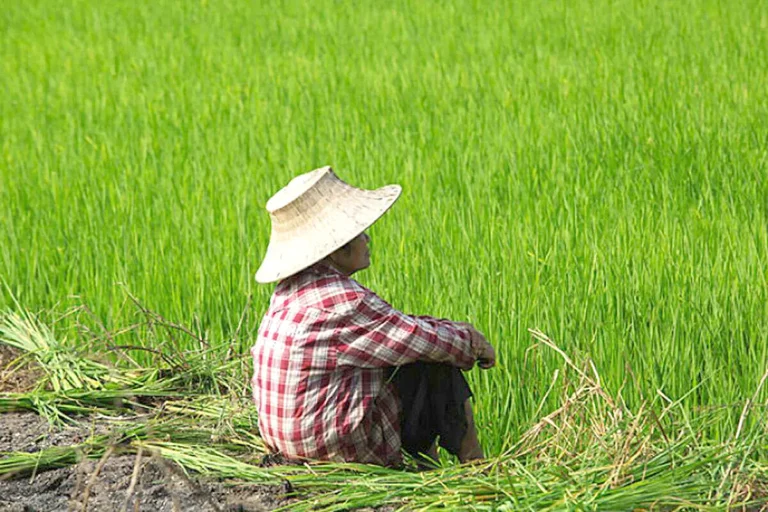
PALAYAN CITY, Nueva Ecija — Across Central Luzon, the talk among embattled farmers ranges from drought and floods to planting and climate change. Conversations are also about abandoning their homes as the government enforces its land property policies, demanding families to leave or simply survive under the heel of abusive landlords.

Net results are emerging food shortages across Region 3 where some 12 million people are facing potential famine as international organizations warn of a “possible economic collapse” after heavy rains were blamed by farmers for ruining the recent planting season.

“Nagtanim kami pero tinangay ng baha,” 52-year-old farmer Mang Andres laments, his face dark and aged from decades in the sun. “Naglagay kami ng abono, na sobrang mahal, tinangay rin ng baha.

“Napakahirap ng aming kalagayan pero ang sabi ay dahil daw sa climate change. Dati nga may inipong tubig sa maliit na lawa malapit sa aming taniman, kaya lang natuyot na ito at naging lubluban na lang ng kalabaw.” he describes his current situation.

It’s Complicated

The list of complaints blamed on climate change goes on, complicated in a sense because farmers cite the man-made shift in weather patterns for drought, clean water shortages, severe storms and landslides, dying forests, insect plagues, silted rivers, and disappearing fish populations as contributory factors to their sorry plight.

Perhaps the biggest impact is the unpredictability of the seasons. Traditionally, farmers would plant and harvest around the annual May to September monsoon when plants and wildlife bloom and breed accordingly.

That, according to a farmer from Apalit in Pampanga— who declined to be identified—resulted in years of patchy drought which ended with recent late floods that ruined his vegetable and rice crops and seeds needed for next year.

He lamented: “Kung hindi man binaha, natutuyot ang lupa. Nakakalungkot pagmasdan. Sixteen years ago, maganda ang pananim at ani.

“Dalawang buwan nakalipas, bumaha ng malalim at tinangay ang aming abono sa ilog. Naglaho na rin ang mga isda at ang tubig hindi na kasing linis gaya ng dati.”

Perhaps the biggest impact is the unpredictability of the seasons. Traditionally, farmers would plant and harvest around the annual May to September monsoon when plants and wildlife bloom and breed accordingly.

Drought and Destruction

Five kilometers southeast of his farmland, another farmer, Winifredo aka Mang Winnie, tells a similar story. His family is sub-leasing a few acres of land and growing rice some chili, Lady Finger bananas, and spinach on the banks of the nearby river.

He has two sons aged 25 and 29 who are now working in Saudi Arabia. When his farmland was submerged in flood waters, his family was put in a difficult position: “Talagang nahirapan kami. Kaya nga nag-abroad ang aming dalawang anak para matulungan kami at umasenso naman ang aming buhay.”

His sentiments were echoed by Mang Chito, a 45-year-old farmer who moved his wife and two children from the lower region of Pampanga to a plot of land bordering with Nueva Vizcaya.

Mang Chito expressed belief climate change is proving too hard to combat while providing a living for his family at the same time. “Alam namin ang tungkol sa global warming at dahil dito, dahilang ng kakulangan sa patubig… Gumagamit kami ng mga chemical fertilizer para labanan ang pamiminsala nila.”

Mang Chito is aware that the loss of large trees due to drought and destruction of forests have resulted in landslides when the rains arrive. 
According to the National Disaster Risk Reduction and Management Council (NDRRMC), the recent super typhoon Kristine destroyed farms, deteriorated produce quality and blocked roads due to torrential rains. Its strong winds and the landslides and flooding severely disrupted delivery of farm goods and created delays in the transport of farm produce to public markets in Metro Manila that affected selling prices.

Can We Ignore Our Mounting Debt?

0

The global economy is in danger of getting stuck on a low-growth high-debt path. And this redounds to lower incomes and fewer jobs anywhere in the world. 

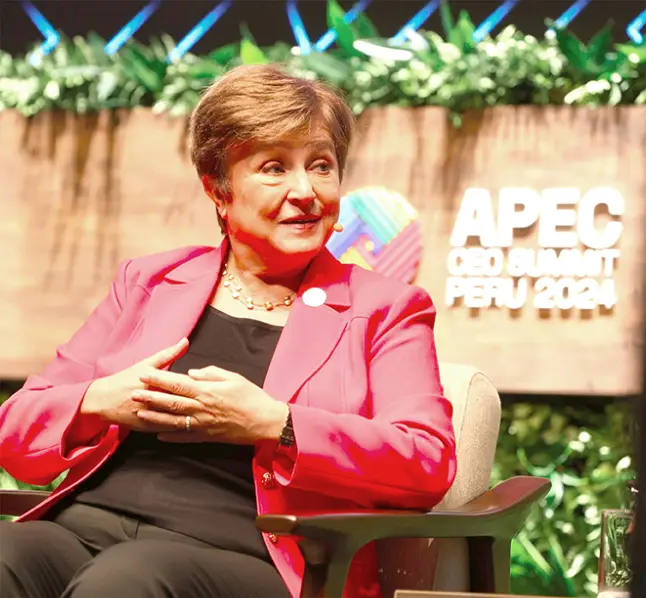
The alarm was sounded off by a top official of the International Monetary Fund (IMF) Managing Director Kristalina Georgieva during the press conference of the recent 2024 IMF and World Bank Group Annual Meetings in Washington, D.C.

The global economy is in danger of getting stuck on a low-growth, high-debt path, emphasizing the need for governments to take action on the debt issue and institute pro-growth policies and reforms, Georgieva stressed. “So less investment to support families and fight long-term challenges like climate change.” 

There is a need to “finish the job of inflation without unnecessarily damaging the job market” and to start addressing the debt issue, she added. “That can be done gradually, but it needs to start now.”

Besides the high debt levels, of equal concern is debt servicing which can negatively affect the budget allocations of developed nations, including for social services like education and health.

Georgieva concluded, “Governments must work to reduce debt and rebuild buffers for the next shock—which will surely come, and maybe sooner than we expect. 

Credit Rating Respectable

Georgieva’s statements resonate for the Philippines which has seen an increasing debt load that, ironically, is expected to further go up as the country’s credit rating remains respectable.

As of end-2023, the Philippines had a debt-to-gross domestic product (GDP) ratio of around 61.9 percent, increasing from 60.1 percent from end-2022. During the Duterte administration, the debt-to-GDP ratio was below 40 percent, but the pandemic forced the government to borrow to plug budget gaps.

Meanwhile, the country’s total outstanding debt slightly increased by 0.8 percent to P16.02 trillion as of end-October, according to the Bureau of the Treasury (BTr).

Besides the high debt levels, of equal concern is debt servicing which can negatively affect the budget allocations of developed nations, including for social services like education and health.

Capable To Repay

The irony is despite the country’s increasing debt load,  it got an investment upgrade rating up to “positive” from “stable,” as reported by Standard & Poor (S&P) Global Ratings.

S&P also kept the sovereign credit ratings at “BBB+” for long-term and “A-2” for short-term.

The investment upgrade sends a signal that the government has the capability to repay its debts.

“The positive outlook reflects our improved assessment of institutional and policy settings in the Philippines … (which) could lead to stronger sovereign support over the next 12-24 months if the Philippines’ economy maintains its external strength, healthy growth rates, and that fiscal performance will strengthen,” said the American credit rating group.

Committed To Deliver

On Philippine GDP growth, S&P expects this to settle at 5.5 percent this year, below the government’s low-end target of 6 percent.

S&P added that while slower global economic growth may drag down the economy, growth in the Philippines “should be well above the average for peers at a similar level of development.”

Factors lead to improvements in the quality of expenditure, manageable fiscal deficits, and low general government indebtedness.

As for inflation, S&P said that it has settled the government’s 2 to 4 percent target. November inflation settled at 2.5 percent, and year-to-date inflation is 3.2 percent, citing the diversified economy of the Philippines, with its “strong record of high and stable growth.”

GDP Growth Falters

The government’s confidence on sustaining higher GDP growth seems to be faltering. Specifically, the Development Budget Coordination Committee (DBCC) revised anew this year’s GDP growth target to 6 to 6.5 percent from the previous 6 to 7 percent.

“Despite domestic challenges, we are optimistic that we can still attain our growth target for the year of 6 to 6.5 percent,” Budget Secretary and DBCC Chairperson Amenah Pangandaman said, expecting the Philippine economy to bounce back during the last quarter.

Furthermore, the economic growth forecast for 2025 to 2028 have been adjusted to 6 to 8 percent from the 6.5 to 7.5 percent for 2025 and 6.5 to 8 percent for 2026 to 2028.

When it comes to its peers in Southeast Asia, Indonesia and Vietnam both have debt-to-GDP ratio of 39.9 percent as of end-2023. 

Meanwhile, Malaysia’s is 63.4 percent and Singapore 160 percent as of end-2023. While Singapore’s debt-to-GDP ratio is the highest in Southeast Asia, its status as a developed economy gives it more leverage to deal with its debt.

It’s Strictly A Family Affair

FOR the longest time, the Philippines has been at the disposal of around a hundred clans, despite constitutional provisions prohibiting political dynasties.

In a study conducted and published by the Asian Media Center, three of the country’s past and present Philippine Presidents are direct descendants of former heads of state. They are Gloria Macapagal – Arroyo (daughter of former President Diosdado Macapagal), the late Benigno C. Aquino III (son of former President Corazon Cojuangco Aquino), and Ferdinand Marcos Jr. (son of the late doctor Ferdinand Marcos Sr.).

Up and beyond these three is a long list of families who have been swapping elective posts – or holding similar positions at the same time.

Dynasty Up-Close

According to Ateneo de Manila University Dean Ronald Mendoza, political dynasty is a situation wherein members of the same family are occupying elected positions, either in sequence for the same position, or simultaneously across different positions.

“Political Dynasties in the Philippine Congress,” a recent study of Dean Mendoza et al in 2013, hinted that “75 percent of district representatives, 85 percent of governors, and 66.67 percent of mayors could be considered dynastic.

The same study showed that these families tend to dominate the major political parties, making members of the political family formidable as indicated by winning ratios – making it extremely difficult for the “best and the brightest” to serve the government.

Family Rule

Studies showed a link between the prevalence of political dynasties and underdevelopment as dynastic politicians are extracting wealth and resources to optimize their own economic interests at the expense of their constituents. 

They steal and destroy while operating under a weak rule of law through their access to extractive industries – like illegal mining, deforestation in the guise of land development, and reclamation to name a few tricks with immediate benefits. 

They are exhausting resources to establish economic and political dominance, weaken political competition, and undermine political accountability. 

Some are promoting development in their political bulwark while expanding their family’s wealth and clout. Under conditions of political stability and economic opportunities, dynasties can invest in limited economic development to maintain popular support and business connections.

[A] study showed that these families tend to dominate the major political parties, making members of the political family formidable as indicated by winning ratios – making it extremely difficult for the “best and the brightest” to serve the government.

As May Be Defined

The 1987 Constitution explicitly restricts political dynasties. However, the Philippine Congress for the last 37 years has not been able to enact an enabling law banning political dynasties.

Section 26 of the Constitution hinted at the need for an enabling law to enforce the prohibition – “The State shall guarantee equal access to opportunities for public service, and prohibit political dynasties AS MAY BE DEFINED BY LAW.”

The reason – both chambers of the Philippine Congress are dominated by political families who are not bent on enacting a law that would weaken their political clout and control.

Previous legislative bills were deemed dead from the time proposals were filed as 80 percent of the members of the Philippine Congress form part of political dynasties.

Strictly A Family Affair

For one, the 24-member higher legislative chamber is at the mercy of political families. Except for Senators Risa Hontiveros, Bong Go and Ronald dela Rosa, all the rest are members of continuously expanding political clans.

For some, the Senate has become a “reunion” of senators who have the same surnames — Cynthia and Mark Villar, Jinggoy Estrada and JV Ejercito, Alan Peter and Pia Cayetano. Interestingly, these pairs are not keen on the idea of giving up any seat in the Senate.

In the case of Sen. Cynthia Villar who is already on her last term, her daughter Camille has filed her certificate of candidacy for senator.

One of the Cayetano siblings – Pia, is running for reelection. Half-brothers Jinggoy and JV who both won during the 2022 senatorial derby still have until 2028 in office.

Absolutely No Way

A direct descendant of a political clan, Senate President Francis Escudero, previously warded off criticisms over the prevalence of political families in the Senate amid efforts to resurrect a once powerful political clan by endorsing the congressional bid of his younger sister Bernadette for the first legislative district of Sorsogon. 

Why? Because there is no way for Senate members to support an enabling law that would diminish their political prowess.

Consider this: Senators Bong Revilla and Francis Tolentino are protecting their clout in Cavite, so are Senators Cynthia and son Mark preserving their business interests, in the same manner that Senator Nancy Binay’s family are preserving their hold in Makati City. 

The Cayetano siblings, both lawyers, are not keen on diminishing their hold in Taguig City. Not to be left behind is Senator Sherwin Gatchalian whose brothers have expanded family prowess by notching a top Cabinet seat while maintaining control over Valenzuela City.

Senators Aquilino Pimentel III, Lito Lapid, Loren Legarda, Imee Marcos, Robin Padilla, Grace Poe, Raffy Tulfo, Joel Villanueva, and Juan Miguel Zubiri – they all form part of the country’s political dynasty landscape.

Addressing Local Squatter Problem

0

FOR THE LONGEST time, the national government has been dealing with the perennial problem of the proliferation of squatters, spending quite a huge chunk of its budget and yet hardly showing improvements.

The government’s socialized housing could not seem to cope-up with the rapidly growing number of families wanting to have a decent place they could call their own, mainly because of the magnitude of corruption taking place in the national government agencies delving on the matter. 

These agencies have become a milking cow of political appointees who probably mistook the government portfolio as reward for their “unconditional support” to whoever gave them what seemed to be “a juicy position.”

As such, dubious groups made use of this predicament to go into something lucrative, to the detriment of the hapless Filipino families who only wanted a safe place where they could live. These are the professional squatter syndicates who are enticing homeless families to become beneficiaries of what they claim as an earnest effort to do what the government failed to do – for less.

Professional squatter syndicates entice homeless families to become beneficiaries of what they claim as an earnest effort to do what the government failed to do – for less.

Compassion and Common Sense

I am no expert in addressing a problem that many scholars have tried, but failed to solve. But from what I have seen in a small lakeshore town in Rizal, addressing the problem of human settlement does not require one to be a genius.

According to a longtime friend, Gerry Calderon, solving the problem only requires two things – human compassion and common sense. By the way, Gerry was Angono, Rizal mayor for 18 years. Her daughter Jerimae has taken over and sustained her dad’s vision for a town that is widely referred to as the Art Capital of the Philippines.

According to Calderon, they too have their share of problems with the proliferation of squatters, and it took years before they got over it.

Calderon said that Angono does not have sufficient resources to buy land and transform it into a socialized housing zone, but they do have in sight a vast tract of idle private lands whose owners they have been talking to for a mutually beneficial tender.

Gerry’s take – mas maigi nang maibenta na lang nila in easy payment term ang lupa nila kesa magising sila isang umaga, pinasok na sila ng mga squatting syndicates. His trick seemed effective. 

Angono has warded off illegal squatting syndicates from taking over somebody else’s property. Angono has also addressed the need for a place for local folks who don’t have a place they could call their own. They have also given what many informal settlers usually prefer — in-city relocation.

Safety of Locals

It doesn’t end there though. The local government is not bent on gambling on the safety of their local folks. 

To ensure the safety of the houses that families would live in, the LGU is somehow being strict insofar as the structural integrity is concerned. Houses should not be in a place that would qualify as a hazard area. 

And most of all, human settlement areas should be accessible to the local government services.

After all, these families are human beings too.

Kadiwa Faces Rivals

0

THE DEPARTMENT OF AGRICULTURE would be better off tapping the existing network of hard discount stores (HDS) – DALI Everyday Grocery, which is funded initially by a loan of $15 million from the Asian Development Bank and another $13 million later, and O!Save of Robinson’s Retail Holdings Inc. (RRHI) – to augment its network of Kadiwa outlets in the government’s desire to sell affordable food items to low income consumers of major cities in the country. 

Presently, there are 71 Kadiwa ng Pangulo (KNP) outlets, targeted to hit 179 this month. By mid-2025, 300 stores will rise, to reach 1,500 by the end of the Marcos administration.

Dali, the leading HDS, now has 630 stores as of last April. Before the year ends, the goal is 920 outlets.

Location is Paramount

Hard discount store chains, living up to its objective, were set up to make basic goods and food items affordable to the lower classes by sourcing unbranded stocks mostly from local manufacturers. HDS outlets have less marketing, merchandizing and operational costs. 

If you’ve noticed, there are little or no store shelves as items are places in boxes. There are lesser sales assistants, promodisers, and hardly any airconditioning. 

Location is paramount. These discount stores are mostly located in city centers and areas with high foot traffic.

Most Kadiwa stores are located within the compounds of DA agency offices. Others are mobile which have erratic and uncertain schedule of operation.

Hard discount store chains, living up to its objective, were set up to make basic goods and food items affordable to the lower classes by sourcing unbranded stocks mostly from local manufacturers.

No Contest

Dali, a Swiss-based retail chain, was first established in Sta. Cruz, Laguna in February 2020. Being small did not cause a stir to its major rival, Puregold. 

But years later, it faced complaints and charges with regulatory agencies filed by Puregold. This did not make a dent in its expanded operations. 

Not even sari-sari stores can approximate the low rates at HDS outlets because the latter sell mostly branded products purchased at wet markets and groceries that had already made a huge mark-up.

Rushing Expansion

In the next 12 months, O!Save, on one hand, expects to more than double its store network in its pursuit to close the competitive gap with HDS pioneer and market leader, DALI.

After doubling its footprint to 318 stores in the 12 months to September, O!Save is gearing to add around 382 stores through end-2025, according to Gina Roa-Dipaling, vice president at Robinsons Retail, in a report of Bilyonaryo.

“O!Save is accelerating expansion. They really need to scale up,” Dipaling said at an investors forum. 

Expanding the store network will enhance O!Save’s capacity to contract manufacturers for in-house or private-label products, a critical factor for hard discount retailers to compete on price and affordability.

Pricing Strategy

The share of private labels in O!Save’s income improved to 17 percent of its $155 million nine-month revenue, up from 13 percent of $64 million in the same period last year. 

However, the hard discount retailer’s profitability depends heavily on how quickly this share can grow.

O!Save was established in 2021 by investors who had previously departed from the emerging DALI, a company disrupting larger retailers with its pricing strategy.  

Since the President’s instruction to DA is to make Kadiwa stores more accessible and strengthen its operations so more people can benefit from its lower-than-prevailing market prices, tying up with HDS would be a logical strategy.

A Business Model

How the competing companies would be able to gain respectable margins from their sales at prices that customers with tight budgets can afford would be an interesting case study for business students.

Other business conglomerates would be closely watching the HDS model of Robinson’s retail group. If this proves to be profitable, everyone would join the bandwagon. See how the generics pharmacy stores mushroomed?

With Power and Wealth, the HECK with Responsibility

0

Many successful and powerful people in their ivory towers are wont to do away with responsibility, thus ushering their fall.

Winston Churchill said: “The price of greatness is responsibility.”  In the same vein, Michael Korda, editor-in-chief of Simon and Schuster, suggested, “Success on any major scale requires you to accept responsibility. In the final analysis, the one quality that all successful people have in common is the ability to take on responsibility.”

Voltaire, a towering figure of the French Enlightenment, put it most succinctly: “With great power comes great responsibility.”

On the other hand, Lord Acton boldly exclaimed, “Power corrupts, and absolute power corrupts absolutely.”

Verily, thus, responsibility is an essential element in both the attainment and management of power and success – and this has been long recognized by great men and women.

Taking responsibility for your choice, decision and action will keep you on track of your end-goal and, at the same time, from falling into the trap of finger-pointing or blaming others.

Don’t Blame Others

Taking responsibility for your choice, decision and action will keep you on track of your end-goal and, at the same time, from falling into the trap of finger-pointing or blaming others.

Lou Ludwig, author and inspirational speaker, said it beautifully: “The price of success comes with responsibility; (persons who want) to succeed takes 100 percent responsibility for their actions. Staying on track may not be easy; but they stay focus on their desired outcome. 

When things go wrong, they don’t blame others; they take the responsibility to find the solutions and get things back on track. If you want to create a life of success and greatness, you have to take responsibility of the results.”

After attaining success or power, responsibility becomes even more imperative. The higher you go in the ladder of success or in the totem pole of power, the greater demand on you to live up to your responsibilities. The more successful you are in life, the greater your power and influence, but also the more complex and multilayered your responsibility becomes.

Actions Matter

However, truth be told, for others who are most successful, they would rather cling to power even if it means turning their back on responsibility.

What could be behind their behavior?

The most obvious explanation is greed or “wanting more and more for oneself”, which impels one to manipulate and take advantage of others.

Thus, instead of opting for the high ground – that is, exercising responsibility – powerful and successful people tend to go low.

It is worth reckoning: What’s the point in being wealthy or powerful, wanting more and more for yourself, when people around you are wallowing in poverty because of your unbridled greed or, at the least, apathy?

A Better Place

People will remember not your wealth, but your actions.

To paraphrase Steve Mueller, a management specialist: “It is not the immense wealth, assets or tangibles that people will remember about the departed. It is their actions, especially if such have made a difference in other people’s lives. Not the amount of money and luxury goods they amassed in their lifetime. 

People will not remember your wealth, but the way you invested this money, either for yourself and your family, or in making this world a better place to stay.”

Who Is Sabotaging The Law?

0

“Give us the names of big-time smugglers—not the small fry,” the solons are wont to demand (more often hollering) from customs authorities or even from the prosecutors during congressional probes.

But, wait! Isn’t smuggling a crime? As such, only the courts can adjudge or pronounce a person guilty of smuggling? The authorities of the Bureau of Customs (BOC) and the prosecutors of the Department of Justice (DOJ) can only investigate, do case build-ups, and whenever this thing called “probable cause” do exist, they file the smuggling case in the appropriate courts.

And before our courts, the desires, biases, and swagger of the BOC and the DOJ are of no moment. Only those evidence—relevant, material, and competent—that they proffer to the court matter. Pending the decision of the courts, no person can be pronounced guilty of the crime of smuggling, let alone be called a smuggler. As the Constitution exhorts, all persons shall be presumed innocent until the contrary is proved. And the Constitution is the “mother of all laws” and rules—even supreme than the Rules of Congress. 

[U]ntil the courts have convicted the suspects, they are presumed innocent and are to roam free and treated guiltless. This is our sad reality.

Thrown Into The Gaol 

For the solons to press their demand on the executive officials—BOC and DOJ, to submit to Congress the list of big-time smugglers is clearly off the mark—“wala sa hulog”. To repeat, only the courts can pronounce a person guilty of smuggling and thus be called smuggler. 

No amount of badgering—even shaming, Customs will force the latter to submit “that list” of smugglers. No one in BOC will have the heart to label people as smugglers until they are adjudged guilty as such. They run the risk of ending in the calaboose for libel ahead of these people whose names the solons want to hear getting thrown into the gaol for the crime of smuggling. 

We are not saying the BOC front liners are blameless. No! What we are saying is: until the courts have convicted the suspects, they are presumed innocent and are to roam free and treated guiltless. This is our sad reality.

The Probable Cause
Perhaps, what the solons can do while the DOJ prosecutors are hard pressed on finding “the probable cause” or the Courts proving the crime “beyond reasonable doubt” is to put to task the BOC leadership on why it continuously disregards Congress’s strict prescriptions in Section 412, 413, among others, that require all “entries” now known as “Single Administrative Documents” to be lodged, allowed, and/or processed only when filed/submitted “under oath” or under pain of perjury or falsification. 

And, please, not by “fake notaries” that abound throughout the length and breadth of the metropolis, nay archipelago. After all, ICT-driven apps, I.e., techOATH and iSWEAR, among others, are now readily available in the technological bureaucracy.

Until this Oath requirement of the Customs Tariff and Modernization Act is done—or Congress wakes up from its deep slumber pursuant to its oversight powers both under Republic Act No 10863 (CMTA) or Republic Act 12023 (AntiAgricltural Economic Sabotage Act) the evils of “undervaluation,” “misclassification,” “misdeclaration,” and other frauds upon customs will continue to haunt us notwithstanding today’s and future quadcom, pentacom/quintacom, or whatever forum their fertile minds can concoct.

And the congressional probes? Well, “all sound, no fury,” many are wont to say.