


WITH STRONG EARTHQUAKES hitting different parts of the country in the last several days, many must be wondering whether or not the government has put in place an appropriate disaster plan to cushion its impacts.
Earlier today, a magnitude 7.4 earthquake rocked Manay, Davao Oriental that sent people from down south scampering to safety in a manner that is way different from the National Simultaneous Earthquake Drills (NSED) being exercised on a quarterly basis.
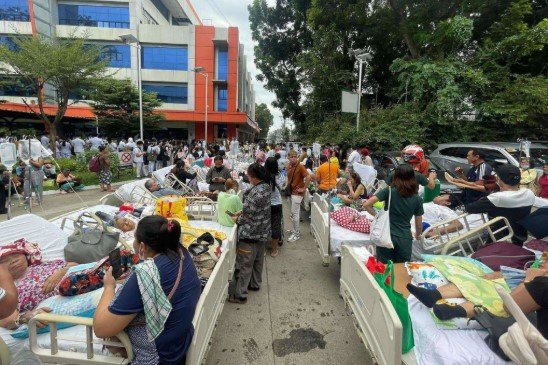
Citing data from the Philippine Institute of Volcanology and Seismology (Phivolcs), the earthquake with a depth of 20 kilometers occurred at 09:43 Friday morning.
Days before the Davao Oriental tremor, strong earthquakes also hit the provinces of Cebu (in the Visayas) and La Union (in Luzon). Phivolcs however clarified that all three earthquakes are not related.
VICIOUS AND WIDE
The intensity of the earthquake, initially reported as magnitude 7.6, was eventually downgraded to 7.4 before 11 in the morning of the same day.
The shuddering of the ground affected localities in adjoining regions. The earthquake’s impact was also felt in the Visayas region.
Reported intensity is the measure of the strength of an earthquake based on what people feel as well as the effects on structures and the environment.
Initial reports coming from the Davao Oriental provincial government claimed that a resident from Mati City was killed after being hit by a beam.
POOLING EFFORTS
In a statement, President Ferdinand Marcos Jr. said that the government is mobilizing efforts to ensure the safety of everyone affected.
“We are now assessing the situation on the ground and ensuring that everyone is safe,” Marcos said.
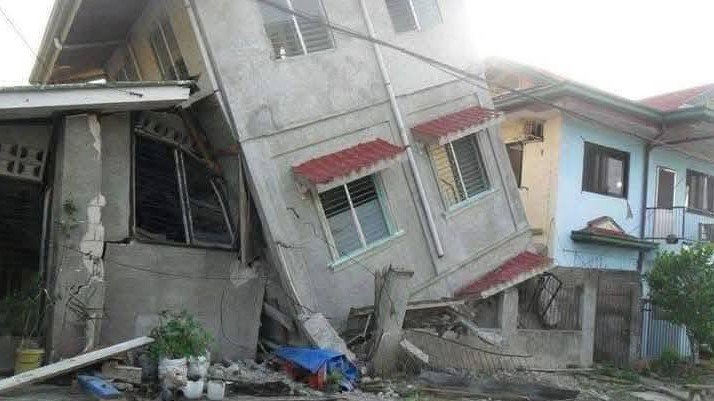
“We are working round the clock to ensure that help reaches everyone who needs it. Let us continue to look out for one another and pray for the safety of all our countrymen,” he added.
As of posting, concerned government agencies have yet to release other details including the extent of damages.
TSUNAMI WARNING
Following the incident, Phivolcs “strongly advised people in the coastal areas to immediately evacuate” to higher grounds or move farther inland, in view of a “destructive tsunami with life threatening wave heights.”
“Based on the local tsunami scenario database, it is expected to experience wave heights of more than one meter above the normal tides and may be higher on enclosed bays and straits,” Phivolcs said.

“It is forecasted that the first tsunami waves will arrive between 09:43:54 to 11:43:54, 10 Oct 2025 (PST). These waves may continue for hours,” it added.
Meanwhile, Indonesia has also issued a tsunami warning for northern Sulawesi after the quake hit Davao Oriental.
Indonesia’s geophysics agency suggested that there was a risk of tsunami waves as high as 50 cm hitting Indonesia’s shorelines.
Phivolcs lifted the Tsunami warning at 1:43 p.m.
MORE AFTERSHOCKS
Shortly after the magnitude 7.4 earthquake that hit Davao Oriental, Phivolcs recorded nundreds of aftershocks.
In a television noontime news program, Phivolcs Supervising Science Research Specialist Angelito Lanuza said that the number had been recorded from the Mati seismic station within one hour of the initial quake.
“So far, siguro nasa hundreds na po ‘yan kasi one hour pa lang. Ganun naman po kadalasan ‘yan pero sa ngayon nagbibilang pa lang,” he said.
“Malakas po talaga yung 7.5, it’s almost kasing lakas ng 1990 earthquake. [Magnitude] 7.8 ‘yung 1990 earthquake. Ang kagandahan, medyo may kalaliman nang konti po ‘yung depth [ng lindol ngayon] tapos po medyo 44 kilometers naman po [at] nasa dagat,” Lanuza added.
EXPECT POWER OUTAGE
The Department of Energy (DOE) reported some electric cooperatives and distribution utilities are experiencing partial power interruptions following the magnitude 7.4 earthquake.
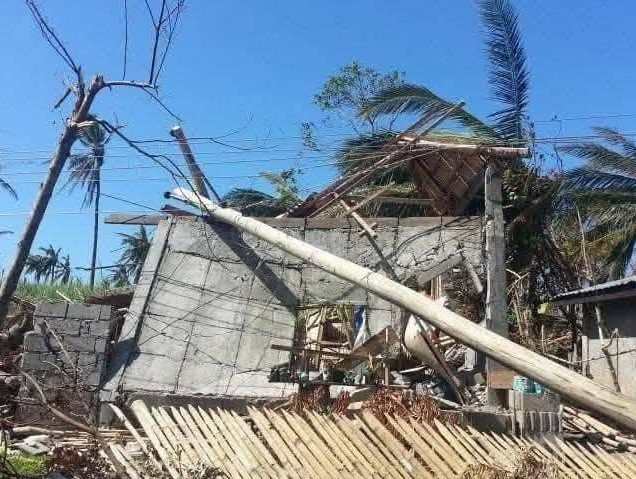
In its situation report, the DOE said three electric cooperatives — Davao Oriental Electric Cooperative Inc. (DORECO), Davao del Sur Electric Cooperative Inc. (DASURECO), and Northern Davao Electric Cooperative, Inc. (NORDECO) — are currently experiencing partial power interruptions due to the National Grid Corp. of the Philippines’ (NGCP) ongoing line assessment.
Two electric cooperatives — Surigao del Sur I Electric Cooperative Inc. (SURSECO I) and Surigao del Sur II Electric Cooperative (SURSECO II) — are under normal operations following the earthquake.