

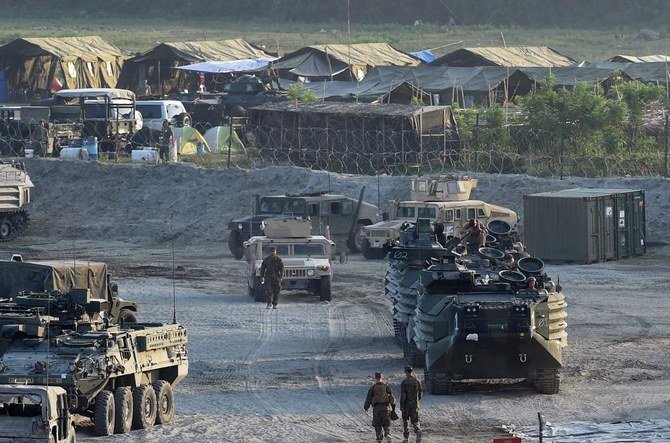
AMID INFLATION, NATURAL disasters, and political instability, a war thousands of miles away, could actually affect the Philippines, which plays host to at least nine military installations referred to as Enhanced Defense Cooperation Agreement (EDCA) sites.
This comes as the United States and Israel launched an attack on Iraq, decimating the city into rubles. The attack also resulted in the death of Iran Supreme Leader Ayatollah Ali Khamenei and its top government and military officials.
In return, Iran fired upon Dubai and Saudi Arabia, where the US has been maintaining military installations as part of its geo-political strategy.
International news reports also hinted at the possibility of Iran retaliating on other US-allied countries — like the Philippines.
‘To date, there are nine EDCA sites strategically located in various parts of the archipelago. Of the nine EDCA sites, five were installed in 2016. The rest were consummated in 2023, under the Marcos administration … The establishment of EDCA sites where American troops were given full access, has fueled concerns of escalating tensions with China.’
STRATEGIC ALLIANCE
By his own admission, Senator Erwin Tulfo, in his capacity as chairman of the Senate Foreign Relations Committee, has expressed alarm over the presence of US military installations in the Philippines.
Tulfo called for a review of the presence of American military installations in the guise of EDCA sites, which to him could become a potential target of Iran’s missile attacks — in retaliation to the US.
Under an agreement that was sealed in 2014, the Philippines and the US agreed to fortify defense cooperation under the 1954 Mutual Defense Treaty. But under the Marcos Jr. administration, US troops have been given expanded military access to the Philippines.
According to the senator, there is an “urgent need” to review the EDCA pact to shoot down the possibility of Iranian forces striking the country with drone and missile attacks.
POTENTIAL TARGET
Tulfo said that the recent developments are more than enough reasons for the Philippines to be “concerned” on the possibility that the Philippines could become the next target of Iran’s reprisal attacks due to expanded EDCA sites.
The legislator then cited Iran’s launching of a barrage of retaliatory missiles in the Middle East, including those in the United Arab Emirates, Kuwait, Qatar, and Jordan, which hosted US military bases.
Interestingly, most of the missiles fired by Iran were intercepted.
“With all these instances and events that are happening, where other countries are targeting American facilities, perhaps you’re right that we should review the Enhanced Defense Cooperation Agreement because we might be targeted,” Tulfo was quoted as saying in a radio interview.
“It’s high time. Since I’m the chairman of foreign relations, I need to look into this and consult the Senate leadership on this issue,” he added.
EXISTING EDCA SITES
To date, there are nine EDCA sites strategically located in various parts of the archipelago. Of the nine EDCA sites, five were installed in 2016. The rest were consummated in 2023, under the Marcos administration.
The original EDCA sites include the Antonio Bautista Air Base in Palawan; Basa Air Base in Pampanga; Fort Magsaysay in Nueva Ecija; Lumbia Air Base in Cagayan de Oro; and Mactan-Benito Ebuen Air Base in Cebu.
A year after Marcos took the helm of Malacañang transformed four Philippine military bases to EDCA sites — the Naval Base Camilo Osias in Santa Ana, Cagayan; Lal-lo Airport in Cagayan; Camp Melchor de la Cruz in Gamu, Isabela; and Balabac in Palawan.
The establishment of EDCA sites where American troops were given full access, has fueled concerns of escalating tensions with China.
LIKE FATHER, LIKE SON
At the House of Representatives, Davao City Rep. Paulo Duterte has a lot to say against the successor of his father, former President Rodrigo Duterte.
According to the younger Duterte, the Marcos administration “painted bullseye on the Philippine soil” by allowing the “aggressive” and “unchecked” expansion of the US troops in Philippine military bases, even as he claimed that the continued presence of the Americans in Philippine military bases invites “retaliation, escalation, and entanglement in wars that are not ours.”
He likewise expressed apprehension on the possibility of transforming the Philippine communities, airports, and seaports into potential battlegrounds.
“In basic military doctrine, any territory made available to foreign forces automatically becomes a legitimate target,” Duterte noted.
“The Philippines should stand as a sovereign nation, not as collateral damage in another country’s war,” he added.
OPPOSITE POLICIES
Under the previous administration, the Philippines pivoted to China for the purpose of economic considerations and eased tensions in the West Philippine Sea.
But when Marcos became president, the Philippines sided back to the US and has since adopted a bold stance against Beijing, to assert sovereign right over the 200-nautical mile Philippine exclusive economic zone, aptly referred to as the West Philippine Sea.
The Marcos administration stood firm on the need to respect the 2016 arbitral ruling junking China’s nine-dash line argument.

