


BEFORE THE proliferation of national beauty pageants and product endorsers in the country, there was the so-called Carnival Queen during the turn of the century.
The Carnival Queen may not be as prestigious as Miss Philippines, Bb. Pilipinas, Mutya ng Pilipinas, Miss RP, Miss World Philippines, and Miss Universe Philippines to name a few.
It may not be as grand like muses of commercial and corporate reps as Miss Caltex, Miss Magnolia, Baron Travel Girl or state-sponsored beauty titles like Miss Green Revolution, the local beauty searches as Miss Barangay Uno, Miss Quezon Province, Miss Talipapa or even Miss Gay Manila.
But Filipino women at that time mostly dreamt of being part if — if not becoming the Carnival Queen herself.
In the American period, sense of pulchritude is one of the factors that sustained the assimilation of imperial, colonial culture and to publicly show the economic development, however debatable or it might serve the elite, under the Commonwealth government.
One of the most personal and historical figures in the Carnival Queen era was the candidacy of Rosario H. Panganiban as Miss Pampanga in 1926 and her discovery by film pioneer Vicente Salumbides who later became her husband.
Soon-to-be-statesman Carlos P. Romulo was the consort of 1922 Miss Pansanjan, Laguna Virginia Llamas who later became his wife.
Pacita Ongsiako de los Reyes, 1929 Carnival Queen was a socialite who was married to an American surgeon, Dr. Ralph Phillips.
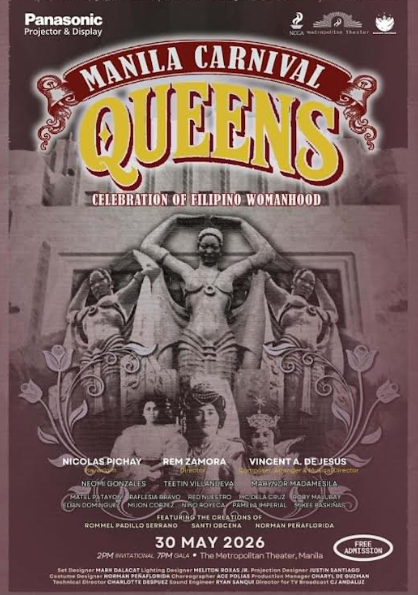
To bring back the glitz and glamour, the atmosphere of Uncle Sam conquest and the American Dream of milk and honey, the socio-politico-cultural era of high society and the essence of democracy, the National Commission for Culture and the Arts (NCCA) presents “Manila Carnival Queens: Celebration of Filipino Womanhood,” a closing tribute to the celebration of the National Month of Heritage this month by the Metropolitan Theater with the collaboration of Panasonic Projector and Display.
The exclusive play, which goes onstage at the Metropolitan Theater on May 30, 2026 at 7 pm, is written by Nicolas Pichay, directed by Rem Zamora and musically scored by Vincent A. de Jesus.