


SHORT OF ONE year, it has been six decades of Nora Aunor supremacy not only in the local entertainment industry but Philippine society as well.
No other actor has ever received the adulation and emulation given her to this day.
Nora’s visibility and presence transcend eternity.
She might be gone to the great beyond but she is still around.
She is a representation of the immortal.
Even the verb attributed to her is in the present tense.
Precisely and simply put, because she is an artist.
ARTISTS AS IMMORTALS
An artist doesn’t die.
And Nora’s artistic creations are timeless.
She herself doesn’t even fade away.
Only her body disintegrates.
But her memories linger forever.
They have, creatively, body and soul as well.
Let’s start off with her music, the very field she was initially known for as a champion in the “Tawag ng Tanghalan (Beckon of the Stage)” amateur singing contest on TV.
Her singing voice is being heard up to now on radio, television and the multimedia—music that brought the National Artist for Broadcast Arts in her.
Her tone was shaped by experiences within and without.
She was a dissenting voice in the wilderness.
‘KAHIT KONTING AWA’
The music that expressed the Filipino soul in her, the sound and the fury echoed among the marginalized like “Kahit Konting Awa (Just a Little Compassion),” “Sulat ni Inay (Letter to Mom)” and “Aking Mahal (My Love),” three haunting and biting songs about the plight and tragedy of an Overseas Filipino Worker (OFW).
The folk and hoi polloi music representing the masses, the working classes and the proletariat such as “Ang Tindera (The Sales Clerk or The Seller),” “Kusinera (The Cook),” “Bulaklak sa Parang (Flower in the Field)” etc. were bases for a NA for Broadcast Arts if not for NA for Music.
‘What more of her films which evolved from the kitsch Filipino teenybopper delineation to a citizen oppressed and victim of injustice to a mature, socially conscious and awakened member of human society, produced for or by her that made her National Artist for Film.’
‘MAHIWAGANG DAIGDIG NI NORA’
Guy also ruled the small screen with her drama anthology like “Mahiwagang Daigdig ni Nora (The Mysterious World of Nora)” and other TV series that portrayed the harsh realities of Filipino life and how to do away with them lawfully and peacefully, again, enough to proclaim her NA for BA.
One of the longest running musical variety shows, “Superstar,” reflected the pop culture syndrome of a national mass entertainment.
What more of her films which evolved from the kitsch Filipino teenybopper delineation to a citizen oppressed and victim of injustice to a mature, socially conscious and awakened member of human society, produced for or by her that made her National Artist for Film.
P.E.T.A.
Theater was also an avenue of collective expression of the Filipino people through Ate (a term of endearment to an older woman by blood or affinity) Guy’s body, the instrument of a stage thespian in commoners’ socio-political landscape in Philippine Educational Theater Association (PETA)’s adaptation of “Minsa’y Isang Gamu-Gamo (Once Moth)” and presentation of “DH (Domestic Helper),” an original play by Ricardo Lee, also known as Ricky Lee, now National Artist for Film.
Cecile Guidote-Alvarez’ Dulaang Balintataw produced the classic-inspired “The Trojan Women” for the national actress.
All three dramaturgies merited cultural prizes.
AUNOR’S FILM
Arts that disturbed, pondered, acted and fought against inhumanity are the staple Aunor’s films were made of.
They represented the great unwashed and the plebeian—”Bulaklak sa City Jail,” “Tatlong Taong Walang Diyos,” “Minsa’y Isang Gamu-Gamo,” “Bakit May Kahapon Pa?” “Condemned,” “Kastilyong Buhangin,” “Kung Ako’y Iiwan Mo,” “Bona,” “Atsay,” “Ikaw ay Akin,” “Andrea Paano Ba Ang Maging Isang Ina?” “Ang Totoong Buhay ni Pacita M.,” “Annie Batungbakal,” “Bongga Ka, ‘Day,” “The Flor Contemplacion Story,” “Himala,” “T-Bird at Ako,” “Bughaw ang Kulay ng Langjt,” “Burgis,” “Ina Ka ng Anak Mo,,” “Hinulid,” “Tuos,” “Thy Womb,” “Taklub,” among many others.
LIBINGAN NG MGA BAYANI
Look at the Nora fans who gathered during the first death anniversary of the Superstar at the Libingan ng mga Bayani (LNMB) in Taguig City and at the Philippine Navy Golf Club clubhouse in Pasay City and spent time not only to look back but to project as well the future of their idolization although it’s just La Aunor’s first death year.
I bet, though, the posthumous remembrances on her will be year after year just like the annual memorial dedication of admirers to national heroes or dead popular idols like Elvis Presley or John Lennon or Michael Jackson.
ELVIS PRESLEY, JOHN LENNON, MICHAEL JACKSON
That brings to mind the significance of Ate (a term of endearment to an older woman by blood of affinity) Guy in Philippine society as Elvis, John, Michael etc. are cultural icons in American consciousness who brought social classes together through their music.
These socio-cultural foreign histories are unifiers and they are patterns in local signification.
Since her ascension to star power, Nora in her representation of the social castes in the country had differentiated the rich from the poor particularly her screen portrayals of the underprivileged and the marginalized which were distinctly separated from her already private, advantaged self.
Because of her entitlements and the privileges which she had enjoyed as a powerful woman or artist or just plain celebrity who could influence the general public for the betterment of Philippine society, especially for the improvement of the lives in all aspects (economic, for one) of the powerless and the lowly, she was expected to rally behind them in fighting against oppression, exploitation, discrimination and other forms of social injustices.
Emancipation Of The Working Class
How many times she got invited to lead and to espouse the causes for free expression and the emancipation of laborers, urban poor, indigenous peoples, factory workers, migrant workers, victims of sexual harassment and other oppressed sectors from the clutches of inhuman treatments?
Yes, Ate Guy would show up in dialogues, rallies or protest marches but sadly, they weren’t sustained.
POLITICALIZATION OF NORA AUNOR
How true that La Aunor’s fighting spirit was limited as her politicalization was personally handicapped paling in comparison with her principled and emphatic public performances in liberating films, reflective TV dramas, patriotic music etc. generously provided for her by committed artists like screenwriters or directors or even producers?
Until she left a vacuum as a catalyst in changing society for the better.
Her followers, though, consciously or not, still cling to the common vision of freedom she had perceived no matter how idolatry, as seen not only on the influx of mourners during her funeral wake at Heritage Park and Crematorium but also on her first memorial year.
MARIE CUSI, ARDENT NORANIAN
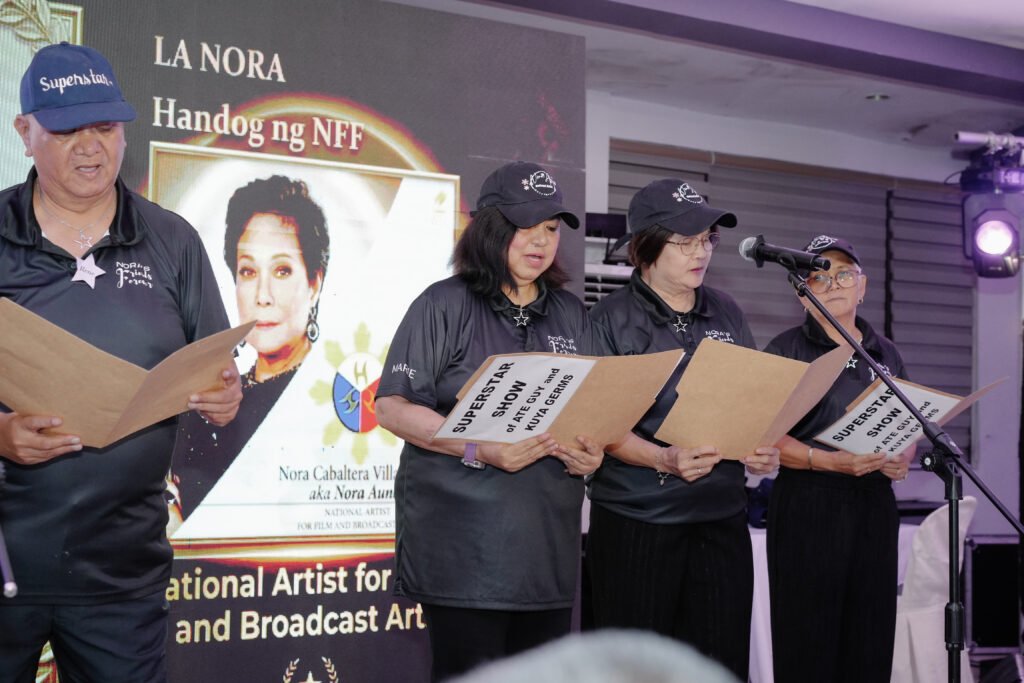
According to Marie Cusi, an ardent Noranian, her fellow fans were well-represented on the special memorial occasion billed “Bongga Ka, Guy” at the PNGC.
Amid the brewing tension between Ian de Leon, Guy’s biological son and his siblings, Lotlot, Matet, Kiko and Kenneth de Leon (all adopted) over an inheritance issue where the eldest is legally the sole heir of Nora’s estate, Noranians were vigorously detached from the family feud.
As usual, the PNGC hall was filled to the rafters of intergenerational Nora fans which is a reminiscence of Noramania in the late 60s and early 70s.
NORA AUNOR, A GONER?
Who says Nora Aunor was a goner?
She wasn’t.
She is still an inspiration to her avid fans to make life better not only for themselves but for the rest of the Filipinos.
Nora’s guiding force, guiding light is illumined by words and actions.
Their activism albeit unarticulated but they are an organized body of people to reckon with.
It’s not the end of the struggle yet.
Cynics might consider Noranians nuisances but they aren’t hollow noise.
They are fervent voices enough to wake up the sleeping giant in the massive reactionary forces of any regime for their idol is the symbol of the citizenry, an anti-establishment tradition—complacent but furtive to bolt out from the oppressive system.
#thephinsider
#boyvillasanta
#pureimagination
#noraaunor
#nationalartist
#libinganngmgabayani
#noranians