Thursday, March 26, 2026
Home Blog Page 2

Villars No Longer Sacred Cows

THE MERE FACT that the Securities and Exchange Commission filed criminal cases of insider trading and stock manipulation against Villar Land Holdings Corp. before the Department of Justice (DOJ) in itself manifests sufficient probable cause under existing legal precedents.

This was declared by DOJ Senior Deputy State Prosecutor Peter Ong in denying the defense team’s bid to remand or return the case back to SEC, but wittingly hinted at considering the attorneys’ motions as the counter affidavit.

One noted that the SEC’s decision to file the criminal cases itself constitutes a sufficient finding of probable cause under existing legal precedents, reported Bilyonaryo.

FAMILY DISCLOSURE

The case stemmed from a January complaint by the SEC alleging that Villar Land (formerly Golden MV Holdings Inc.) and its officers engaged in market manipulation and misleading disclosures.

The SEC claimed that the company distorted its share prices by releasing a premature 2024 financial statement reporting P1.33 trillion in assets. After an external audit, the figure was adjusted downward to P35.7 billion, a reduction of 97 percent.

Respondents in the case include former Senate President Manny Villar in his capacity as Villar Land chairman, his wife Cynthia and their children — Senators Mark and Camille, and Paolo. The SEC has also accused Camille of insider trading related to a 2017 transaction.

NO MORE PROXIES

The prosecution panel granted the respondents an extension until April 20 to file their counter-affidavits. Ong directed the Villars and other officers to personally appear on that date to swear to their submissions.

Among the individual respondents, only former independent director Garth Castañeda appeared in person on Monday to file his counter-affidavit.

In a session Monday at DoJ, a DoJ panel of prosecutors gave the respondents until April 20 to file their counter-affidavits on the complaint filed by the SEC.

The investigation involves alleged violations of Sections 24.1(b), 26.3, and 27.1 of Republic Act No. 8799, or the Securities Regulation Code (SRC), which cover manipulative practices and insider trading.

OTHER RESPONDENTS

Villar Land independent director Respondent Garth Castañeda was the only party to submit a counter-affidavit during the proceedings. Villar Land director Cynthia Javarez filed an Omnibus Motion seeking to suspend the preliminary investigation, recall the subpoenas, and return the case to the SEC.

The defense argued in the motion that the SEC failed to make a finding of probable cause required under Section 53.1 of the SRC. 

In reply, Ong said: “I said that if that is your motion, we will take that as a motion to dismiss… [and] that will serve as your counter-affidavit. So, you won’t have to file [anything else]… then they suddenly said they would file [counter-affidavits] after all.”

NO LENTEN BREAK

The prosecutors granted the extension, citing the technical complexity of the case and the upcoming Lenten break.

“We gave them enough time to prepare because the annexes from the SEC are quite thick. It’s not just one case; I think there are four. It’s very technical,” Ong explained.

Despite the motion to suspend the proceedings, Ong said the panel will continue with the investigation while considering the respondents’ arguments.

The panel also directed all respondents to personally appear before DoJ prosecutors to affirm their affidavits.

The SEC earlier flagged Villar Land Holdings Corp. for allegedly reporting P1.33 trillion in assets and P999.72 billion in net income in its March 2024 disclosure, a sharp jump from P1.46 billion the previous year.

PROPERTY VALUATION

Audited financial statements later showed assets of only P35.7 billion after about P1.3 trillion linked to the Villar City valuation was removed. The corporate regulator subsequently fined the company and its officials P12 million for late filing. 

The DoJ earlier issued subpoenas to Villar Land Holdings Corp., its related entities, and key officers. Company officials, who initially said they welcomed the opportunity to respond to the allegations, snubbed Monday’s hearing and were represented only by legal counsel, along with lawyers for related entities.

“I am requesting them to come here. They should swear before us so that we won’t have any doubts about who they swore before,” Ong said, noting the need for procedural transparency.

OMNIBUS MOTION

The SEC has been ordered to file its opposition to the Omnibus Motion before the next hearing on April 20. The panel will then decide on a date for a clarification hearing.

Coincidentally, Villar who for past years was reported by Forbes as the top millionaire of the Philippines, now tails several steps behind Ricky Razon of the International Container Terminal Services Inc. and several other big companies, here and abroad. 

Perhaps this was due to the filing by the SEC of criminal charges against Villar Land for misrepresentation and market manipulation.


Vinegar From Plastic Waste, Anyone?

A REMARKABLE SCIENTIFIC breakthrough by researchers at the University of Waterloo may soon transform how the world deals with plastic pollution. 

Using nothing more than sunlight and an innovative catalytic process, scientists have discovered a way to convert plastic waste—including microplastics—into acetic acid, the primary component of vinegar and an important industrial chemical.

The discovery opens a promising path toward reducing plastic pollution while simultaneously producing a valuable product widely used in food production, manufacturing, and energy applications.

INSPIRED BY NATURE

The pioneering research was led by PhD student Wei Wei under the guidance of Yimin Wu, a professor of mechanical and mechatronics engineering and the Tang Family Chair in New Energy Materials and Sustainability.

“Our goal was to solve the plastic pollution challenge by converting microplastic waste into high-value products using sunlight,” Wu explained.

The project received early support from the Waterloo Institute for Nanotechnology and the Water Institute through a joint seed funding initiative focused on sustainable environmental solutions.

HARNESSING SUNLIGHT

At the heart of the innovation is a process known as photocatalysis, a chemical reaction driven by light energy. In this case, researchers developed a bio-inspired cascade system using iron atoms embedded in carbon nitride.

The design mimics how fungi naturally break down organic matter using enzymes. When sunlight strikes the material, a sequence of reactions begins, gradually converting plastic polymers into acetic acid.

Unlike traditional plastic recycling techniques, this process occurs in water under mild conditions, making it especially promising for addressing plastic pollution in rivers, lakes, and oceans.

The research demonstrated that the method works with several common plastics, including PVC, polypropylene (PP), polyethylene (PE), and polyethylene terephthalate (PET). Even mixed plastic waste streams—which often complicate recycling—can be processed effectively.

BEHIND THE CATALYST 

Central to the technology is a single-atom catalyst system, where isolated iron atoms are dispersed within a carbon nitride framework. These atomic sites allow for more precise reaction control and improved efficiency.

Under sunlight exposure, the catalyst selectively produces acetic acid rather than generating unwanted by-products.

Acetic acid has broad commercial uses, from food preservation and vinegar production to chemical manufacturing and emerging energy systems. 

By converting plastic waste into this valuable compound, the process effectively turns pollution into a useful resource.

GLOBAL CHALLENGE 

Plastic has become one of humanity’s most durable and widely used materials. Its strength and versatility made it essential for industries ranging from medicine to transportation — the same durability that created a mounting environmental crisis.

Hundreds of millions of tons of plastic are produced worldwide every year, with much of it ending up in landfills, incinerators, or natural ecosystems where it can persist for centuries.

Existing disposal methods often carry environmental risks. Landfills can allow chemicals and microplastics to seep into soil and water, while incineration releases harmful emissions. 

Mechanical recycling frequently downgrades plastics into lower-value products, and chemical recycling typically requires large amounts of energy and extreme processing conditions.

The new solar-driven method offers a cleaner alternative. According to Wu, the process harnesses “abundant and free solar energy” to break down plastics without generating additional carbon dioxide emissions.

FUTURE OF PLASTICS  

Although the technology remains at the laboratory stage, researchers believe it could eventually be scaled up for large-scale recycling and environmental cleanup operations.

A techno-economic study led by Water Institute executive director Roy Brouwer suggests that the approach could also provide strong economic potential.

“Both from a business and societal perspective, the financial and economic benefits associated with this innovation seem promising,” Brouwer noted.

If successfully developed for industrial use, the technology could help transform the global plastics problem into a sustainable circular system—where waste becomes a resource and sunlight powers the solution.

Where Checkups Meet Chalkboards: A Community Writes A Healthier Future In Pasig

ON ANY GIVEN school day, Manggahan Elementary School hums with the familiar rhythm of recitations, recess, and the quiet determination of young learners chasing big dreams. But from February 10 to 25, something more profound echoed through its corridors—stethoscopes, shared purpose, and a resounding message: healthcare should meet people where they are.

In a powerful display of public-private collaboration, MaxicareHealthcare Corporation joined forces with Robinsons Land Foundation—alongside partners like Southstar Drug, Ideal Vision Center, the Department of Education, and the Pasig City Government—to bring essential health services directly into the school grounds. The result? A two-week medical mission that served around 800 Grade 1 to 6 students and school personnel, turning classrooms into gateways of care.

At its core, the initiative wasn’t just about treating illness—it was about catching it before it begins. Preventive care, often overlooked in underserved communities, took center stage. Free X-rays, laboratory tests, and medical consultations were made available, removing the usual barriers of cost, distance, and time. For many families, this meant fewer “what ifs” and more “we’re okay.”

“Healthy kids grow into great leaders,” shared Christian Argos, capturing the spirit of the mission with both clarity and conviction. His words didn’t just resonate—they materialized in every child checked, every diagnosis clarified, and every parent reassured.

Yet beyond the numbers lies a more compelling story: what happens when institutions choose collaboration over convenience. This initiative became a living example of how aligned goals can amplify impact. As Constantino Felipeemphasized, when private sector resources converge with public priorities, the result is not just service delivery—but system strengthening.

And in a country steadily advancing the goals of Universal Health Care Act, efforts like this medical mission offer a glimpse of what scalable, community-based healthcare can look like. It is not confined to hospitals or limited by geography. It travels—to classrooms, to barangays, to the very heart of where people live and learn.

The presence of barangay leaders, educators, parents, and corporate partners during the February 20 appreciation program underscored a shared truth: health is everyone’s business. From Kapitan Quin Cruz to school nurse Alexander Gunio, each stakeholder played a role in turning intention into impact.

But perhaps the most inspiring takeaway is this: the future of healthcare isn’t only high-tech—it’s high-touch. It’s found in the simple act of showing up, of listening, of ensuring that a child’s cough is checked before it worsens, that a vision problem is caught before it hinders learning.

Because when healthcare enters the classroom, it does more than heal—it empowers. It tells every child: you matter, your health matters, and your future is worth investing in.

And if this initiative proves anything, it’s that when sectors unite, communities don’t just receive care—they thrive. Learn more: https://www.maxicare.com.ph/maxicare-plans/

Agriculture’s Sustainability Rests On local Production

THE CHINESE LOOKS at shortcomings or problems as opportunities to be grabbed. But we look at it as a chance to diversify our sources of all our basic needs. Truly a wrong mindset.

The sustainability of agriculture and every economic endeavor is not to depend on our neighbors’ capabilities to produce for us– but we must produce for what we need locally.

The ongoing war in the Middle East since last year and that of Ukraine since 4 years ago is a constant reminder to us to strive for self-reliance. Yet, we constantly just pay lip service to such advocacy, and once things ease even a tiny bit, we revert to our parasitic habits and source almost everything abroad.

We are not lacking in land– in fact many of our lands are scorched from non-use and abandon which makes it attractive for property developers to aspire for development into high rises which are already in abominable excess while more people are being deprived of food and decent shelter. 

Quoting the recent column of former DA Undersecretary Ernesto Ordonez: “During the 2008 global financial crisis, Rahm Emanuel said: “Never let a good crisis go to waste.” This concept, he added, appears very early in the writings of Roman philosopher Seneca (first century AD) when he wrote “misfortune is a test that allows good people to grow stronger.”

The Middle East crisis poses serious problems for Philippine agriculture. Our global supply chains are jeopardized, with less access to the agriculture imports we need. We must grow stronger by taking this opportunity to implement critical agriculture reforms, Ordonez wrote.

Considering this crisis, the four areas where we can start implementing meaningful reforms are solar energy, fertilizers, vegetable production and consolidation.

He then quoted Batangas Gov. Vilma Santos-Recto who cited the need to turn to solar energy where we can count on the sunshine that we get. She said this at the First Gen’s groundbreaking for its P2-billion Inara Solar Power Project in Tanauan.

Santos-Recto said “reusable energy is important amid global fuel shocks and this project will boost the local economy.”

Nathaniel Magsino added: “The timing of this project is strategic, diversifying energy sources through solar that can help reduce our long-term exposure to fuel stocks.”

Today, only 4,000 hectares out of our 1.2 million irrigated hectares use solar energy. We must have a long-term strategy for using solar power in our irrigation and other agriculture ventures, Ordonez said.

Our heavy dependence on imported petroleum-based chemical fertilizers is shown by the fact that only 5 to 10% of our fertilizers are locally-made. (A P2 billion plant in Sta. Rosa– the AgriSpecialist Inc. of Dr. Mario Labadan can meet the entire requirement of the country’s farms for nitrogen-fixing fertilizer Bio N yet the Department of Agriculture keeps allowing the importation of 85 to 90 percent of urea, which has made our farmlands sterile and nonproductive).

Other sources of organic fertilizers from local manufacturers are the village-level composting plants, vermiculture (earthworm compost) and biofertilizers using beneficial microbes. These would all reduce import dependence and improve our dying farmlands (from over acidity due to urea and chemical fertilizers).

A nationwide campaign with support from our critical local government units should be launched very soon, Ordonez urged.

Vegetable production

With the Middle East crisis, our access to nutritious food is further limited. Our nutrition status compares very poorly with Vietnam’s. We have 30 percent child stunting and a 5 percent to 6 percent undernourished population, he noted.

Vietnam has only 19 percent stunting and 3 percent to 4 percent undernourished. Vegetables are a key solution to our nutrition problem. We consume vegetables at an average of 120 grams a day per person, half of Vietnam’s 270 grams.

At the budget hearing, we learned that the three DA vegetable production programs can be better coordinated since they are under two different undersecretaries. However, the DA’s 1,370 Gulayans sa Bayan (GSB) sites launched last year have not yet been linked to the Department of Education’s 44,965 Gulayans sa Paaralan program. The latter covers 94 percent of public schools and are in need of the DA’s GSB vegetable technology. This must be addressed immediately.

As the war jeopardizes our agriculture imports, we must have an effective national consolidation strategy so we can effectively provide our own food. For our food security, we must import less agricultural products and export more. Last year, we imported double what we exported: $1.6 billion versus $885 million.

We must have an effective consolidation strategy for the average 0.9-hectare farms in the country. Only with economies of scale can we efficiently produce the food we need for our food security. At the budget review, it was highlighted that the sugar sector’s over P3 million per clustered hub is more effective than the rice sector’s P 300,000 consolidation plan.

The Middle East crisis endangers both our agriculture development and food security. We must now take urgent reform steps in critical areas like solar energy, fertilizers, vegetable production and consolidation. As stated earlier, we should not let a good crisis go to waste, Ordonez concluded.

2 OFWs Arrested For Posting War Videos

TWO FILIPINOS HAVE been arrested — and currently detained by local authorities in the United Arab Emirates, for allegedly sharing videos of missile attacks on social media.

In a statement, the Philippine Embassy assured that it will provide legal assistance to the arrested OFWs, adding that their families in the Philippine have already been made aware of the situation. The embassy officials however did not divulge the names of the arrested migrant workers.

“In view of the ongoing investigation and at the request of the families,” the embassy said.

“Legal assistance is being extended to the arrested through the embassy’s retained legal counsel,” the embassy assured.

“A request has been submitted to the relevant UAE authorities for a consular visit to the arrested nationals, subject to approval by the competent authorities.”

NOT JUST FILIPINOS

The UAE Attorney General’s Office earlier announced the arrest and expedited trial of 25 foreign nationals for posting images of the Middle East conflict on social media.

The UAE state media quoted UAE Attorney General Dr. Hamad Saif Al Shamsi as saying that the 25 individuals published content that harms national defense measures and glorifies acts of military aggression against the UAE.

The two OFWs were among the 25 people.

“The Public Prosecution has commenced investigations into the charges filed against the defendants and ordered their preventive detention pending further inquiries,” reads part of the report.

JUST CONSEQUENCE

The same report added that the arrested individuals were clustered into three groups — those who posted the actual video of the missile attack, those who posted AI-generated footage of the supposed war atrocities, and those who “glorified” a hostile state and its military leadership.

According to the Attorney General, such actions incite public anxiety and panic, while risking exposing defensive capabilities and allowing hostile accounts to promote misleading narrative.

Al Shamsi added that any individual proven to be involved in these acts will be referred to the judiciary to receive the prescribed legal penalty. 

“Appropriate legal action against the 25 individuals serves as a just consequence for actions involving the deception and exaggeration of facts without regard for the country’s circumstances or its security requirements.” 

EMBASSY ADVISORY

The Philippine Embassy and Consulate General have already issued an advisory reaching out to UAE authorities and seeking formal confirmation of the identities, legal status, and circumstances involving Filipinos.

Ambassador Alfonso Ver, in his capacity as head of the Philippine mission to the UAE, also cautioned Filipinos against posting photos of the ongoing Iran war on social media.

“All Filipino nationals in the UAE are reminded to exercise utmost caution and responsibility in their use of social media and messaging platforms,” Ver added.

“Filipinos are advised to refrain from recording, posting, forwarding, or commenting on unverified or sensitive security related content; to avoid spreading rumors or speculative information and to rely only on official announcements of UAE authorities and credible news sources for information on ongoing security situations.” 

WANTED: LAWYERS

The Philippine government, through the Department of Migrant Workers, asked the embassy and consulate to recommend qualified lawyers familiar with UAE cybercrime laws.

Officials note that the legal defense of the individuals concerned may consider several factors, including the possibility that some shared online materials without malicious intent.

In many instances though, individuals may forward or repost videos during emergencies to inform family members or friends of unfolding events. Such actions, however, may still fall under provisions of UAE cybercrime regulations if the shared content is deemed misleading or harmful to public order.

UAE CYBER LAWS  

Authorities in the UAE enforce strict rules governing online communication, particularly regarding security-related information.

Under Federal Decree-Law No. 34 of 2021 on cybercrime, sharing unverified or misleading content about security matters—including footage of military activity or air-defense responses—may result in penalties of at least one year of imprisonment and fines starting at AED 100,000.

Philippine officials stressed that many foreign workers may not be fully aware of the seriousness of the UAE regulations, especially when sharing content through private messaging platforms such as WhatsApp or social media groups.

EXERCISING CAUTION

To prevent similar incidents, Philippine officials issued an advisory urging OFWs in the UAE to exercise caution and responsibility when using digital platforms.

The advisory specifically reminded the Filipino community to refrain from recording, posting, or forwarding unverified security-related content, particularly during sensitive situations.

Instead, OFWs are encouraged to rely only on official announcements from verified government sources, including the UAE Ministry of Defence and the Dubai Media Office.

The embassy emphasized that maintaining responsible online behavior helps ensure compliance with local laws and protects the safety and reputation of the Filipino community abroad.

All To Increase, Except Salaries 

0

THE ADVERSE EFFECTS of the Middle East crisis to a country that is highly-dependent on imported fuels goes beyond oil prices. 

In the Philippines where petroleum products are being sold twice as much as compared to its price two weeks ago, the cost of basic commodities have started to peak to the detriment of the minimum wage earners.

According to the Philippine Amalgamated Supermarkets Association Inc., rising global oil prices driven by tensions in the Middle East could eventually lead to higher prices of basic goods in the local market.

Steven Cua, president of the supermarkets group, said the movement in oil prices usually affects the cost of nearly all products.

“Kapag gumalaw ang presyo ng krudo, in any country, I guess, and you import the way we do, talagang gagalaw ang presyo ng lahat na bilihin. Labor, electricity, fuel, kapag gumalaw yan, galaw lahat ng presyo yan, sigurado,” Cua was quoted as saying in an interview with GMA Integrated News’ Unang Balita.

“Lahat ng produkto maapektuhan,” he added.

NO PANIC-BUYING

This comes as Cua urged the public not to resort to panic buying, which according to him could quickly deplete stocks and subsequently trigger an artificial shortage.

According to Cua, shortage — artificial or otherwise — affects the law of supply and demand, even as he explained that limited stocks could alter the price of commodities in the market.

“Kaya nga huwag tayong mag-panic buying. When we do that, nakatulong tayo sa pagtaas ng presyo. Relax lang tayo,” Cua said.

“If you want to buy, maybe buy 15% more than what you normally do. You want to be on the safe side pero don’t buy more. Let’s give time for the production people to come up with more stocks,” he added.

DISRUPTED SUPPLY

According to Cua, consumers may not feel the immediate impact yet as the Philippines currently has around 50 days’ worth of fuel supply.

However, the real time situation proves otherwise as the price of petroleum products have already doubled — and may continue to rise for as long as oil-exporting countries in the Middle East finally resume global distribution.

With soaring fuel costs, provinces are experiencing supply disruptions mainly because delivery trucks are affected by fuel limitations – “Itong problema sa probinsya, delivery, distribution… kaya siguro yung ibang probinsya, medyo mas maagang mawawalan ng certain stocks,” he added.

EXPENSIVE WATER

Starting next month, consumers would be paying more for their water consumption after the Metropolitan Waterworks and Sewerage System approved the implementation of the Foreign Currency Differential Adjustment (FCDA) for the second quarter of 2026 for both Manila Water Company Inc and Maynilad Water Services Inc.

According to the MWSS, the FCDA is a tariff mechanism that allows concessionaires to recover losses or give back gains from fluctuations in foreign exchange rate, from foreign-denominated loans by concessionaires.

The MWSS said for Maynilad, it has approved an upward tariff adjustment by an average of P0.09 per cubic meter. For Manila Water, the tariff shall be adjusted upward by an average of P0.04 per cubic meter, the regulator said.

Maynilad’s adjustment translates to an increase in the water bill starting April of P0.27, P1 and P2.07 for consumption of 10 cubic meters or less, 20 cubic meters and 30 cubic meters, respectively.

ELECTRICITY COST

Not to be left behind is the cost of electricity, which is expected to increase following the upward movement of global fuel prices due to the ongoing conflict in the Middle East

Citing projections from the Independent Electricity Market Operator of the Philippines (IEMOP), the Energy Regulatory Commission (ERC) said electricity prices in the Wholesale Electricity Spot Market (WESM) could climb should global supply disruptions persist.

The simulations took into consideration scenarios involving increases in international coal, oil, and liquefied natural gas (LNG) prices and supply constraints. This indicates that higher fuel costs could push WESM prices higher as generators pass this on in their market offers.

MINIMUM FARE HIKE

The Department of Transportation (DOTr) earlier hinted at the possibility of fare increase amid soaring oil prices stemming from the conflict in the Middle East, 

Transportation Secretary Giovanni Lopez said the Land Transportation Franchising and Regulatory Board (LTFRB) has already submitted a recommendation. He however told the agency to “recompute” and “re-crunch” the numbers.

“I told (LTFRB) chairman Vigor (Mendoza II),  study this again, you have to re-crunch the number especially on what is going on right now. We have to remember, the rise in fares is accompanied by the rise in the prices of goods and services,” Lopez said.

Asked if there is already a decision to increase fares, Lopez replied in the affirmative, but stressed that the final numbers are still being computed.

Crisis Compels Gov’t To Impose Fare Hike

0

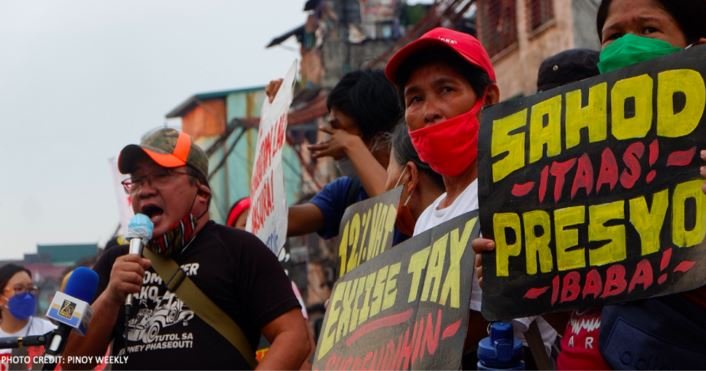
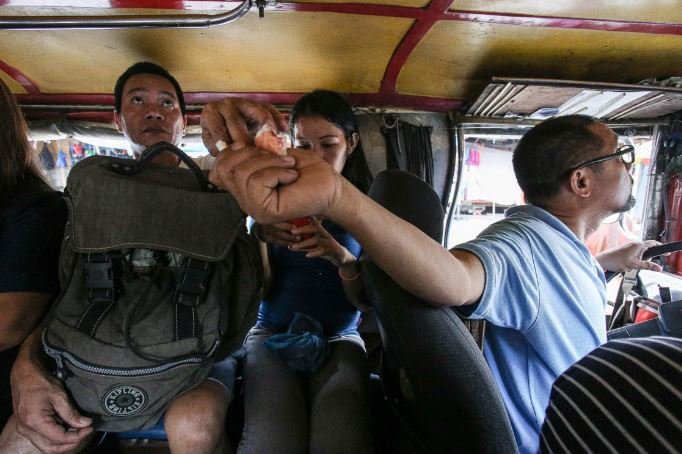
THE MIDDLE EAST crisis left the Philippine government with no other choice but to cave in to the mounting pressure applied by the public transport sector — to implement a fare increase amid an ongoing war that disrupted supply chains and caused fuel price escalations.

On March 17 (Tuesday), the Land Transportation Franchising and Regulatory Board (LTFRB) is expected to make an announcement as to the amount of increase in fares for passenger jeepneys and buses in Metro Manila in an apparent effort to cushion the effects of the so-called mega oil price hikes.

By his own admission LTFRB chairman Vigor Mendoza said that the government is compelled to provide a lifeline to drivers reeling from the ever-rising price of diesel, speculated to breach the P100 per liter mark for diesel this week.

BIGGER INCREASE

Mendoza earlier said in a radio interview that the LTFRB would announce the fare rate adjustments on Tuesday, the same day oil companies are expected to impose another round of double-digit price hikes for the second consecutive week.

According to the LTFRB chief, the fare increases will “definitely be higher” than what they initially recommended to the Department of Transportation before the start of the Middle East crisis on February 28.

Mendoza claimed that even without the fuel crisis, his recommendation was for a more tempered fare hike.

“But we cannot impose fares that are too high since it would be too hard on passengers. We also coordinated with other government agencies on the impact on inflation. We do not want prices of goods to rise too much because of our decision,” Mendoza was quoted in an Inquirer report.

NO MORE DELAYS

Mendoza said once Transportation Secretary Giovanni Lopez questions are sufficiently answered “we will immediately enforce the fare hikes. We won’t delay this any longer.”

“We do not know how long the conflict in the Middle East will last. And we know that the P5,000 [fuel] subsidy [for public transport drivers] will not be enough, especially that another price increase on fuel products is expected this coming Tuesday,” he added.

“So we need a more long-lasting solution as far as public transport is concerned. And this fare adjustment is what we have seen to help our struggling public utility vehicle drivers and operators.”

BUS CAME FIRST

Following the hikes in pump prices last week, the LTFRB on March 13 provisionally increased fares of provincial buses, which took effect the next day. The updated fare matrices were uploaded on the LTFRB’s website on Sunday.

The LTFRB raised fare for ordinary provincial buses by P1 in the base fare and an additional 30 centavos for every succeeding kilometer. Regular airconditioned provincial buses now charge 35 centavos per kilometer while deluxe and super deluxe provincial buses would pass on 45 centavos per kilometer.

Interestingly, the fare hike proposals of taxis and UV Express, though approved in principle, would still have to go through hearings and nationwide consultations.

FURTHER STUDY

Although fares for ordinary and modern jeepneys have already been raised by P1 on base rate or from P12 to P13 by the LTFRB in October 2023, another round of hikes being sought by local jeepney drivers are still being studied.

Even before the Middle East conflict, jeepney transport groups had already requested a P2 fare hike, citing rising fuel and maintenance costs, while also asking the LTFRB to make the provisional minimum fare increase permanent.

The Pagkakaisa ng mga Samahan ng Tsuper at Opereytor Nationwide (Piston) said it would ask for a higher increase of P5 since diesel prices have increased by about P50, even after price rollbacks, since October 2023. 

REFER TO MATRIX

In a statement, the LTFRB advised all provincial bus operators to strictly follow the updated Fare Guide and ensure that the approved fares are properly posted inside their units for the guidance of the riding public.

“Passengers are likewise encouraged to verify the correct fares based on the official Fare Guide and report any violations or overcharging incidents to the LTFRB through its official communication channels,” it added.

As for the MM fare hikes, Mendoza said, the LTFRB will also coordinate with other government agencies on the impact on inflation. “We don’t want the prices of commodities to increase too much because of what we’re going to do.”

CUT AIRPORT FEES

Passenger service charges (PSC) in provincial airports could be cut by as much as P200 to soften the blow of what could be a drastic spike in airfares prior to the Holy Week’s peak demand.

The Civil Aviation Authority of the Philippines (CAAP) is looking to reduce the PSC in airports under its jurisdiction to sustain flight demand in the midst of rising fuel prices.

Danjun Lucas, CAAP deputy director general, said the agency’s board of directors is discussing a P50- to P200-reduction in PSC across the 77 airports it is handling.

“Subject to board approval, this will be applied to all CAAP-operated airports. We are looking at P50 to P200 depending on the airport, but no approval yet,” Lucas told the Star.

COSTLY JET FUEL

In 2025, CAAP increased the PSC across all airports under its management. The hike was meant to generate funds for capacity expansion, maintenance projects and talent investment, especially as some regional gateways are playing a larger role in tourism.

The DOTr is targeting the PSC in CAAP-run airports because it has no control on how airfares would swing from here on, with jet fuel prices reaching new highs due to supply disruptions in the Middle East.

Based on the monitor of the International Air Transport Association, jet fuel prices have gone up on a weekly basis by 58 percent to $157.41 per barrel as of March 6. Before this, the average was way lower at $99.4 a barrel on Feb. 27.

LOBBYING AIRLINES

Lopez meanwhile instructed the CAAP to look into the option of reducing service fees paid by airlines.

This way, the DOTr can ask carriers to minimize fare hikes as much as possible, especially as the Holy Week is nearing, which is historically a time for homecomings and vacations of many Filipinos.

Lopez also directed the Civil Aeronautics Board (CAB) to shorten the evaluation period for the fuel surcharge to 15 days, from 30 days, so price reductions can be reflected quickly.

The CAB is expected to adjust the surcharge level for the first time in eight months. The regulator has set the fuel surcharge steady at Level 4 since August 2025, but this is likely changing in April so airlines can recover some of their additional costs.

FUEL SURCHARGE

At Level 4, airlines can collect a fuel surcharge of P117 to 342 for domestic flights and P385.7 to P2,867.82 for international trips, depending on the distance. Carriers are permitted to voluntarily impose a fuel surcharge to cut down losses from price fluctuations in jet fuel.

Some of the world’s largest carriers are billing passengers a fuel surcharge to cushion the impact of rising petroleum prices.

Cathay Pacific, for one, slapped a fuel surcharge of P386 on flights between Hong Kong and the Philippines, along with other destinations like Canada, Japan, New Zealand and South Korea.

All in all, fares will increase across the board in the transport sector, whether by land, air or sea, as Dubai crude oil hits $127.86 per barrel as of last week due to geopolitical uncertainties in the Middle East, the world’s largest petroleum source.

LIBRENG SAKAY

On top of reducing excise taxes on fuel and granting financial assistance to drivers, the government should also revive the government’s “Libreng Sakay” program, the Star quoted Rep. Ching Bernos.

The congresswoman from Solid North partylist pointed out that the DOTr said there is a P1-billion allocation in the 2026 national budget for the Service Contracting Program.

Through the SCP, the agency may sign contracting deals with PUV cooperatives and operators for the delivery of transport services.

From Hearth to Heritage: Honoring the Women Who Feed Our Stories

THERE ARE DINNERS you attend… and then there are dinners that quietly rearrange how you see the world.

On March 21, something beautifully unassuming yet deeply powerful will unfold at Cafe Gloria. It won’t be loud. It won’t be flashy. There will be no over-the-top plating theatrics or ingredients you can’t pronounce. Instead, there will be something rarer: women, fire, memory, and food that tells the truth.

Welcome to Let’s Celebrate Our Women Cooks!—an intimate Slow Food Dinner hosted by the Slow Food Community Bingawan.

The Real Secret Ingredient? Women.

Behind every simmering pot of kansi, every carefully wrapped suman, every perfectly balanced adobo, there is a woman who didn’t just follow a recipe—she lived it.

These are not just cooks. They are keepers of tradition. Archivists of taste. Quiet innovators who stretch what’s available, honor what’s local, and feed not just families, but entire communities.

In Bingawan, these women are the heartbeat of food culture. Their kitchens are classrooms. Their hands carry stories passed down not through cookbooks, but through repetition, instinct, and love. No measuring cups—just memory. No timers—just intuition.

And for one evening, they are stepping out of their homes and into the spotlight they’ve long deserved.

Slow Food, Fast Truths

The philosophy of Slow Food isn’t just about eating slowly—it’s about remembering why food matters.

In a world hooked on instant everything, this dinner is a gentle rebellion.

Each course you’ll taste is rooted in Ilonggo soil—ingredients sourced locally, recipes shaped by generations, and flavors that don’t rush to impress but linger to connect. This isn’t just a meal; it’s a narrative you can taste.

And here’s the truth: when you slow down, you don’t just eat better—you listen better. To stories. To people. To the land.

25 Seats, Infinite Stories

With only 25 seats available, this isn’t just exclusive—it’s intentional.

Because intimacy matters. Because conversations taste better when shared across a small table. Because the women cooking for you aren’t feeding a crowd—they’re welcoming you in.

At ₱1,600 per person, what you’re paying for isn’t just dinner. You’re investing in local livelihoods, in cultural preservation, and in the recognition of women whose work is often overlooked precisely because it feels so ordinary.

But we all know: what feels ordinary is often the most extraordinary thing of all.

Come for the Food, Stay for the Feeling

Expect laughter that sounds like home. Stories that remind you of your grandmother. Flavors that don’t try to impress you—but end up doing so anyway.

You might arrive as a guest. But don’t be surprised if you leave feeling like family.

A Gentle Invitation

So here’s your invitation—not just to eat, but to participate.

To slow down.
To savor.
To celebrate.

Because in every dish served that evening, there is a quiet declaration:

Women’s work is not “just cooking.”
It is culture. It is care. It is community.

And on March 21, in a cozy corner of Iloilo City, we finally set the table where it belongs—front and center.

The Bitter Taste Of One’s Misdeed

0

I would never disrespect any man, woman, chick or child out there. We’re all the same. What goes around comes around, and karma kicks us all in the butt in the end of the day.

                               — American singer-songwriter Angie Stone

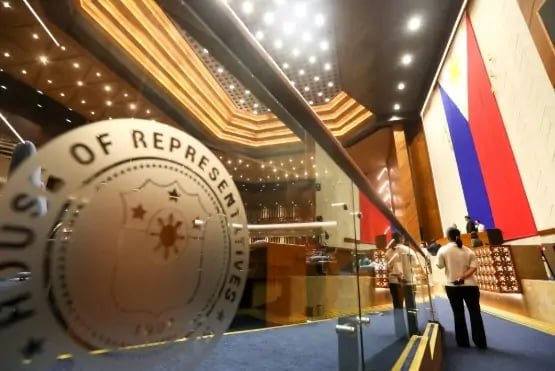
LET’S TALK ABOUT this honorable but otherwise addle-brained member of the illustrious House of Representatives who has become a controversial figure in our democratic society due to his unsavory remark in one session of the Lower House of Congress. 

I just can’t get over the seemingly uncouth behavior of Quezon City District IV representative Jesus Manuel Angel “Bong” Cabochan Suntay, mentioning his “imaginative” description (and sexual desire) for Australian-Filipino actress-model Anne Curtis-Smith during a House committee deliberation on the impeachment complaints against Vice President ‘Inday’ Sara Duterte-Carpio.

It was really and simply violated several of our laws, such as Republic Act  11313 or the Safe Spaces Act, and nine women, including members of the World March of Women, filed a letter serving as a complaint-affidavit against the’ dishonorable’ lawmaker, who surprisingly appears to have a miniscule knowledge of ethics or perhaps the law. 

And actress Meg Imperial pushed back against what she described as Suntay’s misguided perception of the work of actresses and celebrities, emphasizing that the acting profession is not about attracting or arousing men but more on depicting slices of life in the thesilverscreen. 

‘[P]rivate desire is one thing (but) saying it out loud in public is another, especially when you are a public servant … women do not dress or present themselves to please men but rather for their own confidence and comfort … A woman dressing confidently is not an invitation for disrespect.’

IT’S OUR JOB!

In a Facebook post, Imperial spoke out: “Actresses are not here to arouse men,” Meg Imperial speaks out.

She added: “Being an actress or celebrity does not mean our job is to arouse men. Our work is for a much wider audience, not just for men.”

Well said from an actress who also epitomizes Filipinas’ unique beauty. She stressed that while personal feelings may be private, expressing such desires publicly—especially by a government official—crosses a line.

We strongly agree that “private desire is one thing (but) saying it out loud in public is another, especially when you are a public servant—“sabi nga, with power comes responsibility, not only in how you serve, but in how you speak,” according to Meg as she asserted that women do not dress or present themselves to please men but rather for their own confidence and comfort.

“Hindi po lahat tungkol sa inyo. A woman dressing confidently is not an invitation for disrespect,” she clarified to urge our government and private leaders and influential figures to use their voices responsibly.

POSSIBLE LEGAL ACTION

The controversy expanded further when another controversial figure in Philippine society, lawyer Ferdinand “Ferdie” Topacio, criticized Anne’s sister Jasmine Curtis-Smith for posting bikini photos online, suggesting such images invite attention from men.

To this, Jasmine later responded strongly to Topacio’s deplorable comment, while Anne also released a statement condemning the remarks and said she is exploring possible legal action.

In ending, let me just send this message as a thrown gauntlet to our “dishonorable” representative of Quezon City’s Fourth District: “Sir Bong, may I have the privilege to get your permission to say to you that your wife, Sheila, is f_ckable?!” 

I’m sorry about this, I just want our lawmaker the bitter taste of his own misdeed. 

ICI Recommends Charges Against 8 Congressmen

0

WEEKS BEFORE THE Independent Commission for Infrastructure (ICI) finally disbands as a fact-finding panel, eight members of the House of Representatives have been recommended for filing of criminal charges in connection with the anomalous flood control projects.

No less than Ombudsman Jesus Crispin Remulla made the announcement on the second day of the ICI’s turnover of documents on its flood mess probe to the Office of the Ombudsman in Quezon City. 

“Sa Congress (House of Representatives) eight lang. 13 [House members] attended the hearings, but they only suggested eight to be prosecuted,” Remulla told reporters during a press conference. 

‘The Ombudsman assured the public that government prosecutors are well-equipped to go after the perpetrators of the flood control mess, and that capacity is bolstered by the documents submitted to them by the ICI.’

BOYING WANTS MORE

Remulla, however, clarified that the Office of the Ombudsman would continue its investigation even after the ICI winds down its operation by the end of March.

He also hinted at the possibility of expanding the list of House members who’d be criminally charged over their supposed involvement in the trillion-peso infrastructure anomalies.

“We are looking beyond that figure [because] definitely we’re way ahead of them (ICI) in some of [investigation] fields, like [in] the investigation of congressmen,” Remulla said. 

“But their findings will be used by our teams to bolster the evidence they already have,” he added.

TARGETING SENATORS

According to the Ombudsman, there are also legislators from the upper chamber who should be made accountable for what has become the country’s biggest scandal involving public funds.

In an apparent manifestation of the severity of the situation, Remulla said that the Ombudsman is sustaining efforts to gather evidence against senators who are allegedly involved in the flood control mess, among other personalities involved.

“On senators, the ones we’re investigating are the same ones that the ICI also probed. I haven’t seen everything in the ICI files, but we will see that as the days go by,” he further noted.


EXTREMELY CONFIDENT

The Ombudsman assured the public that government prosecutors are well-equipped to go after the perpetrators of the flood control mess, and that capacity is bolstered by the documents submitted to them by the ICI.

“We have the wisdom to deal with each and every case as they arrive at our doorstep, and they (ICI) people were able to source a lot of contract documents. Remember, these contract documents form the backbone of each and every case it (an anomalous project) is a violation of contract,” Remulla emphasized.

“And it’s not only a contract with the DPWH, but a contract with the Filipino people,” Remulla added, referring to the Department of Public Works and Highways.

Ahead of Remulla’s press conference, ICI chairperson Andres Reyes, Jr. said the body’s tenure will end on March 31 since it has already fulfilled its mandate.

A Call To Women’s Action (And Men As Well)

EXCEPT FOR THE revelation and explanation of the aggrieved party herself (the most awaited side to the controversy), the expression of thoughts and feelings by not a few multimedia stars while opinion of Gen Zs and diversified netizens flood the public floor of immediate, rich, varied, and contemplative comments over Quezon City Fourth District Congressman Jesus “Bong” Suntay lewd remarks on actress Anne Curtis, the other sectors’ side to the story is left unsaid.

​“May desire sa loob ko na nag-init talaganakitako ang puwedeng mangayri pero hanggangimagination ko lang ‘yon. Hindi naman siguro akopuwedeng kasuhan dahil sa na-imagine ko(There was inside me that heated up, I saw something could possibly happen but it was only in my imagination. I couldn’t be charged with anything just because of what I imagined),” pronounced Representative Suntayduring a congressional hearing on the impeachment trial against Vice President Sara Duterte on charges of sedition, insurrection and political destabilization.

​Surely, there are other representations in our society of the voiceless, nameless and the faceless on the issue that are left unseen and unsaid as well.

​Even if Suntay has apologized and acknowledged that he has not seen the actress in Shangri-La mall, he is more than the issue although he typifies the main protagonist in this tableau.

‘The future of the nation depends on the kind of women who would serve the national, regional or local leaderships … Men, too, from all walks of life, can help address this issue for liberation of static minds.’

ANNE CURTIS AS MAIN PROTAGONIST

​Curtis, on the other hand, also a main character in the narrative, has just vented out her two-cent worth of thoughts, through an official statement about Bong’s sexual aggression on her.

​Although, strongly worded, Anne’s stand is summarized to “respect for women” but she contextualizes it in a larger scenario merged in a culture of violence, in any form, against women.

​Filipino women, especially, but not limited only, tothe lower and the lowest classes hopefully take thematter seriously, suggestively a top priority because the situation reflects their stations, subjugated and oppressed.

FEMININE MYSTIQUE

​Naturally, the reactionary feminine mystique is stirred like a hornet’s nest.

​Hopefully, Filipino women are challenged by this eventuality.

​Not only are the Gabrielas or World March of Women Pilipinases and other female groups but all girls and women in the Philippines regardless of their social stations, rich or poor.

​This is more than feminism.

​This is more than Filipinism, or if you may, Filipinaism.

​This concerns nationalism.

​This goes beyond Anne Curtis and Bong Suntay, come to think of it.

SARA DUTERTE

​It is simply because Bong expounded on his point and predilection before a congressional inquiry that tackled the case of another woman, Sara Duterte.

​Sara herself, if she is truly for the welfare of her kindred, hopefully defends Anne (even defies rotten political partisanship that ruins the nation) because the Vice President symbolizes womanhood in many and diversified ways and functions of a woman of any origins in her country to better their lives as citizens, free from misogyny, emancipated from all oppressive hegemonies in all aspects of life.

​This is an ideal pursuit but gradually practicing and embodying them can also slowly change lives for the better–enlightenment about multiple roles of sex in daily lives.

​The future of the nation depends on the kind of women who would serve the national, regional or local leaderships.

​We are not espousing any ideological stance on gender equality, but if warranted why not,epistemological or philosophical or any theoretical framework discussion which can crystallize truth and other essentials of life which people can learn from.

​We are just in pursuit of a fair and just society.

​Now that Suntay faces a legal battle, all sexes are invited to be vigilant of court honesty and integrity.

MARGINALIZED WOMEN

​Women from the marginalized (not the organized ones) sectors, like peasants, informal settlers, factory workers etc., hopefully, study also, if not fully support this issue.

​It is high time that showbiz stories should level up its treatment with other narratives in the journalism or multimedia fields because entertainment tidbits, intrigues, scoops, verified or investigative rumors are also of national import precisely because they arewithin the realm of socio-politico-cultural realities that shape the nation.

​Men, too, from all walks of life, can help address this issue for liberation of static minds. 

N. Samar’s Investments Initiatives

FOR ITS EFFORTS to ensure the province is equipped to implement solid investment climate, the Northern Samar government was recognized for implementing a one-stop action center for strategic ventures.

Together with 5 other provinces – Laguna, Bulacan, Cavite, Batangas, and Ilocos Norte, and the City of General Trias, the province was recognized by President Marcos himself. Gawad Bayanihan sa Pamumuhunan Awarding rites were held at the Malacañang Palace.

Also present were Local Governments Secretary Jonvic Remulla, Secretary Maria Cristina Aldeguer-Roque of the Department of Trade and Industry, and Special Assistant to the President for Investment and Economic Affairs Secretary Frederick Go. 

The award also highlighted the Northern Samar One-Stop Action Center for Strategic Investments (OSACSI), the first LGU Green Lane for Strategic Investments in the Philippines.

In 2024, Northern Samar also received an award for the establishment of its Provincial Economic Development and Investment Promotions Office (PEDIPO) and the launch of Winvest Northern Samar campaign. These effectively attracted over 150 billion worth of investments in the province.

With this innovation, both the World Bank and the Asian Development Bank is working to enhance and document Northern Samar’s best practices and recommend its replication in all LGUs in the country.

“When business move quickly, progress moves as fast. Ang mga Lokal na Pamahalaan ang ating mga kaagapay sa pagpapalago ng ating ekonomiya. You helped make an environment which is suitable for business to succeed,” the President said in his address. 

Northern Samar Gov. Edwin Ongchuan acknowledged the vital role of the provincial government departments and local government units in making Northern Samar a prime investment destination specially in renewable energy.

40th Anniversary Of The EDSA People Power Revolution

0

“MARCOS SINGILIN, DUTERTE Panagutin!” “Mga Kurakot, Ikulong na Yan!” ”Mga Magnanakaw, Panagutin at Ipabalik ang Pera ng Bayan!”  

Such were strong demands in placards and in speeches delivered by thousands of rallyists at Edsa Shrine and at the People Power Monument (PPM) last February 25, 2026. They were clear messages that have resonated even as far back as during the bloody reign of the current International Criminal Court (ICC) jailbird Rodrigo Roa Duterte, former Davao City mayor and former president of the country. 

But the same calls for accountability were actually addressed, more importantly, among the current incumbent senators, congressmen and other government officials under the Bongbong Marcos – Sara Duterte regime. 

‘The people ask: “When will the President Bongbong Marcos and VP Sara Duterte really do their job, as they have promised under oath? And the people need not launch protest rallies”!’

The thousands of students, laborers, farmers, IPs, professionals, church leaders – Cardinal Ambo David of the Archdiocese of Caloocan, Bishop Soc Villegas, other bishops, priests, pastors and seminarians and recognized pro-people government officials loudly declared in no uncertain terms that President Bongbong Marcos, especially as president, should do his mandated job – “to give justice to every man!” 

That means, for one, have the current senators to set themselves up as an Impeachment Court to preside over what the Filipino people have demanded way back in 2025 to “LITISIN NA SI VP SARA DUTERTE!”

CAMPAIGN PROMISES

Moreover, the Filipino people’s mobilization at the EDSA shrine and at the PPM were likewise demanding that the Uniteam’s promise of marketing P20/kgm of rice and affordable basic food items be fulfilled NOW in Luzon, Visayas and Mindanao! 

So too, the people reminded President Bongbong and his VP Sara to create jobs and livelihoods for the millions of jobless Filipinos, instead of encouraging them to find employment abroad (which has been a tragic formula for family-break ups, lack of proper parental home-guidance, and other social costs!). 

The people reminded the government to initiate other public services, such us, fair wages for the workers, assistance to the farmers, fisher folks and IPs; abolition of the notorious NTF-ELCAC that has caused, with its red-tagging and terrorist tagging operations, illegal arrests and detention of activist youths, enforced disappearances and even EJKs; giving justice to the more than 750 political prisoners; improvement of the country’s education system and healthcare services; and stoppage of the aggressive encroachment of the China vessels into our sovereign territories.  

STREET PARLIAMENTARIANS

In other words, the Filipino people’s massive mobilization in the streets, not only in NCR but in other towns/cities in the Visayas and Mindanao was doubtless a serious urgent demand for professional and, indeed, a compelling honest and compassionate governance for the country! 

The people, especially the veteran street parliamentarians, are wondering why government authorities, from the president down to his cabinet secretaries, the legislators, LGU officials and the AFP/PNP officials and ground personnel seem to be surprised and appear to be panicky when the people go to the streets to demand reforms in governance. 

The people are simply expressing certain limitations, in fact critical governance issues causing much suffering to their constituents, particularly the poor, the voiceless and marginalized, and these problems should have been forthwith addressed. 

NEED TO BE RESOLVED

The message these panicky government officials should automatically understand is that they have basically failed to do their jobs. 

That people have to practice their Right of Assembly to air their grievances should simply be a clear signal that as public officials, they simply failed to listen to the people about their problems that needed to be resolved soonest. 

The people ask: “When will the President Bongbong Marcos and VP Sara Duterte really do their job, as they have promised under oath? And the people need not launch protest rallies!”

The Pharmacology Of Fear: Debunking The Drug War One More Time

0

THERE IS A stubborn myth that refuses to die, even as its chief architect now sits in a courtroom in The Hague. It is the myth that drugs create monsters. That methamphetamine automatically turns men into rabid beasts. That heroin produces natural predators. That addiction is a chemical alchemy that strips away humanity and replaces it with violence.

It is a powerful story. It is also largely untrue.

In the catechism of the drug war, the logic is simple: addicts kill, rape, rob. Therefore, killing them is self-defense. Eliminate the source before the harm occurs. It is better, the argument goes, to shoot first than to mourn later. It is an argument that hits the gut before it reaches the head. And because it hits the gut, it wins applause.

But science, inconvenient as it is, refuses to cooperate with this narrative.

Take amphetamines. Methamphetamine or known commonly as shabu is the favorite villain in our moral theater. It is the drug most often invoked when someone says, “Adik ’yan, delikado ’yan.” Amphetamines are stimulants. They increase dopamine and norepinephrine. They heighten alertness, reduce appetite, and in high doses—especially with prolonged sleep deprivation—can produce paranoia or psychosis. Tamang praning. 

Yes, in certain extreme conditions, stimulant intoxication can increase agitation. But to leap from that to “all shabu users are violent” is like saying all caffeine drinkers are berserk because coffee stimulates the brain. The pharmacology shows increased arousal, not a guaranteed descent into murder. Violence, when it occurs, is usually entangled with other factors: prior trauma, gang involvement, access to weapons, a history of aggression, a social environment soaked in conflict.

The drug does not create a killer out of thin air. It may amplify what is already there.

SEDATION, NOT AGGRESSION

Now consider opioids—heroin, morphine, fentanyl. These are depressants. They slow breathing, reduce physical energy, induce drowsiness. The stereotypical opioid user is not sprinting through the streets in a homicidal frenzy. He is often barely able to keep his eyes open. The pharmacological profile is sedation, not aggression.

Violence associated with opioids tends to fall into two categories: theft to finance addiction, or disputes within the illegal market. That is economic and systemic violence, not chemical transformation into a predator. The substance itself does not biologically prime the user to attack strangers. If anything, it suppresses arousal.

And yet, in the public imagination during the height of the drug war, the “adik” was a ticking bomb. A subhuman entity waiting to explode into violence. The narrative flattened pharmacology into caricature. It erased nuance. It erased context. It erased humanity.

CLEARER FRAMEWORK
Criminology has long offered a clearer framework. Paul Goldstein identified three types of drug-related violence: psychopharmacological, economic-compulsive, and systemic. The first refers to violence directly caused by the drug’s effects. The second refers to crimes committed to finance addiction. The third refers to violence inherent in illegal drug markets.

Drug war rhetoric fixated almost exclusively on the first. It treated psychopharmacological violence as universal and inevitable. But research consistently shows that much drug-related violence—particularly in prohibitionist regimes—comes from systemic factors:  militarized enforcement. In other words, violence emerges not only from drugs but from the war against them.

Which leads to an uncomfortable question.

How much of the blood spilled in the Philippines from 2016 to 2022 was the result of pharmacology—and how much was the result of policy?

PREEMTIVE SALVATION
Now that the trial of former President Rodrigo Duterte has begun at the International Criminal Court, the old arguments are being polished and paraded again. Supporters insist the killings were necessary. They claim the addicts were bound to kill anyway. They speak as if elimination was preemptive salvation.

But if the pharmacology does not support the inevitability of violence, then what remains of the justification?

We must be honest about risk. Some substances can increase impulsivity under certain conditions. Some individuals with severe stimulant-induced psychosis may become dangerous. But risk is conditional. It is probabilistic, not deterministic. It does not license execution.

Public safety policy is supposed to be built on evidence, not fear. On patterns, not anecdotes. On data, not demonology.

A PUBLIC HEALTH ISSUE

When addiction is treated as a public health issue—through treatment, harm reduction, rehabilitation—overdoses decline, incarceration declines, and communities stabilize. When addiction is treated as a war, violence mutates. Markets go underground. Police powers expand. Accountability shrinks. The line between law enforcement and lawlessness blurs.

And then something insidious happens. The violence of the state becomes invisible, while the imagined violence of the addict becomes exaggerated.

It is easier to fear the man nodding off in an alley than to scrutinize the machinery of impunity. It is easier to shout “vermin” than to ask for peer-reviewed evidence. It is easier to cheer a strongman than to build institutions.

The myth that drugs automatically create monsters is comforting. It simplifies a complex social problem into a villain you can shoot. It converts structural failure into individual evil. It transforms policy debate into moral crusade.

But pharmacology refuses to cooperate. Amphetamines stimulate. Opioids depress. None of them biologically predetermine murder.

What transforms citizens into executioners is not chemistry. It is ideology.

Why Your Kid’s Brain Is Mom’s Fault (And Everything Else Is Dad’s)

0

HERE’S A SENTENCE guaranteed to start a family argument over dinner:

“Children get their intelligence from their mothers.”

Give it a few seconds and watch every father at the table sit up straighter.

Relax. Nobody’s insulting Dad. This is simply genetics doing what genetics often does — quietly dismantling our assumptions while everyone argues about something else.

Let’s start with the straightforward part: gender.

Every human child receives 23 chromosomes from the mother and 23 from the father. But when it comes to whether a baby is male or female, the father holds the deciding card.

Mothers always contribute an X chromosome. No variation there. Every egg carries one.

Fathers produce sperm carrying either an X or a Y chromosome. If the sperm delivers an X, the baby becomes XX — female. If it delivers a Y, the baby becomes XY — male.

In other words, Dad determines the baby’s biological sex.

So, the next time someone in the family says, “We were hoping for a boy,” the polite scientific response is: take it up with the father’s chromosomes.

‘Studies on brain development also suggest that maternal genes play a major role in shaping the cerebral cortex, the part of the brain responsible for reasoning, language, and complex thought.’

GENOMIC IMPRINT

Now let’s talk about something more interesting — intelligence.

Many genes associated with cognitive ability are located on the X chromosome. That matters because mothers carry two X chromosomes, while fathers have only one.

Some genes are also preferentially expressed, a phenomenon known as genomic imprinting. In simple terms, certain genes from one parent are more likely to be “turned on,” while the corresponding gene from the other parent stays quiet.

Research on these patterns suggests that genes linked to higher cognitive function are more often expressed when they come from the maternal X chromosome.

It’s not the whole story of intelligence — not even close — but it’s an intriguing piece of it.

NOT A SINGLE GENE

Studies on brain development also suggest that maternal genes play a major role in shaping the cerebral cortex, the part of the brain responsible for reasoning, language, and complex thought.

Paternal genes appear to influence other systems more strongly — including growth, metabolism, and instinct-driven behaviors.

If that sounds suspiciously like the difference between organizing the family calendar and asking “what’s for dinner,” feel free to draw your own conclusions.

But let’s slow down before anyone declares mothers the sole owners of brainpower.

Intelligence is not a single gene.

It’s the result of hundreds — possibly thousands — of genes interacting with each other and with the environment a child grows up in. Nutrition matters.

Education matters. Curiosity matters. Sleep matters.

BIOLOGICAL ROLE

A child raised with encouragement and stimulation will usually outperform a child raised on neglect and algorithm-fed nonsense, no matter which chromosome carried the original blueprint.

Genes may set the stage. Life writes most of the script.

Still, the maternal contribution to cognitive development is real enough to acknowledge — especially during Women’s Month.

For much of history, women’s intellectual influence was minimized while their biological role was treated as purely mechanical. The mother carried the child. The father carried the legacy.

Modern genetics suggests something more balanced.

Yes, the father determines whether the baby is a boy or a girl.

But the mother provides a double set of X-linked instructions that help shape the brain doing the thinking.

Put another way: Dad decides the packaging.

Mom contributes a good portion of the processor.

HALF OF THE ENVIRONMENT

Of course fathers still contribute half the DNA — and often half the environment that shapes a child’s mind. Bedtime stories, curiosity, patience, conversation. Those things build intelligence too.

Still, it feels appropriate to say this during Women’s Month.

Behind every sharp, curious child is usually a mother whose DNA — and persistence — helped build the operating system.

And if the kid grows up stubborn, loud, and absolutely convinced they’re always right?

Well.

We’ll let Dad take that one.

The Certified Prick – just the messenger—feel free to argue amongst yourselves. 

Chaos Amidst Humbling Times

THE GOSPEL LAST Sunday (MARCH 15) about the Pharisee and the tax collector– both inside the church praying, with the self-righteous pharisee praising himself for his obedience to all God’s commandments while those around him are not, and the tax collector, kneeling at the farthest end without raising his eyes to the Lord’s image and beating his chest fervently asking for God’s forgiveness.

Clearly, the gospel speaks of pride and humility.

Then the gospel poses: “He who humbles himself shall be exulted, he who exults himself shall be humbled before the Lord.”

I quote the gospel because it speaks truthfully about our current reality: the world is in chaos because of too much self-exultation, pride and self- righteousness.

‘The chaos we find our country in – the noises from politicians and errant businessmen – are products of the pride and indignation we feel towards those around us about their flaws and blunders without looking at our own imperfections and sins against society.’

OUR OWN IMPERFECTIONS

The chaos we find our country in – the noises from politicians and errant businessmen – are products of the pride and indignation we feel towards those around us about their flaws and blunders without looking at our own imperfections and sins against society. 

We mouth too many suggestions and demand changes without introspecting about  our own actions that contribute to the chaos in our country. The world is in shambles because leaders would like to show off their might and self-righteousness, as if they possessed the final dispensers of justice. Wars kill and maim many nations and peoples and greed deprives our neighbors the just compensation for their labor, wisdom and wealth.

Our politicians push laws– despite an over-abundance of laws in our land– just to serve their own and family’s interests and to protect their influence over those of people living in the margins.

And these same legislators (many of them filthy rich from corruption) and top officials in business and government are themselves the ones inflicting harm in our society through nepotism, conflict of interest and corruption– which they justify as necessary for progress.


EVERYONE IS EQUAL

The middle class and the poor shoulder the burden of their misdeeds in terms of oppressive and regressive taxes, discriminatory application of laws and justice and moral shaming of people opposed to them, as if they themselves were blameless and upright.

Globally, the conflicts abound because of the very same pride, self-righteousness and entitlements that those with the means and power exercise over the rest of the world. Pride by showing off what their resources can do to emasculate those who have less in life. 

The desire to show off one’s invincibility and arrogate possessions and influence over human rights and people’s dignity has resulted in abandoning the rule of law and respect for individual rights of nations and of people for freedom and democracy.

People have forgotten that in God’s eyes, everyone is equal– no rich, no poor, no powerful, no powerless and that only God is the dispenser of justice and grace. For when we all perish, we leave everything behind– no material possessions, no influence, no power. From dust we came, to dust we return.

DOH Drowning In Irregularities?

0

MOST OF US are probably under the impression that Health Secretary Ted Herbosa would soon be fired by President Ferdinand Romualdez Marcos Jr. amid a growing public clamor calling for his immediate replacement.

Unknown to many, Herbosa wields a “staying power” being a “relative of the powers that be.” His eldest sister Felicidad “Peachy” Herbosa happens to be the wife of former Health Secretary Alberto Romualdez, who served under the Estrada administration. Oh yes, Alberto Romualdez is Herbosa’s brother in law.

Alberto and Babes (the Philippine Ambassador to the United States) are brothers — and yes, Herbosa calls him “bayaw” too.

Interestingly, Herbosa’s brothers-in-law are the cousins of the sitting President whose mother Imelda is considered the clan’s matriarch.

While there’s no law preventing the Romualdez clan from backing up Herbosa’s ambitions, the clan whose name has become a byword synonymous to corruption, should be wary about people dragging the family in dubious transactions. 

For one, Herbosa has been at the receiving end of nasty remarks following one blunder after another at the Department of Health (DOH) where he has reportedly been making a fortune — the latest of which involves a P1.8-billion contract for the procurement of mobile primary care units (MPCU).

‘DOH employees accused Herbosa of using “undue influence” and manipulation of technical specifications to favor a specific supplier despite the poor quality of previous deliveries.But not all DOH officials are involved in what looks more like a systemic corruption scheme.’

ENOUGH IS ENOUGH

Moving forward, the MCPUs were delivered and shipped to 83 provinces. However, 75 percent turned out to be defective, for which DOH employees finally decided “enough is enough”. Hence, a criminal complaint was filed against the DOH chief before the Office of the Ombudsman.

Aside from Herbosa, the complaint named Undersecretary Glen Matthew Baggao, Head Executive Assistant Brigida Romualdez-Aquino, and Executive Assistant Allan J. Tope as respondents.

Herbosa, et al are facing culpable violations of the Anti-Graft and Corrupt Practices Act (Republic Act 3019) and the New Government Procurement Act (RA 12009).

The DOH employees accused Herbosa of using “undue influence” and manipulation of technical specifications to favor a specific supplier despite the poor quality of previous deliveries.

But not all DOH officials are involved in what looks more like a systemic corruption scheme. Former DOH Undersecretary Gregorio Murillo Jr. stood against bid rigging, and was eventually removed by Herbosa after advocating for upgraded safety standards that conflicted with the preferred procurement directives. 

The complainants urged the Ombudsman to place the respondents under preventive suspension to prevent interference with the investigation, conduct a forensic examination and preservation of procurement records, including email exchanges and text messages.

MONEY TRAIL

In recent months, corruption allegations have piled up against Herbosa. Some DOH employees have accused him of a conflict of interest, claiming he crossed the line by keeping cozy social ties with Zuellig Pharma even as the company was allegedly an active bidder for DOH projects.

Then there is the money trail. DOH employees asked the Office of the Ombudsman to investigate a P1.29 billion cash transfer to UNICEF for vaccines and essential medicines that they alleged remained unliquidated from February 2024 to July 30, 2024.

They further alleged that while that amount was still unaccounted for, Herbosa approved another UNICEF vaccine purchase worth P524.9 million, a move they say violated Commission on Audit rules and a DOH memorandum barring new fund transfers until earlier ones are liquidated.

On another front, Herbosa is taking heat over claims that P98 million in public funds went to a DZMM program produced by Media Serbisyo Production Corporation, owned by Franco Reyes, the husband of DOH Health Promotion Bureau Director Tina Marasigan.

Herbosa, Marasigan, and Assistant Secretary Albert Domingo are listed as anchors of the show on the radio station owned by Martin.

Being Summer-Wise

0

SUMMER’S HERE AND restlessness peaks. Blame it wholesale on climate change that the weather now scorches more than ever before; blame Meralco on the electricity price surge which restrains the relief from electric fans and aircon; blame the US-Israel war with Iran that raised gasoline prices to the roof that urbanites flip-flop on getting away from all cares even for a few days. 

ENVIRONMENTAL WOES

​If the weary and worn-out can’t resist beckoning Nature, in aquatic or terrestrial ecosystems, they are advised to expect that God’s amazing creation may not be as gracious this time. 

​Summer poses significant threats to the environment, driven primarily by rising global temperatures, climate change-induced heatwaves, and increased human activity. They impact ecosystems, air quality, water resources, and biodiversity. Increased temperatures lead to severe droughts causing reduced water availability for plants and animals. Some animal species migrate to cool places. Coral reefs may bleach and die, destroying vital and attractive marine habitats. Warming waters and ocean acidification endanger marine life. Low water levels in rivers can increase concentrations of pollutants.  

​And imagine these personal challenges. Beachcombers can roast on long nap on white sand. Trees can’t be air blower on the tourists’ strolls. Mountain trekkers should watch out for bald, roughpatches on their paths, and may hardly hear the chirp of birds or the rustle of the wind on trees. Water may be scarce in budget lodgings.   

​Hopefully, understanding what a severely hot summer can do to the environment can make visitors care for it better. 

‘Policy-wise, the Philippine government has laid down dual steps on how to conserve/protect our environment that domestic and foreign tourists can visit and appreciate its natural beauty and exciting activities, climate change notwithstanding.’

MAKING PEACE WITH EARTH

​Our planet has taken a beating for long, both from natural causes and human abuses.

​Policy-wise, the Philippine government has laid down dual steps on how to conserve/protect our environment that domestic and foreign tourists can visit and appreciate its natural beauty and exciting activities, climate change notwithstanding.

​In 1998, our Department of Tourism and Department of Environment and Natural Resources jointly started promoting ecotourism as “low-impact, environmentally sound, and community-participatory tourism activity in a natural environment that enhances the conservation of bio-physical and cultural diversity, promotes environmental understanding and education, and yields socio-economic benefits to the concerned community.”

​Today, our stellar ecotourism destinations are in Palawan (4), Bohol, Davao, Negros Oriental, Surigao, and Ifugao.

PROJECT TRANSFORM

 ​Regenerative tourism was recently introduced in the Philippines with focus on actively rebuilding (degraded, destroyed) ecosystems and empowering communities. 

Key initiatives include mangrove planting, coral restoration, using bamboo for soil rehabilitation, turning agriculture into tourism, using tourism for ecological healing. A good model site for DENR-led Project TRANSFORM is Tanay, Rizal (an abundantly forested area along the slopes of the significant climate protector, the Sierra Madre mountain range) which aims to balance development with environmental resilience.

​Both methods are key to making up for our human failings. And the footloose getting to enjoy summertime while doing good to the environment, community, and country. It’s good to know that they have special appeal to millennials who appreciate being able to practice environment stewardship.  

MUFG Sees Peso Dropping To P61 Versus US Dollar

“Our model-based estimates tell us that USD/PHP could range between 59.00-60.00 in a scenario of $90/bbl oil prices, and between 60.00-61.00 with US$100/bbl oil prices, especially if this is coupled with a hawkish Fed. Of course, not all things are equal in practice, and the BSP may choose to not just pause on policy rates but even hike rates, which would provide some offsetting support to PHP,” Mitsubishi UFJ Financial Group (MUFG) said.

THE PESO WILL depreciate to P61 against the dollar if global oil prices continue to hover above $100 per barrel (bbl) and the US and Philippine central banks hike key interest rates, according to the Mitsubishi UFJ Financial Group (MUFG).

In a reported titled “Philippines – Strait of Hormuz closure: Impact of higher oil prices and more” released last week, MUFG said that the Philippine peso is vulnerable to the shocks of the current Middle East Crisis, which started last February 28 after the United States and Israel launched joint attacks on Iran.

On Friday, the local currency again ended weaker against the US dollar after finishing the day at 59.38 from 59.17 on Thursday.

We see the Philippines peso (PHP) as vulnerable and USD/PHP possibly rising above the 60 levels if the Iran and Middle East conflict is sustained and the Strait of Hormuz remains closed, with oil prices already reaching above $100/bbl (barrels of oil) at the time of writing,” MUFG said.

“While we do not yet know how the Iran and Middle East conflict will play out from here, it’s important to stress our current base case USD/PHP forecast of 58.00 by 4Q2026 (fourth quarter 2026) assumes a resolution after March 2026 and implicitly for oil prices to fall towards the $70/bbl levels,” it added.

MUFG added that the US Federal Reserve and the Bangko Sentral ng Pilipinas (BSP) taking a hawkish stance on interest rates can push the peso to trade at P60-P61 against the dollar. 

In an interview with Bloomberg, BSP Governor Eli Remolona said the rising global oil prices can prompt them to raise interest rates. To recall, the Monetary Board of the BSP on February 18, 2026 reduced its key policy rate (Target Reverse Repurchase Rate) by 25 basis points to4.25 percent.

“Our model-based estimates tell us that USD/PHP could range between 59.00-60.00 in a scenario of $90/bbl oil prices, and between 60.00-61.00 with $100/bbl oil prices, especially if this is coupled with a hawkish Fed. Of course, not all things are equal in practice, and the BSP may choose to not just pause on policy rates but even hike rates, which would provide some offsetting support to PHP,” MUFG said.

Global price outlook

Meanwhile, global oil prices almost reached $120/bbl a few days after the Middle East conflict started, but eased to below $100/bbl recently.

“Oil prices have gyrated wildly since the United States and Israel launched joint air strikes on Iran on 28 February. Disruptions to Middle Eastern supplies due to attacks on the region’s oil infrastructure and the cessation of tanker traffic through the Strait of Hormuz sent Brent futures soaring, trading within a whisker of $120/bbl. Prices subsequently eased with Brent around $92/bbl at the time of writing – up $20/bbl for the month,” the International Energy Agency (IEA) said in a post last Friday.

At the local front, diesel prices may breach the P100 per liter this week, and petrol above P80 per liter depending on the source of fuel.

The Philippines imports 90 percent of the oil requirements, mostly in finished products like fuel.

Antipolo Poll Records Lowest Voter Turnout 

THE RECENTLY concluded special election for the vacant second congressional district in Antipolo City in Rizal had just made a record for the lowest voter turnout in history.

Data coming from the Commission on Elections (Comelec) showed that only 66,994 of 252,793 registered voters participated in the special congressional polls meant to fill up the vacancy after Romeo Acop died on December 20 last year.

The figure represents 26.50 percent voter turnout. Comelec data further showed that six of 10 voters are women.

“If you ask me, the earlier projection of 60 to 65 percent turnout will not be achieved. Even the 35 percent estimate may not be reached,” Comelec Chairperson George Garcia said.

Antipolo City second congressional district is composed of eight barangays. San Jose has the most number of registered voters (74,007), followed by Cupang with 42,953. 

Other component barangays are San Roque (36,454), Calawis (5,383), , Dalig (33,595), Inarawan (18,410), San Juan (7,057) and San Luis (34,934).

NO ELECTION FAILURE

According to the Comelec chairman, all 36 voting centers functioned and no untoward incident was reported.

Despite low turnout, Comelec chairman George Garcia shrugged off calls urging the poll body to declare a failure of election.

“We did not have a single precinct that did not function during this election day. That is to say, all of our 348 precincts functioned. We did not have a single precinct that failed, therefore all the election paraphernalia, as mentioned, were delivered at 12 o’clock this morning, in fact they were delivered,” he added.

ACOP REPLACING DAD

As this developed, the District Board of Canvassers proclaimed Dr. Bong Acop, son of the late Antipolo 2nd district Rep. Romeo Acop, as winner following the manual canvassing of votes from the special polls held on Saturday, March 14.

Acop garnered 60,051 votes, defeating his closest rival, Red Llaga, who received 12,054 votes.

The four other candidates include Paulo Tapales (10,080 votes), Nathaniel Lobigas (754), Dandin Infante  (412) and Maria Trinidad Cafirma (199).

Republic Act 7166 or the Synchronized Elections law provides that Comelec shall call for and hold a special election to fill the vacancy not earlier than 60 days nor later than 90 days after the occurrence of the vacancy.

DISQUALIFICATION CASE

Previously, a lawyer who resides in Antipolo’s second district filed a disqualification case against Acop for alleged massive vote-buying.

According to the complainant, Atty. Mark Tolentino, Acop violated Section 261 of the Omnibus Election Code which strictly prohibits doling out money to lure voters to elect a candidate.

Tolentino attached documents, sworn statement, and social media photos which showed cash distribution in Barangay San Roque during the campaign period.