In the papal encyclical Laudato Si’ published 2015, Pope Francis focused on care for our common home (Earth) with succinct, albeit poetically woven, thoughts that pleasantly surprised the Christian world, impacted global politics especially on the raging climate crisis, and struck a common chord with the environment movement.
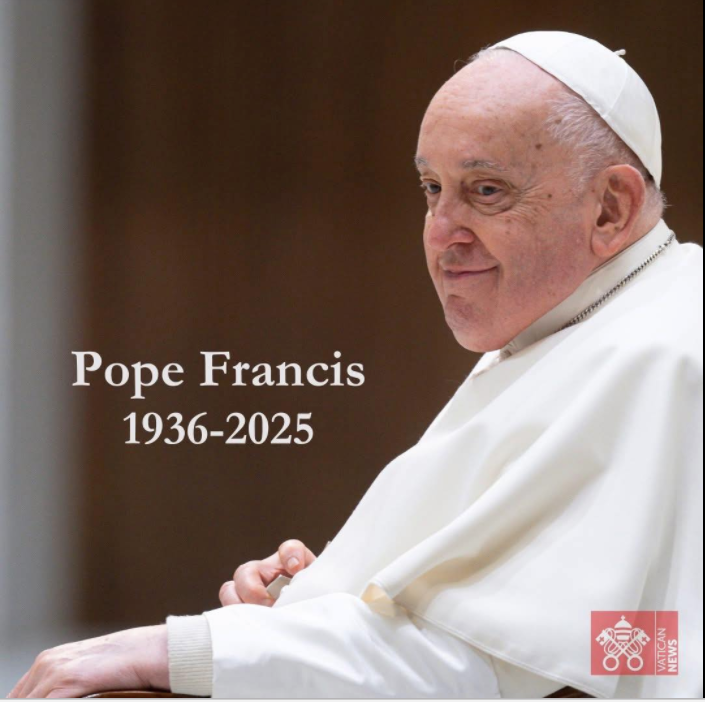
On his passing day after Easter, this highly praised work comes to mind again as one of the beloved pope’s legacies to a world gone mundane, divisive, and destructive.
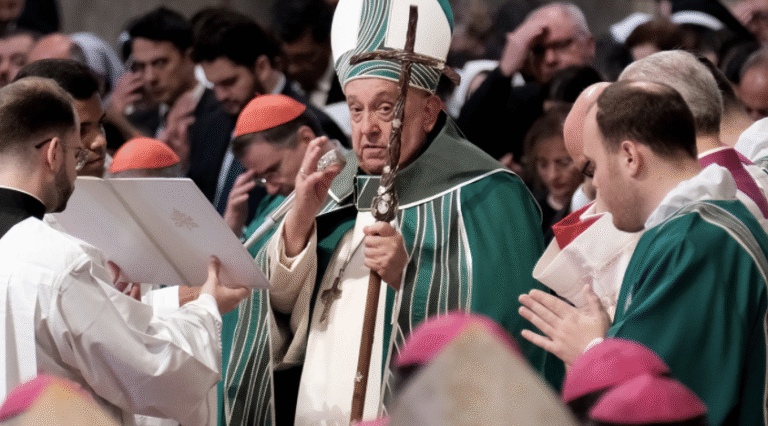
[W]e see a person less from the supremacy and pomp of the pontificate, as when officiating mass and blessing his flock from the St Peter’s Basilica in Vatican City, but as a man of Argentinian country roots bleeding for both the abused creation and the poor excluded in the comforts and other benefits of development.
KEY POINTS OF LAUDATO SI
Pope Francis makes a strong personal stand on the environment and prescribes right human and institutional responses. Key points of his beliefs:
Interconnectedness of all things, including the social, economic, and environmental aspects of life.
Disproportionate impact on the poor of an ecological crisis.
Integral ecology approach needed that considers the environmental, social, and economic dimensions of life.
Ecological conversion: transformation of hearts and minds, change in lifestyle, a commitment to caring for the environment.
Critique of the ‘technocratic paradigm” that prioritizes economic growth at the expense of human dignity and the environment.
Solidarity and social justice as development considerations.
Swift and unified global action to address the environmental crisis by all people of good will.
In such encyclical, we see a person less from the supremacy and pomp of the pontificate, as when officiating mass and blessing his flock from the St Peter’s Basilica in Vatican City, but as a man of Argentinian country roots bleeding for both the abused creation and the poor excluded in the comforts and other benefits of development. Very green, may I add.
A PRAYER FOR THE EARTH
The encyclical concludes with this prayer penned by Pope Francis, with an excerpt below:
“All-powerful God, you are present in the whole universe
and in the smallest of your creatures.
You embrace with your tenderness all that exists.
Pour out upon us the power of your love,
that we may protect life and beauty.
Fill us with peace, that we may live as brothers and sisters, harming no one.”
EVEN BEFORE THE so-called balangay system was put in place were nomads referred to as the Dumagat-Remontados – the first settlers in the Sierra Madre mountain range stretching from the northern part of Luzon down to southern Tagalog region.
They are the group in actual possession of the land which they occupied even before the Torrens titling system came to be. And it is for this reason that the lands they have occupied since time immemorial are at their disposal, use and maintenance.
However, with the onset of the Torrens titling system, wealthy individuals saw the opportunity to grab from the indigenous people the land that has long been theirs even long before these greed-driven people were born.
Taking the case of the Dumagat-Remontados indigenous group at the southernmost tip of the Sierra Madre Mountain Range, they have been settling there for who knows how long. They have been driven away many times in view of greed concealed behind the so-called “development.”
Today, their ancestral domain in the upland portion of Rizal has already been reduced to what seemed too negligible to cater their rapidly increasing population and growing needs.
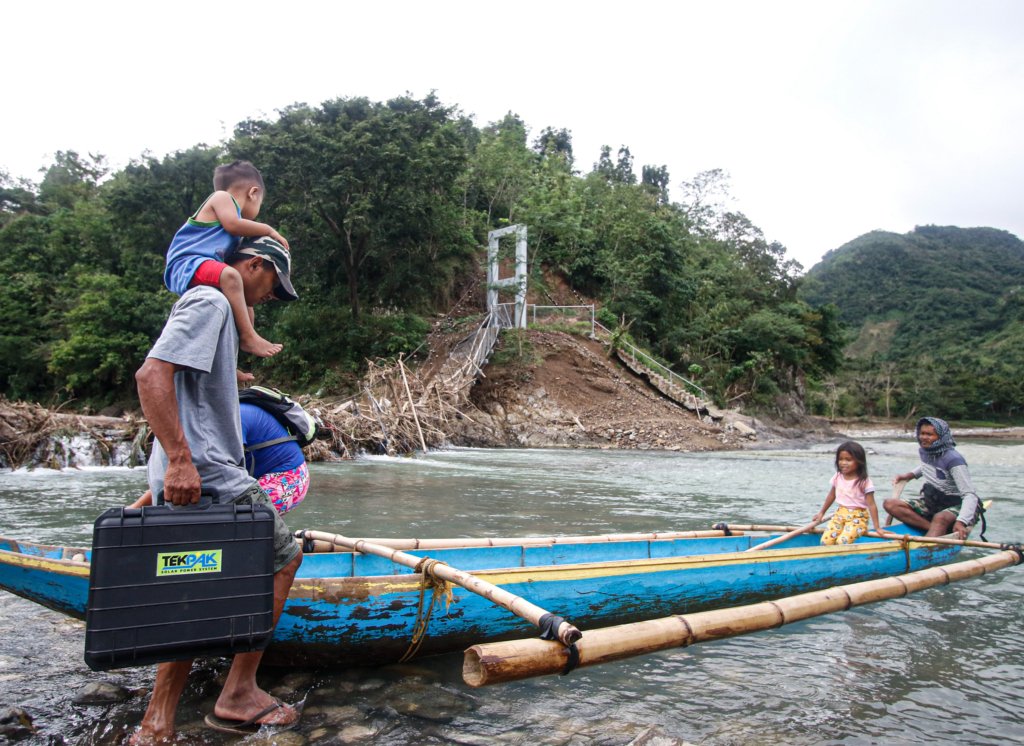
A Dumagat family, carries the TekPak they received from ICSC and 350 Pilipinas, as they cross the river towards Sitio Magata.
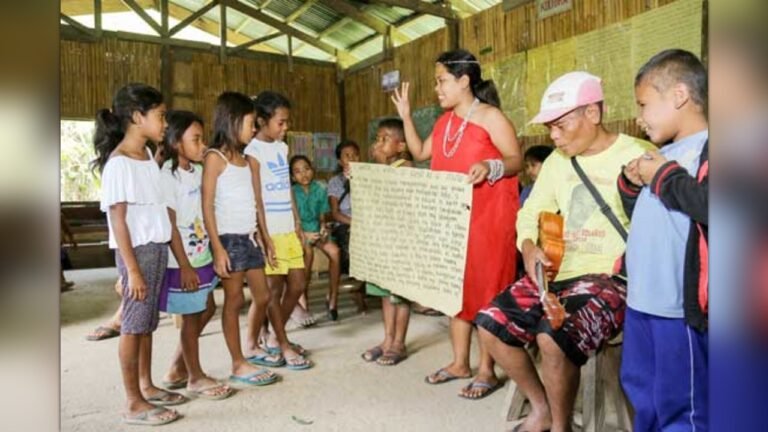
DUMAGAT-REMONTADOS
Dumagat-Remontados of Rizal province are from the bloodline of the Aetas who are deemed and recognized as the first known settlers in the country.
A tribal community of no less than 27,000 families, Dumagat-Remontados have preserved their way of living at the southernmost tip of the Sierra Madre mountain range where they do farming at the slopes and fishing in waterways well within what is legally referred to as their ancestral domain.
Their ancestral domain encompasses Tanay, Baras, Antipolo and Montalban.
However, the so-called development effectively dislodged them from what is deemed as legally theirs in the midst of aggressive efforts reclassifying their ancestral domain, which has become a “luxurious place” for foreign retirees, private recreation facilities, high-end restaurant strips, residential subdivisions, and golf courses to name a few.
‘Today, their ancestral domain in the upland portion of Rizal has already been reduced to what seemed too negligible to cater their rapidly increasing population and growing needs.’
GOVERNMENT CROOKS
For one, the process of reclassifying land requires government approval. In the case of their ancestral domain, Dumagat-Remontados could only blame the Department of Environment and Natural Resources (DENR) which has supervision in an ancestral domain which forms part of the Marikina Watershed. Marikina Watershed is a protected area under existing Philippine laws. There is also this Indigenous People’s Rights Act (IPRA) that is primarily designed to ensure the protection of the IP groups.
However, just a handful of the Dumagat-Remontados would be able to understand these laws since most of them couldn’t even read or write. Their predicament – poverty and illiteracy – made it a lot easier for crooks in the government to put one over the Dumagat-Remontados of Rizal.
Interestingly, politicians who have been neglecting IPs are expected to pay them a visit soon in view of an upcoming election.
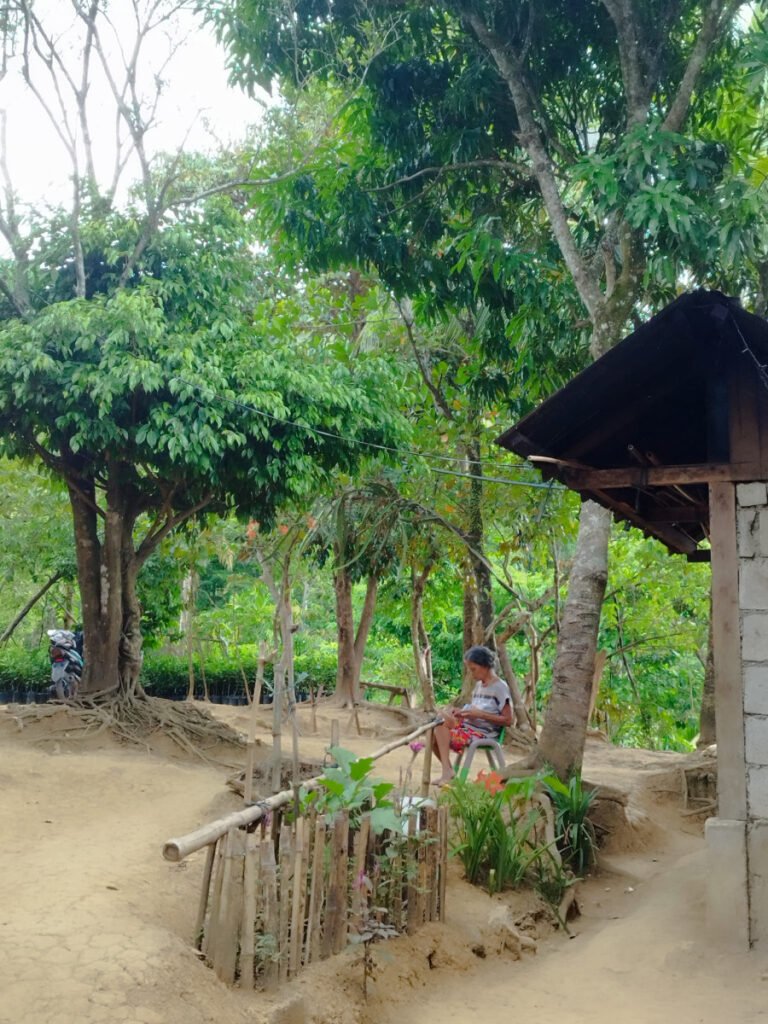
THE WAY members of the Dumagat-Remontado tribes live in the hinterlands of the Sierra Madre Mountains of Rizal and Quezon provinces. Photo Courtesy of National Commission on Indigenous People
LAWS PROTECTING IPs
In an earlier encounter, lawyer Juancho Botor who once served as counsel for the Dumagat-Remontados over a case arising from an incident in October 2020, presented documents as proof of the IP group’s legitimacy at the upland portion of Rizal.
According to Botor, the Dumagat-Remontados of Rizal have been issued their Certificate of Ancestral Domain Title (CADT), which defines the borders of their ancestral domain.
Under the Republic Act 8371 (Indigenous People’s Rights Act of 1997), the State recognizes, protects, and promotes the rights of Indigenous Cultural Communities and the Indigenous People. The law aims to ensure their economic, social, and cultural well-being, and to protect their ancestral domains and cultural heritage.
Since the Dumagat-Remontados’ ancestral domain overlaps with the Marikina Watershed, Botor also cited RA 11038 (National Integrated Protected Areas System) which effectively designated the Rizal-based IPs as “stewards” whose mandate is to protect, preserve and conserve the forest and the watershed within their ancestral domain.”
REMONTADOS CHIEFTAIN
In a previous interview, Dumagat-Remontados chieftain Alex Bendaña shared the same sentiment, as he presented a map of their ancestral domain and stripped areas including their Sacred Grounds.
But instead of recognizing the IP group’s right to their ancestral domain, several groups – including a private foundation masquerading as environmentalists, accused the Dumagat-Remontados as land grabbers.
In October 2020, the private foundation, accompanied by the military and policemen forced their way into the ancestral domain and secured the area using barbed fences. Security guards were also deployed to prevent the IPs from returning to their homes.
The Dumagat-Remontados tribal leaders forming part of the Kaksaan Ne Dumaget De Antipolo Inc. issued a statement denouncing the acts of repression.
“Together with the military, they (private foundation) forcefully intruded our property and fenced it off ” tribal chieftain Ernesto Doroteo said in the vernacular, adding that the place where they stand is what remains of their ancestral domain after being shoved away many times in the past by equally rich businessmen and politicians.
BRIGHTER PROSPECTS
For the last 10 years, the Dumagat-Remontados have been shooed away from the place they call their home.
By some twist of fate, the Rizal-based IPs somehow “saw a light at the end of the tunnel” after the DENR cancelled its contract with Blue Star Construction Development Corp., the company linked to the Masungi Georeserve, citing a long list of red-flags.
The struggle however does not end with Blue Star.
The DENR has to take drastic steps to recover a significant area that has been stripped from the Dumagat-Remontados’ ancestral domain — not to mention the destroyed crops, the demolished sacred area, the lost time in which they could have utilized to earn a modest livelihood.
The rectification however may not be as easy as many thought it is as permanent structures have already been constructed over a huge chunk of their ancestral domain.
PUBLIC office is public trust, says the provincial board following the issuance of a guilty verdict against two incumbent Angono councilors for having an “illicit affair.”
In a 15-page decision, Councilors Roberto Sison Jr. and Jhoana Duran were slapped with a one month suspension for violating Republic 6713, otherwise known as the Code of Conduct and Ethical Standards for Public Officials and Employees.
The case stemmed from a complaint filed by Ernescel Sison (wife of Councilor Sison) who claimed that her husband and Councilor Duran were having an illicit affair.
To prove her allegations, the complainant turned over evidence and testimonies of witnesses to what she described as a “glaring display of immorality.” Among the evidence submitted to the provincial board included cellphone video, verified Facebook posts, among others.
She also accused her husband of selling their conjugal properties, and depriving her kids of their “fair share” from the proceeds of a leased parcel of commercial land.
In its decision, the provincial board cited Section 60 of the Local Government Code which provides grounds for disciplinary actions against elective officials involving “turpitude.”
“Be it resolved as it is hereby resolved by the Sangguniang Panlalawigan ng Rizal that respondent Roberto Sison Jr. and respondent Jhona Duran are hereby found to have violated Section 4 of RA 6713 (Code of Conduct),” reads the verdict that was signed by Rizal Vice Gov. Reynaldo San Juan Jr., Provincial Board Secretary Atty. Roselle Andallo Ramilo and Board Secretary Marilyn Carpio.
Despite the guilty verdict, Duran was allowed to seek reelection. Sison for his part did not run for public office.
The Hyundai INSTER has been honored with the title of 2025 World Electric Vehicle, with the prestigious accolade announced on April 17 at the globally renowned 2025 World Car Awards ceremony, held during the New York International Auto Show (NYIAS).
This momentous achievement marks the fourth consecutive year that a model from Hyundai Motor Company has led one or more categories in the World Car Awards.
“The Hyundai INSTER has been a winner with customers since we introduced it. It’s very gratifying that the experts on the prestigious World Car Awards jurors feel the same way. The combination of compelling design, range, enjoyable driving characteristics, intuitive infotainment and technology that customers appreciate is emblematic of Hyundai’s approach of delivering exceptional value to our customers,” said José Muñoz, President and CEO of Hyundai Motor Company.
“The fact that our global portfolio is successful both commercially and critically speaks to the hard-working people throughout the Hyundai value chain who are delivering some of the best vehicles on the road today. Thank you to all the jurors for your service to this great industry,” he added.
A new benchmark in compact EV driving
INSTER has been designed to enhance driving enjoyment while maintaining the level of refinement and smooth driving characteristics EVs are known for. This has been achieved through a particular focus on INSTER’s ride and handling performance.
Compared with a conventional rubber bushing, Hyundai Motor’s engineers chose a more advanced hydro bushing for the INSTER’s electric motor body mount, improving ride quality and reducing vibration. Hydro bushing enhances vibration insulation by absorbing impact energy through the movement of fluid inside the system.
Compared with the CASPER model with internal combustion engine (ICE, available in Korea only), the all-electric INSTER’s body control and shock absorption capacity have been enhanced by upgrading to a high-performance shock absorber.
INSTER has also been engineered to enhance its competitiveness in terms of noise, vibration and harshness (NVH) to meet customer expectations for EV refinement. This has been achieved across various driving conditions, improving interior refinement.
The vehicle’s body has been enhanced through vibration analysis and optimization of the structure’s vibration dampening material to reduce low-frequency road noise. High-frequency road noise has been reduced by measures such as the application of double seals on both the front and rear doors, thicker front door glass, optimization of airflow around the headlamp strip and the application of a front underbody cover, also reducing drag.
High-speed driving comfort has been further enhanced through body reinforcements around the steering system mountings and optimizations to the internal steering damper. This is particularly noticeable with INSTER’s new steering wheel, which has been designed based on an analysis of steering wheel vibration characteristics.
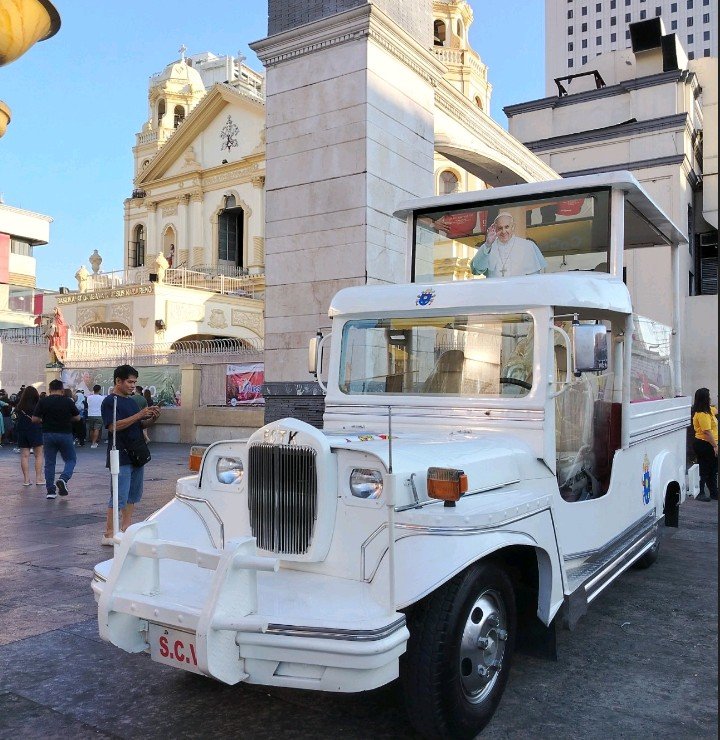
The Pope Mobile that Pope Francis used during his visit to the Philippine in 2015 is now on display at the grounds of the Minor Basilica and National Shrine of Jesus Nazareno – St. John the Baptist Parish in the city of Manila. Hundreds attended the Last Friday mass as a vigil to the fallen Catholic Church patriarch.
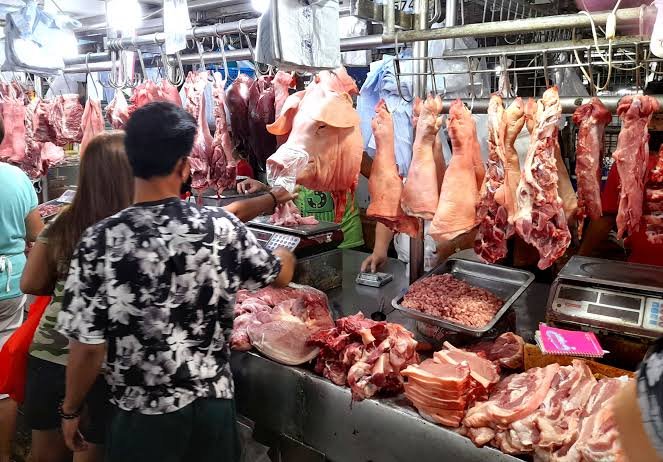
BECAUSE OF THEIR lowly stature in society, pork farmers are always the first to comply with regulations issued by the Department of Agriculture on ceiling prices for pork, but not the traders (which comprise viajeros, retailers and other traders).
At least this is what the Samahang Industriya ng Agrikultura (SINAG) is saying short of describing the farmers as the first ones to be compliant to government regulations because of fear arising for their marginal status in society.
SINAG likewise challenged the DA’s claim of low compliance with the maximum suggested retail price (MSRP) on pork, asserting that hog raisers have been fulfilling their part of the agreement.
The DA set the MSRP in March at P350 per kilogram kilo for kasim and pigue, and P380 per kg for liempo. It later reported that fewer than 10% of retailers were adhering to the price ceiling.
SINAG insisted that the DA based the MSRP on a farmgate price of P230/kg and added a margin of P120— of which P70 is allocated to traders and P50 to retailers.
THERE IS A DISCONNECT
SINAG executive director Jayson Cainglet said the DA should identify where the disconnect lies and not blame the compliant hog raisers.
“Kahit lugi ang maraming backyard farms, sumusunod pa rin sila sa napag-usapan,” Cainglet said.
The DA meantime warned that it and the Department of Trade will start running after pork retailers not complying with the agreed MSRP, said DA Assistant Secretary Genevieve Velicaria-Guevarra with notices to be issued this week.
She confirmed that compliance has been only at 20 percent of monitored retailers in 10 markets in Metro Manila.
“This week, we will begin issuing notices to stakeholders for them to explain their failure to comply with the MSRP. We are coordinating closely with DTI, which has enforcement authority on prices,” said Guevarra.
THE SUPPLY CHAIN
The DA implemented the MSRP in March, setting prices for locally slaughtered pork at P380 per kilo for liempo and P350 per kilo for pigue and kasim.
She attributed widespread non-compliance to elevated farm gate prices, which have risen above the agreed level of P230 per kilo.
Guevarra shared that multiple layers of middlemen in the supply chain have further pushed pork prices higher by the time the meat reaches public markets.
SINAG dared DA to pinpoint exactly where the problem lies, as hog raisers have been adhering to their commitment with the DA to keep the farmgate price of pork at P230 per kilo for kasim and pigue and P260 for liempo.
COMPLIANCE
Unlike rice, which passes through several middlemen, the pork supply chain involves only the hog raisers, traders, and vendors.
The DA had earlier noted that less than 10 percent of retailers are observing the pork MSRP.
The pork MSRP was based on the farmgate price of P230 per kilo for pigue and kasim and P260 for liempo, plus a margin of P120 that is split between traders and retailers at P70 and P50 per kilo, respectively.
SINAG also cited data from the Bureau of Animal Industry (BAI) showing that 93 percent of hog raisers complied with the P230/P260 per kilo farmgate price. The figures are based on invoice records.
Lexus unveiled the all-new ES at its world premiere at the Shanghai Motor Show, and a phased rollout across various regions is scheduled to begin in the middle of 2026.
The Shanghai Motor Show is scheduled for April 23 to May 6.
“Launched alongside the flagship LS in 1989, the ES has been a core model in Lexus, earning global acclaim for its quietness, ride comfort, and spacious interior. It has been sold in over 80 countries and regions worldwide,” Lexus said in a statement.
“Since the launch of the RX 400h in 2005, Lexus has led the way in luxury electrification―consistently pursuing both dynamic performance and environmental responsibility. In 2024, electrified vehicles accounted for a record-high 52% of global sales,” it added.
With a continued focus on hybrid electric vehicles (HEVs), plug-in electric vehicles (PHEVs), and battery electric vehicles (BEVs), Lexus will work toward realizing a carbon-neutral society while responding to the evolving needs of diverse customers and markets. Lexus is committed to delivering a unique brand experience by advancing core vehicle performance through electrification. This movement will drive an engineering focus that redefines the future of mobility while providing services that enrich modern lifestyles.
As the latest expression of these commitments, the all-new ES is the second of three new Lexus BEV models scheduled to debut by March 2026. It catalyzes a product momentum that coincides with a comprehensive reimagining of the Lexus brand set to be revealed at the Japan Mobility Show 2025 in October.
‘The all-new 8th-generation ES stands as a forerunner in Lexus next-generation electrification lineup. Developed under the concept of Experience Elegance and Electrified Sedan, this model aspires to deliver a refined driving experience across every scene―further enhancing quietness and ride comfort while staying in tune with customer needs,” Lexus said.
“In pursuit of carbon neutrality through a multi-pathway approach, both HEV and BEV powertrains are offered to meet a diverse range of mobility demands,” it added,
Design and a bold evolution
The design draws inspiration from the next-generation BEV concept, LF-ZC, marking a bold evolution in Lexus design language that begins with the new ES. Deepening the expression of elegance, the design creates a clean, welcoming atmosphere that is uniquely Lexus. The exterior strikes a delicate balance between intelligent packaging and proportions that highlight the sedan’s inherent beauty―realizing a sleek, flowing silhouette that hints at the emotional driving experience to come.
Inside, Lexus debuts two groundbreaking innovations: the world’s first* Responsive Hidden Switches, which seamlessly blends physical controls into the interior for both functionality and sophistication, and the Sensory Concierge, a Lexus-first feature that delivers a personalized, immersive cabin experience.
Building on its spacious rear-seat design, the new ES enhances comfort and luxury to create a more refined cabin experience. Furthermore, by thoroughly refining the vehicle’s core fundamentals and electrification technologies, the new model aims for a high-level balance between handling that creates a seamless connection between driver and car―offering a level of engagement that inspires the desire to drive endlessly―and ride comfort and cabin quietness that naturally bring a smile to everyone on board.
Additionally, the ES integrates next-generation multimedia for enhanced connectivity and convenience, along with the latest Lexus Safety System+ for advanced safety and peace of mind.
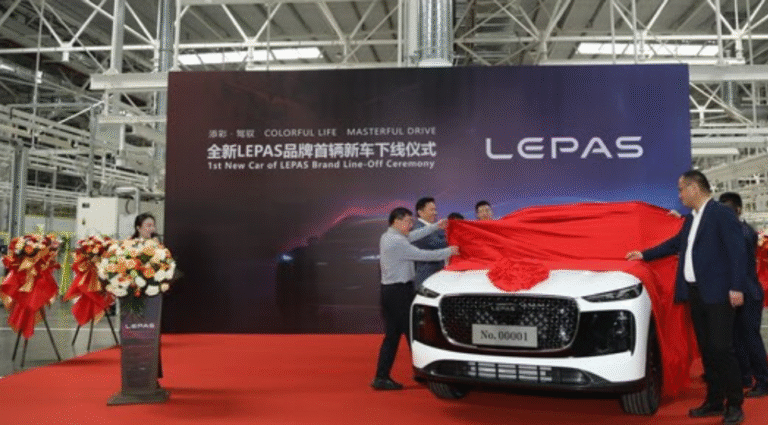
Chery has unveiled its global brand and the first product under it – the LEPAS L8 – that officially rolled off the company’s production line.
As a strategic move in Chery’s premium positioning, LEPAS not only addresses a market gap but also redefines elegant mobility with its philosophy of “Colorful Life, Masterful Drive.”
The launch of LEPAS marks the culmination of Chery’s nearly three decades of automotive expertise and global capabilities. It aims to enrich users’ lives through innovative technology and design while delivering a poised yet exhilarating driving experience,” Chery said in a statement.
“As a cornerstone of Chery’s upmarket strategy, LEPAS transcends the car’s functional role, transforming it into an expression of lifestyle aesthetics. The brand name fuses ‘Leap’ and ‘Passion,’ symbolizing dynamism and vitality while balancing elegance with fervor,” the company said.
“Its ‘Leopard Aesthetics’ design also creates boundary-defying visual signatures. Backed by Chery’s eight global research and development centers, LEPAS reimagines “elegant control.”
LEPAS L8, the brand’s inaugural model, sets a new benchmark for mainstream SUVs. With its sleek styling, tech-forward cabin, spacious comfort, and comprehensive safety features, it caters to urban elites seeking a premium lifestyle.
Beyond L8, LEPAS will expand its lineup to cover all mainstream segments, building a diverse product portfolio tailored to discerning customers – from family-oriented elites to those with refined tastes.
The LEPAS L8’s debut heralds its global launch at 2025 Chery Business Conference in late April. Centered around the theme “Colorful Life, Masterful Drive,’ the event will showcase the perfect fusion of elegance and technology to a worldwide audience.
“Amid the dual trends of automotive intelligence and consumption upgrades, the arrival of LEPAS represents not only a testament to Chery’s technological prowess but also a bold reimagining of the future of mobility aesthetics,” Chery said.
“True to its vision—Making LEPAS the choice for stylish, elegant mobility—this journey, beginning in Wuhu, China, is now accelerating onto the world stage,” it added.
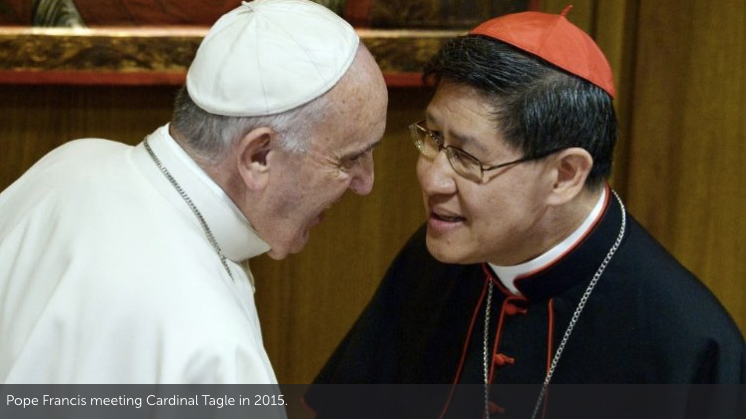
MANILA ARCHBISHOP CARDINAL Luis Antonio Tagle, whose closeness to the late Pope Francis, has earned for himself the name “the Asian Francis” and is now among the contenders to the seat of St. Peter in the Vatican.
Though it brings immense joy and pride for Filipinos as he would be the first to be considered for the venerable seat, still reports among those knowledgeable in the workings of the Vatican conclave process consider him a remote possibility.
As the Inquirer mentioned, “an old Italian saying warns against putting faith or money in any presumed front-runner ahead of the conclave, the closed-door gathering of cardinals that picks the pontiff.”
It cautions further that “He who enters a conclave as a pope, leaves it as a cardinal,” Inquirer added.
WHO IS TAGLE? Among the names of cardinals cited by Reuters for “papabili” or “electable” is Cardinal Luis Antonio Gokim Tagle, who is often called the “Asian Francis” because of his similar commitment to social justice.
Tagle, 67, generally prefers to be called by his nickname “Chito” seems to have all the boxes ticked to qualify him to be a pope, the story added.
Tagle has had decades of pastoral experience since his ordination to the priesthood in 1982. He then gained administrative experience, first as bishop of Imus and then as archbishop of Manila.
He was appointed by Pope Francis in 2019 as head of the Church’s missionary arm, formally known as the Dicastery for Evangelization, as a strategy to give him Vatican experience.
He comes from what some called “Asia’s Catholic lung,” because the Philippines has the region’s largest Catholic population, Reuters said. His mother was an ethnic Chinese-Filipino. He speaks fluent Italian and English.
Between 2015 and 2022, Tagle was the top leader of Caritas Internationalis, a confederation of more than 160 Catholic relief, social service and development organizations around the world.
‘(Pope Francis) was the gift of the Good Shepherd to the Church. He served us with humility. He showed us God’s mercy. He linked us with bridges of compassion with fellow believers and with nonbelievers.’
In 2022, Pope Francis fired its entire leadership following accusations of bullying and humiliation of employees, and appointed a commissioner to run it.
Tagle, who was also removed from his role, had been nominally president but was not involved in the day-to-day operations, which were overseen by a lay director general.
Announcing the Pope’s dramatic decision, Tagle told a meeting of the confederation that the changes were a moment for “facing our failures.” It remains to be seen how the saga will impact Tagle’s chances at the papacy. If elected, he would be the first pontiff from Asia.
The Modern Jesus Bells of the Philippine Catholic churches will toll, requiem masses will be said, in keeping with the order of Cardinal Pablo Virgilio David, president of the Catholic Bishops Conference of the Philippines. Candle stands will be placed on churchyards for the faithful to light candles and pray for the eternal repose of the pope.
Photos of the revered Pope Francis on his four-day visit in 2015, where he comforted the still grieving survivors of Super Typhoon Yolanda (international name: Haiyan) in the Visayas and celebrated with more than 6 million Filipinos in Rizal Park, making it the largest papal gathering in history, are splashed in Facebook.
Lingayen-Dagupan Archbishop Socrates Villegas called Pope Francis “the Jesus of our age.”
“He was the gift of the Good Shepherd to the Church. He served us with humility. He showed us God’s mercy. He linked us with bridges of compassion with fellow believers and with nonbelievers. He bravely disturbed us in our complacency and prejudices. He taught us to care for God’s creation. He taught us Jesus,” he said in his message.
Villegas, who was the president of CBCP when Pope Francis visited the country in 2015, remembered the warmth that the Holy Father gave to the Filipinos.
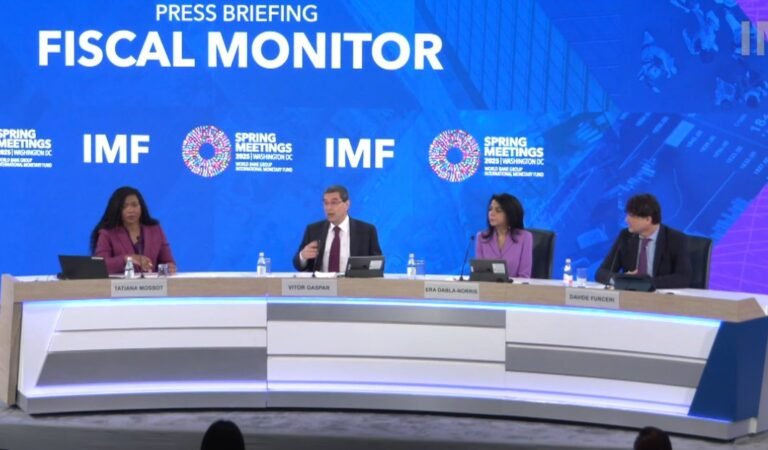
The policy of the United States on tariffs as ordered by President Donald Trump has increased volatility in the financial markets, according to report of the International Monetary Fund (IMF) released on Tuesday.
The IMF reported titled “Enhancing Resilience amid Uncertainty” that is an edition of the Global Financial Stability Report for April 2025 stressed that risk assets have been sharply repriced since February following a series of tariff announcements by the US. This also accelerated after the US announced high tariff rates in early April.
The US tariff issue has caused more economic uncertainty that was reflected in stock markets getting badly affected.
“Our assessment is that the global financial stability risk has increased significantly due to heightened economic policy uncertainty and rising market volatility,” said IMF Financial Counselor Tobias Adrian.
“The decline in investor confidence that we have seen has triggered recent sell-offs in equity markets. The tightening of global financial conditions is putting downside pressure on economic activity,” he added.
Emphasizing that financial market volatility in stock, foreign exchange, and bond markets has increased significantly, the IMF report stated that the reaction of other countries has further increased the uncertainty.
In the face of such high asset price volatility, the report stated that global financial stability risks have increased significantly, particularly as financial conditions tightened, as have macro-financial downside risks to growth.
“Currently, financial conditions have shifted from being more or less accommodative to being neutral with the potential for further tightening. In conditions of prolonged volatility, financial institutions with high leverage may experience significant stress. Non-bank financial institutions could struggle during market turbulence, potentially impacting the broader financial system. In weaker and poorly managed banks, vulnerabilities could reemerge,” Adrian warned.
Despite the recent turmoil in the markets, valuations in some key segments of the equity and corporate bond markets still remained elevated, according to the IMF report, pointing out that this meant that readjustments in valuations could go further if the outlook worsened.
The report noted that policy uncertainty remains high, increasing the likelihood of a correction in asset prices.
With that scenario, Adrian said that countries should start preparing for potential challenges.
“It is crucial that we prepare for potential challenges ahead, Equipping authorities to manage financial instability effectively. The policy toolkit should encompass measures that ensure market functioning, support prudential supervision and regulation of financial institutions, and provide emergency liquidity and crisis resolution tools,” he said.
“We recommend that financial institutions and regulators allocate resources for identifying risk and mitigating risk, employing stress testing and scenario analysis. Emerging market and developing economies should focus on enhancing their financial markets while maintaining adequate fiscal policy space and international reserves to cushion against geopolitical shocks,” Adrian added.
The head of the Catholic Bishops’ Conference of the Philippines on Monday called on the faithful to pray for the eternal repose of Pope Francis as well as carry forward the late pontiff’s call to become a “missionary synodal Church.”
In his message on the passing of the pope, Pablo Virgilio Cardinal David, the bishop of Calookan, said “Pope Francis has now returned to the Father, but his legacy as a supreme pontiff—that is, as bridge-builder—will never be forgotten by the Church.”
A TRUE SHEPHERD
David, one of three Filipino cardinals created by the late pope, said Francis was a “shepherd who walked with his people, often choosing the dusty road toward the peripheries rather than the comfort of the center.”
He recalled the late pope’s key messages in his apostolic exhortations and encyclicals, citing Evangelii Gaudium (2013) and Fratelli Tutti (2020) where Francis called for a more welcoming Church amid complex challenges faced by the world.
“[H]e reminded us that the heart of the Gospel beats most strongly where pain, poverty, and exclusion dwell. He invited us to be a listening Church—one that opens its ears to the cries of the people and its heart to the stirrings of the Spirit,” said David.
OUR COMMON HOME
In Laudato Si (2015) and Laudate Deum (2023), Pope Francis “taught us to see the earth as our common home, entrusted to our care, especially for the sake of the generations to come,” the cardinal said.
David, who played a prominent role in the recent Synod of Bishops at the Vatican, said that “through his vision of synodality, Pope Francis challenged us to rediscover the Church not as a fortress, but as a field hospital—welcoming, healing, and journeying together.”
He also recalled the pontiff’s tribute to the Filipino diaspora during a milestone event in the Philippine Church — the 500th anniversary of the arrival of Christianity in the islands in 2021.
“And with his characteristic wit and warmth, he once called our Overseas Filipino migrant workers ‘contrabandistas de la fe’—smugglers of the faith—reminding us that the witness of simple, faithful lives can cross borders and touch hearts where formal missionaries cannot go,” David said.
LEAVING FOR ITALY
Noting that the pope’s death occurred at the beginning of the Eastertide, marked by the joy of Christ’s resurrection, David again recalled the late pontiff’s words to Filipinos: “It is okay to shed tears of sorrow during this joyful Easter Octave. After all, it was he who reminded us that ‘we can only see more clearly through eyes washed by tears.’”
It was the pope’s moving response to 12-year-old Glyzelle Palomar’s query about why God allowed suffering in the world, during a meeting with 30,000 young people at the University of Santo Tomas in Manila near the tail-end of his historic 2015 apostolic visit to the Philippines.
David, along with Manila Archbishop Jose Cardinal Advincula, is expected to travel to Rome to witness the pope’s funeral and join Luis Antonio Cardinal Tagle, the highest-ranking Filipino in the Vatican Curia.
POPE FRANCIS’ LIFE principle– “Who am I to judge”– endeared him to a wide range of people erstwhile shunned by traditionalists in the Vatican. These traditionalists, now vying fiercely to grab that venerable position in the Catholic Church, want to return to traditional doctrines and return to the materialistic Vatican II which became a source of corruption from a lack of transparency and values unacceptable to God’s commandments.
Pope Francis, the patriarch of the Catholic Church, had always stuck to the inclusivity of all religions, races, and called for a listening church to the marginalized and isolated in earthly societies.
Temporarily hindered by his frail health, Francis served the flock with humility and compassion until his death on Easter Sunday.
It is no wonder then that many people around the globe are now praising him and his simplicity, honesty and openness, which was so unusual with the former Vatican occupants (except the now St. Pope John Paul II). The past Vatican high priests wielded immense power and snobbery distancing themselves from the problems of the faithful.
‘Pope Francis may have departed this world, but the values he lived and preached continue to inspire millions. In a time often marked by division, he reminded us of the power of humility, the necessity of empathy, and the enduring call to serve others.’
KNOWN FOR HUMILITY, COMPASSION
Crucial now is the selection of Francis’ successor to the chair of St. Peter, which people around the world are praying for guidance from the Holy Spirit. Names have been floated with accompanying noises for each candidate, akin to the election of politicians.
Rather than dwell on the conclave, I would like to hype on the fact that Francis reached out to all faiths and religions, he staunchly exposed the sexual misdeeds of priests even as he reached out to the marginalized, to China and to the ostracized in society like homosexuals, transgender as he did not disdain same sex unions.
As one article posted on Facebook said, Francis, “known for his humility, compassion, and deep concern for the marginalized,” reflected until his final days the very values he championed throughout his life. Seated in a wheelchair on the balcony of St. Peter’s Basilica, he greeted the faithful with a gentle smile and offered his Easter blessing. The moment was quiet but profound—an act of courage that now stands as his parting gift to the world.
LAST APPEARANCE
Because of his fragile health, Easter Mass was presided over by Cardinal Angelo Comastri but Francis’ voice and spirit “were present in the powerful Easter message read aloud by a Vatican archbishop.”
His words were heartfelt and urgent, calling for peace in war-torn regions such as Gaza and denouncing rising anti-semitism across the globe. He underscored the essential role of fundamental freedoms: freedom of religion, expression, and thought—principles he firmly believed were the foundation of lasting peace.
Later, Pope Francis was driven through the square one last time in an open vehicle, blessing the thousands who had come to witness the celebration, the very last glimpse they had of the pontiff who reshaped the global image of the Catholic Church.
HIS PAPACY
Pope Francis, born Jorge Mario Bergoglio in Argentina, made history as the first Jesuit pope, the first from the Americas, and the first to take the name Francis—honoring Saint Francis of Assisi, the patron of the poor.
His papacy, beginning in 2013, was marked by bold efforts to reform the Church, embrace the marginalized, and engage with pressing global issues like climate change, economic injustice, and interfaith dialogue.
He often said the Church should resemble a “field hospital” more than a place of judgment—open to those who are wounded, struggling, or searching for hope. This vision resonated with millions and helped renew faith in many corners of the world.
Now, the Church and the world mourn his passing with candlelight vigils held outside the Vatican, and churches around the world have opened their doors for prayer and reflection. Philippine churches have scheduled requiem masses in his honor.
Leaders across faiths and nations have shared tributes, honoring his legacy of compassion, justice, and mercy.
Pope Francis may have departed this world, but the values he lived and preached continue to inspire millions. In a time often marked by division, he reminded us of the power of humility, the necessity of empathy, and the enduring call to serve others.
May his soul rest in peace, and may his final message echo far beyond the walls of the Vatican.
The International Monetary Fund (IMF) sees a “notable” downward revisions in the new global economic growth forecasts in its World Economic Outlook report to be published next week.
However, no recession is seen for the global economy. In January, the IMF said it forecast a global growth of 3.3 percent in 2025 and 3.3 percent in 2026.
Kristalina Georgieva said the flow of trade will change direction as countries set barriers with tariffs and non-tariff barriers, and that trade will continue but disruptions will cause costs.
“We will quantify these costs in our new World Economic Outlook, to be released early next week. In it, our new growth projections will include notable markdowns, but not recession,” she said in a speech in Washington.
“We will also see markups to the inflation forecasts for some countries,” Georgieva added.
She said that at present, world economy is being tested with the restructuring of the global trade system, caused by US recriprocal tariffs and retaliation on the issue by China and the European Union.
Describing the trade tensions as “a pot that was bubbling for a long time and is now boiling over,” Georgieva said what is happening globally is largely the result of an “erosion of trust.”
“Trade distortions—tariff and nontariff barriers—have fed negative perceptions of a multilateral system seen to have failed to deliver a level playing field,” she said.
Also, observing the fall of global stock prices as trade tensions escalated, Georgieva said this should serve as reminder that the people now live in a world of sudden and sweeping change.
SINCE MY YOUTH, I thought that kidnap for ransom operations were just a creative plot of comics magazine writers and graphic artists. Only lately, as a journalist did I realize that these groups exist and operate not just in foreign shores but right in our country.
This is also causing jitters to the business community after steel magnate Anson Que (aka Anson Tan) and his driver Armanie Pabillo were last seen on March 29 after leaving Que’s office in Valenzuela City. The next day, the family received a ransom demand of $20 million (or P160 million, which was paid by the family) via WeChat prompting the immediate filing of a report with the PNP-Anti Kidnapping Group.
As soon as reports and photos of the kidnap-killings came out, three big and influential business groups published strongly-worded statements that denounced the government’s apparent helplessness in containing such organized crime and bringing to justice those involved in such heinous activities.
CALCULATED CRIME
But on Easter Sunday, PNP Chief Gen. Rommel Francisco Marbil announced the swift resolution of the kidnapping and murder of Que and Pabillo calling it a landmark breakthrough that underscores effectiveness of PNP in solving such heinous crimes. “This was not a random act of KFR but a calculated KFR operation.” Those involved will be identified and formally charged this week, he added.
Investigation showed the crime was orchestrated by Chinese national David Tan Liao (aka “Xiao Chang Jiang,” “Yang,” “Jianmin,” and “Michael Agad Yung,”) now under police custody, after he voluntarily surrendered.
Filipino cohorts were identified as Raymart Catequista and Richard Tan Garcia (aka Ricardo Austria David), who were arrested in Roxas, Palawan on April 18.
Liao personally directed a rogue kidnap-for-hire operation—a shadowy and transactional criminal enterprise where he contracted local henchmen to carry out abductions and executions of individuals embroiled in disputes over unpaid debts, betrayals, or internal conflicts. “In effect, Liao’s criminal scheme operated like a rogue collection agency—except they collected through blood,” Marbil said.
CASE BUILDUP
With the PNP’s swift case buildup, pursuit and intelligence coordination, Liao’s network led to solving five other major kidnap-for-hire cases linked to the same group. Now the PNP is focusing on the financiers —the real power behind these blood-for-hire operations,” he added.
Marbil assuaged the jitters in the business sector of a widespread or random kidnapping spree in the country saying “these are isolated, calculated acts rooted in personal and financial vendettas. Criminal networks are being taken down.”
Comebacking senator and ex-PNP chief Panfilo M. Lacson reminded the PNP that the next step now is to ensure the conviction of the perpetrators.
With the arrest of at least three of the five suspects, it is important now to convict all perpetrators by building an airtight case, he posted on X (formerly Twitter). Lacson earlier said the only way to mollify the Fil-Chi community and the public is to solve the case and bring the perpetrators to justice.
Liao was said to be scared that he may also be killed. The PNP is now tracking down at least two more Chinese linked to the kidnap-slay of Que and Pabillo.
Liao was said to be moving in the same business or social circles as Que. As Arsenio Evangelista dubbed “the enemy within. Beware of friends deadlier than enemies.” Liao operated a travel agency and managed a collection firm catering to clients from mainland China, Bilyonaryo.com reported.
EMPTY PLATITUDES
Business groups like the Philippine Chamber of Commerce and Industry, the Federation of Filipino Chinese Chambers of Commerce and Industry Inc., and the Philippine Exporters Confederation earlier denounced the government’s “empty platitudes and bureaucratic inertia” and demanded that justice be served without delay.
“No more excuses. No more talking in circles. We need swift and relentless justice, not more waiting around. We’re watching our country unravel. Investors are losing confidence, tourism is taking a hit, and every Filipino is left wondering if they’ll be next.”
“It’s time for the government to prove it can do more than just talk. We want action—real, visible, and immediate action.”
FAR from the very purpose of the observance of a sacred tradition, Holy Week in the Philippines has transformed into a peak season for tourism for which private resorts, beaches, campsites and other “summer refuge” have attracted more city folks.
No less than the Department of Tourism (DOT) hinted at more than 30 million domestic and international travelers during the Holy Week break as tourists head to popular destinations across the country.
According to Tourism Secretary Christina Frasco, the volume of tourist arrivals in various parts of the country compelled the agency to activate its regional operations centers to coordinate and monitor high-traffic tourism areas to ensure proper coordination and oversight of the tourism destinations if only to ensure a smooth flow of tourists and manage peak volumes.
Interestingly, the number of tourists flocking the country’s tourist attractions represents roughly 38 percent of the total number of Filipino Catholics.
PURELY INCIDENTAL
Catholicism dates back to the 16th century when Spanish explorers on a search for exotic spices set their foot in what is now referred to as the Eastern Visayas.
Interestingly, the Spaniards did not only find what was then the most expensive spices but also found a colony to annex its global domination.
It was also then that friars introduced the Catholic faith which later on became the state religion during the colonial period. Even after they left, Catholicism remains a significant influence in the Filipino society notwithstanding the country’s secular constitution.
As per data collated from various web sources, Catholicism is the dominant religion in the Philippines, with about 78.8% of the population identifying as Roman Catholic.
OUR WAY OF LIFE
The Philippines has adopted Catholicism as a way of life, and remains as such despite some misconceptions relegating Holy Week as a long vacation.
For one, the observance of the Holy Week tops the long list of traditions passed on from one generation to another and one of the most prominent ways of commemorating the chronological events leading up to Jesus’ death by crucifixion until resurrection as foretold in the Holy Bible.
And speaking of the Holy Week, the first thing that comes to the mind of believers is the need for a little sacrifice, which many Catholics do in many forms – Fasting, Abstention, Visita Iglesia, Pabasa, Cenaculo among many other ways.
The week-long observance starts on Palm Sunday and ends on Easter Sunday. The highlight of the Holy Week observance is Good Friday as it commemorates Jesus’ suffering and death on the cross, translating to a day of sorrow, penance, and fasting.
THE GOOD FRIDAY
Good Friday is deemed as the most solemn as streets fall silent, so as the airwaves (except for the Netflix and other pay per view channels) which adopt a radical shift in programming – from the usual entertaining segments to liturgical productions.
Most businessmen are imposing a halt in operations for a day or two. In many towns, the only sounds are the tolling of church bells and the slow, deliberate rhythm of processions winding through narrow streets.
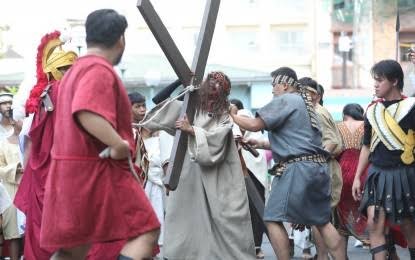
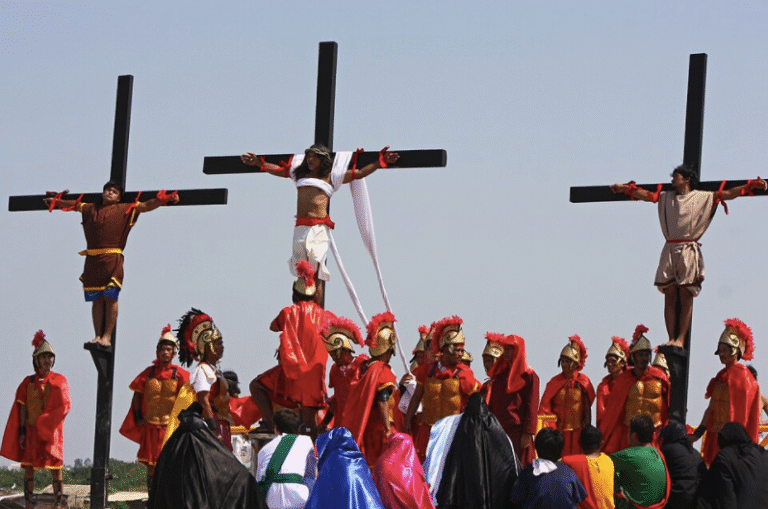
Key rites include the Siete Palabras or meditations on Christ’s seven last words, and the Veneration of the Cross. In the provinces, however, Good Friday takes on a dramatic dimension.
In San Fernando, Pampanga, flagellants lash their backs in penance, while some volunteer for full crucifixion reenactments.
Despite official disapproval from the Catholic Church, these acts continue to draw crowds and provoke both admiration and discomfort.
BLACK SATURDAY
A day after Jesus Christ’s death on the cross, the nation commemorates mourning, referred to as the Black Saturday. Marked by absence, this is the day when altars are stripped, bells are silent, and there is no celebration of Mass until the evening.
To the Catholic faithfuls, Black Saturday is an ideal time for quiet contemplation or household chores—part tradition, part superstition.
It is also the night of the Easter Vigil, when churches darken and then slowly come alive again with candlelight and the announcement everyone’s been waiting for — the resurrection of Jesus Christ, or Easter Sunday.
EASTER SUNDAY
At the break of dawn, many communities are staging the theatrical Salubong, a symbolic meeting between the risen Christ and His mother, Mary, with children (dressed as angels) being hoisted on harnesses to lift a black veil of mourning from the statue of the Virgin Mary, marking the transition from grief to joy.
Often accompanied by choral singing, brass bands, and flower petals cascading from balconies, Salubong radically shifts the mood with the ringing of church bells, reopening of the market, feasting and other forms of celebrations.
To non-Catholic believers, the rise of modern distractions and the shifting priorities of a fast-paced world has significantly decimated the observance of Holy Week in the Philippines.
On the contrary, Holy Week in the Philippines remains the biggest Catholic event.
And to quote a priest in Baras, Rizal — “Holy Week is more significant than Christmas… it marks the start of a new life after introspection.”
One of the most coveted race-bred cars, the evolved GR Yaris by TOYOTA GAZOO Racing (TGR), will go on sale in Japan starting May 6.
TGR will also make available the GR Yaris factory-installed option Aero Performance Package, the elements of which were first unveiled as part of a concept vehicle at Tokyo Auto Salon 2025, incorporating insights gained from motorsports.
Under the slogan of “Thanks for breaking it” directed at the drivers who pushed the vehicle to its limits, TGR honed the GR Yaris through constant enhancements, thoroughly pursuing the cause of problems by analyzing driving data, reviewing steering feel, and examining what kind of scratches and foreign matter were on broken parts.
“TGR’s journey of making ever-better motorsports-bred cars is without end. It intends to continuously evolve the GR Yaris by incorporating input from various drivers garnered through continued racing,” TGR said.0
MAIN FEATURES
The performance of the GAZOO Racing Direct Automatic Transmission, which first appeared in the GR Yaris announced in 2024, has been further honed. Aiming to achieve both the unique operability of a two-pedal vehicle and drivability, performance has been enhanced by making detailed improvements to gear selection control, mainly during sporty driving.
Responsiveness during sporty driving has been increased by expanding the vehicle speed range for downshifting (2nd gear to 1st gear) when downshifting via the paddle shifter while driving in the “D” range, shortening the time between paddle operation and the start of gear shifting, and improving the sense of directness near the red zone when selecting “SPORT” in manual mode.
Retained are the all-wheel drive system, and 1.6-liter, turbocharged, 3-cylinder engine producing 304 PS at 6,500 rpm and 400 Newton-meters of torque at 3,250 to 4,600 rpm.
“As a symbol of TGR car-making, the GR Yaris was born through making ever-better motorsports-bred cars. TGR has continued to compete in various motorsports, such as the FIA World Rally Championship, the Super Taikyu Series, and the Japanese Rally Championship, using the GR Yaris since the model’s launch in September 2020,” TGR said.
“That is because problems that occur in the extreme environments of rallies and other races provide opportunities to evolve the GR Yaris into an ever-better car,” the company added.
As the government keeps boasting of decreasing inflation, it cannot turn a blind eye to the increasing number of Filipinos who are experiencing involuntary hunger – a major contradiction.
This, as a recent Social Weather Stations (SWS) survey commissioned by the Stratbase Group showed that the number of Filipino families who experienced involuntary hunger at least once in the past three months increased to 27.2 percent. This is higher than the 25.9 percent logged in December last year.
Involuntary hunger is defined as “being hungry and not having anything to eat.”
Furthermore, the commissioned SWS survey, conducted from March 15 to 20, 2025, showed that that hunger rate in March was 6 points higher than 21.2 percent logged in February.
When it comes to regions, the Visayas logged the highest involuntary hunger incidence.
“Compared to February 2025, the incidence of hunger rose by 13.7 points from 20.0 percent in the Visayas, 4.9 points from 19.1 percent in Balance Luzon, and 4.0 points from 23.3 percent in Mindanao. However, it hardly moved from 27.3 percent in Metro Manila,” the SWS survey said.
LOWER INFLATION AN IRONY
What surprises, however, is inflation has been on downtrend this year, reaching a five-year low of 1.8 percent in March.
The March 2025 inflation rate is also lower than the 2.1 percent recorded in February, which the government attributed to the substantial decrease in rice prices from the imposition of lesser tariff on imported rice in July 2024.
PSA Undersecretary Claire Dennis Mapa said rice prices have decreased by around P3 to P5 per kilograms (kg) between July 2024 and March 2025.
National Economic and Development Authority (NEDA) Secretary Arsenio Balisacan said that the government’s measures against inflation were effective.
“The continued decline in inflation indicates the effectiveness of the government’s proactive measures to stabilize prices and protect the purchasing power of Filipino households,” he said.
“While the inflation rate continues to ease and remain within the target range, we commit to monitoring risks and shocks, particularly on anticipated electricity rate hikes and higher prices of fish and meat, and addressing them through timely and targeted interventions,” Balisacan added.
However, the fact that involuntary hunger is increasing is definitely disturbing amid lowering inflation, pointing to one factor that the government has failed to address: income inequality.
That issue has hardly been discussed in government foras and conventions, and is not a major issue being raised during this campaign period.
Surely, it will be very interesting to see what the next hunger survey will reveal.
What used to be a solemn, somber and sorrowful day for Christians around the world has become a day of celebration– beaches, family reunions, outings and festive gatherings– for most Pinoys here and abroad.
As Holy Wednesday approached, most were bound for distant provinces and even abroad for those that can afford such outings. Priests and churchgoers take part in religious services and rituals/processions. Many Catholic priests lament that most people have lost their time for God and to reflect on his torture, insults, suffering and carrying the heavy cross in Golgotha until his demise on Good Friday.
Even malls and restaurants are opening their doors for commercial activities (thereby negating the practice of fasting and abstinence for Christians), when in decades past people had nowhere else to go but the church or participate in the Pabasa (chanting of the passion and death of Jesus Christ) usually held on street corners, private homes, small chapels and at the sides of the big churches.
HOLY WEEK TRADITIONS
On Maundy Thursday, Catholics attending the Holy Mass for the Last Supper witness the priests washing the feet of his disciples (a random selection of mass attendees) to reminisce Jesus’ act of humility and service.
While it’s a central part of the Roman Catholic Church’s liturgy, many other Christian denominations also observe it in their worship services.
The Visita Iglesia or the visitation of at least seven churches for some (which I personally raised to 14 in years past to symbolize the 14 stations of the Way of the Cross) is usually done on Maundy Thursday (after the mass of the Last Supper), and Good Friday, but some have spread their visits to the different churches for the entirety of the Holy Week.
PASSION OF THE CHRIST
Good Friday is named such because of the belief that Christ’s death on the cross was the ultimate sacrifice for man’s sins and their redemption from death.
At noon of Good Friday, Jesus breathed his last, surrendering his spirit to the Father with the words “Father, into your hands I commend my spirit,” then he died. Curiously, at 3 p.m. the skies normally turn dark although this is the hottest period in that day.
Before breathing his last, the two criminals who were crucified with him– one at his left, the other at his right had time to ‘communicate’ with him. One mocked him saying “you save and heal others, why can’t you save yourself.” But the other rebuked his peer saying this man had not committed any sin and do not deserve this death but we deserve what happened to us, after which he turned to Jesus to ask forgiveness saying “Lord remember me when you are in paradise,” to which Jesus answered “today, you will be with me in paradise.”
This was followed by loud thunder, lightning and the earth shaking which made those that participated or witnessed his entire ordeal rushing to the safety of their homes.
The curtain of the temple was mysteriously torn in two from top to bottom and there was a great earthquake.
After Jesus’ body was taken down from the cross, He was wrapped in strips of cloth and laid in a tomb. Roman guards were sent to guard the tomb to ensure no one stole the body or spread rumors that He wasn’t dead.
Finally, three days later, Jesus rose from the dead and conquered death.
COMPASSION, HUMILITY
Amid the commercialism and secularism of our times, let us still follow the ways of Jesus from Maundy Thursday to Good Friday by practicing contemplative prayer and worship, by atoning for our sins in confession and receiving the Holy Communion and by keeping these few days in the year as solemn and meditative as possible.
Let us be humble, forgiving and compassionate towards everyone.
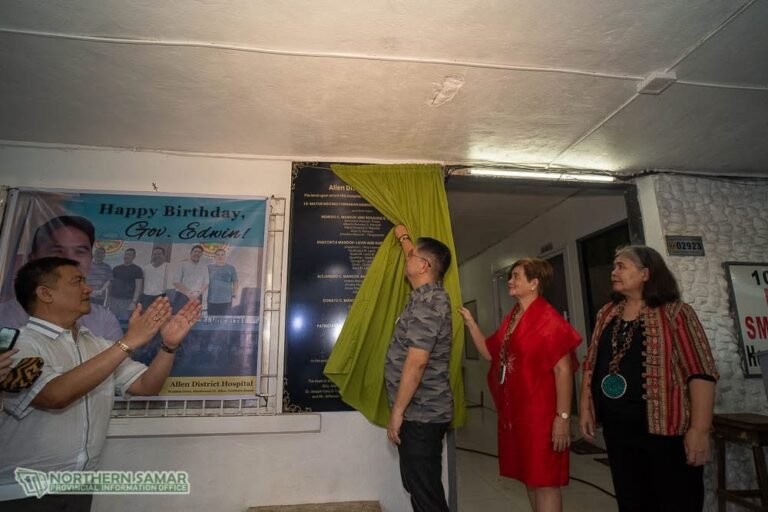
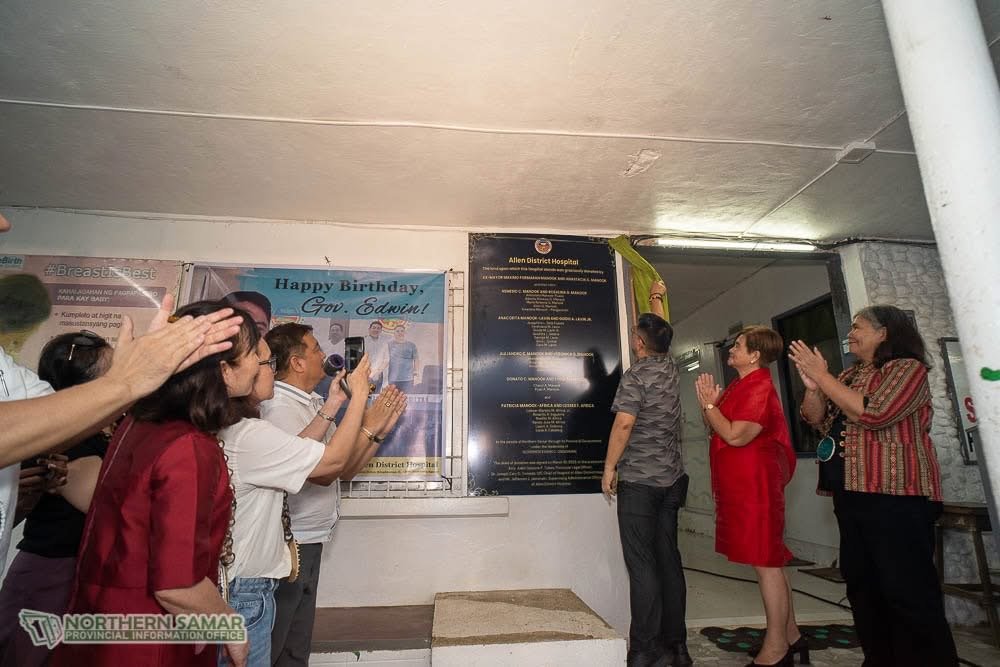
Northern Samar Gov. Edwin Ongchuan, on behalf of the Provincial Government, unveils the marker signifying the 6,500 sqm lot donation by the heirs of the late Allen Mayor Maximo Manook and Anastacia Manook where the Allen District Hospital stands.
The governor expressed sincere appreciation to the Manook heirs for the act of generosity, which he said “is a lasting legacy of the family to the Balicuatro community”.
On this site will also rise the intended dialysis building.
Photo courtesy of by Jhon Allen Berbon, PEDIPO chief
The Manook family was represented by National Bureau of Investigation Deputy Director Ferdinand Lavin, LMP Northern Samar President Gary Manook Lavin, and the children of Nemesio Manook, Anacorita Manook-Lavin, Alejandro Manook, Donato Manook, and Patricia Manook-Africa.
Also present were Board Member Arturo Dubongco Jr, OIC Provincial Health Officer Ma. Aurora Vicencio, ADH OIC Chief of Hospital Dr Joseph Cary Tomada, Provincial Government heads, ADH officials and staff and members of the Allen community. — Jhon Allen Berbon
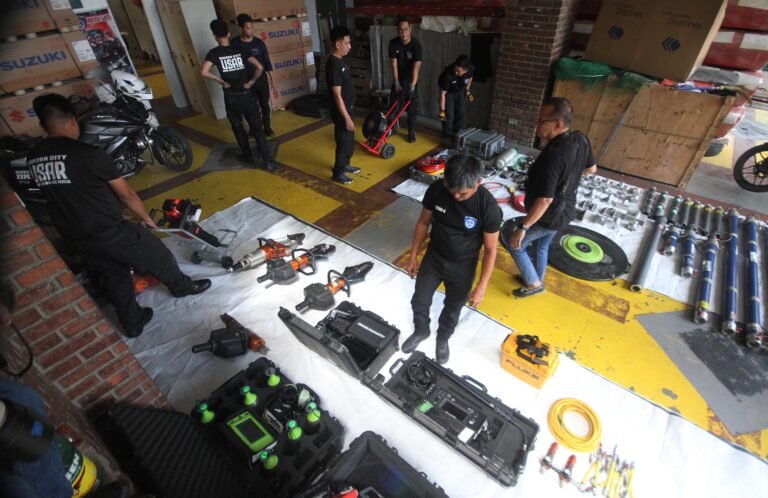
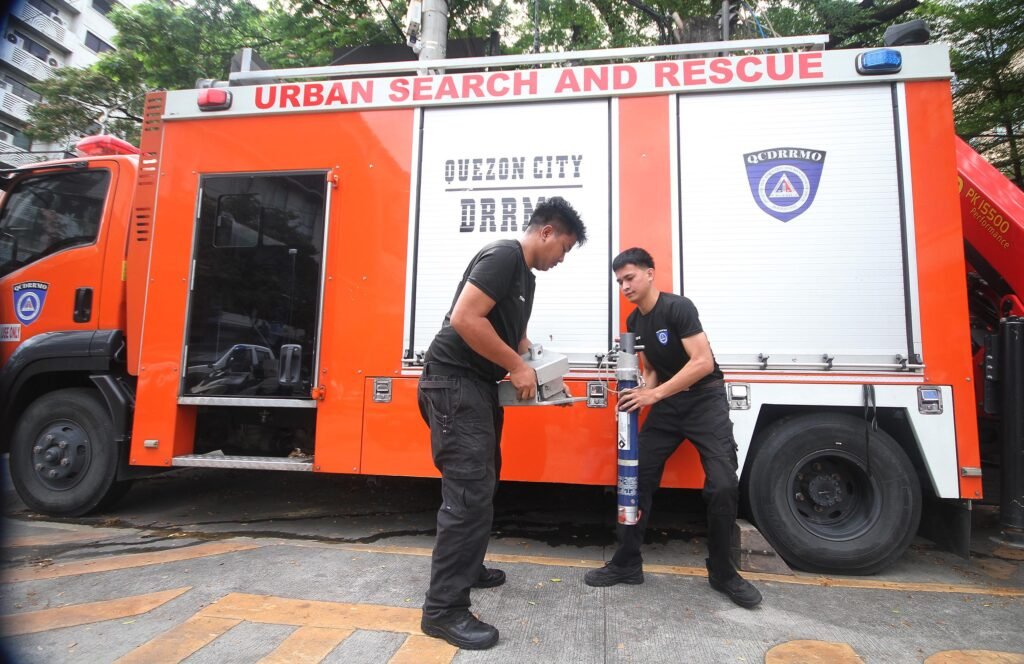
Members of Quezon City- Urban Search And Rescue (QC-USAR) are prepared for the eventual ‘The Big One’ as they show different search and rescue equipment for incident of structural collapse, including a Life Locator machine to search a human life that was covered by a collapsed building during an earthquake. This is part of their preparation for ‘The Big One’ that could possibly occur any time as the Philippines is prone to earthquakes. Recently, a destructive and powerful temblor hit neighboring Myanmar and Thailand. This exercise was held recently at their headquarter in Quezon City.