
Thursday, March 26, 2026
Home Blog Page 59

Why You Should Care About Heart Failure

Heart failure (HF) is a growing yet often overlooked health crisis in the Philippines. The Philippine Heart Association (PHA) urges Filipinos to take heart health seriously before it’s too late.

Heart Failure: A Silent Threat

Cardiovascular disease (CVD) remains the leading cause of death worldwide, and HF—a condition where the heart struggles to pump blood efficiently—is often a consequence of untreated CVD. In advanced cases, a heart transplant becomes the only viable option, but access to this life-saving procedure is severely limited in the country.

During PHA’s Usapang Puso sa Puso webinar on March 27, 2025, experts discussed the far-reaching impact of HF on patients, families, and the healthcare system.

Why You Should Be Concerned

Dr. Liberty Yaneza of the Philippine Heart Center (PHC) warns that individuals with hypertension, diabetes, or existing heart conditions face a high risk of developing HF. In its advanced stages, conventional treatments often fail, leaving patients with few options.

PHA director Dr. Avenilo “Jun” Aventura Jr. highlights the urgent need for government support in heart transplant programs, similar to the assistance provided for kidney transplants. Currently, PHC is the only hospital in the Philippines performing heart transplants, significantly limiting access to those in need.

Recognizing Heart Failure: The ‘Great Mimicker’

HF symptoms can be mistaken for other health issues, making early diagnosis crucial:

  • Shortness of breath, especially when lying down
  • Waking up gasping for air
  • Swelling in the feet, ankles, or neck veins
  • Fatigue and loss of appetite

Ignoring these symptoms can be dangerous. Early detection saves lives.

The Four Stages of Heart Failure

  • Stage A: Individuals at high risk (e.g., those with hypertension or diabetes) should focus on prevention.
  • Stage B: No symptoms yet, but heart damage may already exist.
  • Stage C: Symptoms begin affecting daily life.
  • Stage D: Advanced HF leads to frequent hospitalizations and severe limitations.

What You Can Do

  • Monitor your health by tracking blood pressure, cholesterol, sugar, and weight.
  • Take maintenance medications if diagnosed with hypertension, diabetes, or heart disease.
  • Adopt a heart-healthy diet by reducing salt, sugar, unhealthy fats, and cholesterol.
  • Stay active with doctor-approved exercises.
  • Quit smoking and excessive alcohol consumption.

The Need for Government Action

Dr. Yaneza stresses that PHC’s Heart Transplant Program requires full government backing, including financial support for lifelong post-transplant medication. Without it, many patients remain without options.

HF Clinics: Prevention Over Cure

The PHA’s National Heart Failure Network (NHFN), launched in 2021, connects 18 PHA chapters, 26 training institutions, and numerous healthcare professionals to enhance awareness and patient care. Expanding HF clinics nationwide can lead to early detection and improved management, reducing the number of severe cases.

Act Now

HF doesn’t happen overnight—it’s a gradual decline. Getting checked, staying informed, and prioritizing heart health can make all the difference. As Dr. Aventura puts it, “Let’s not wait until it’s too late.”

US and Europe gird for tariff war

It is final – the United States will impose “reciprocal tariffs” globally, with Europe among those most agitated by the move.

The White House said that the imposition of reciprocal tariffs on nations as a major milestone in US history.

“Tomorrow, April 2, 2025, will go down as one of the most important days in modern American history,” spokesperson Karoline Leavitt told reporters.

“Our country has been one of the most open economies in the world, and we have the consumer base, hands down the best consumer base, but too many foreign countries have their markets closed to our exports. This is fundamentally unfair,” she added.

The White House said that the import duties will be “effective immediately” after Trump’s announcement on Wednesday (Thursday in Manila).

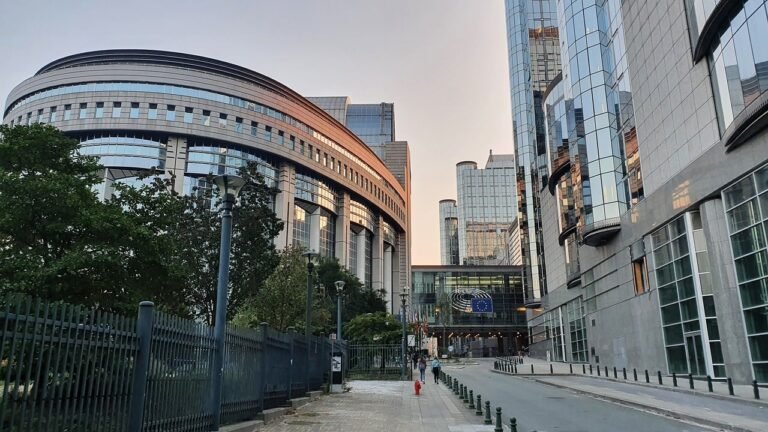
For her part, European Commission President Ursula von der Leyen on Tuesday issued a stern warning to the US over its escalating trade tariffs.

“We do not necessarily want to retaliate, but we have a strong plan to retaliate if necessary,” von der Leyen said at the European Parliament Plenary debate.

Von der Leyen stressed that across-the-board tariffs would only worsen the situation by driving up costs, fueling inflation, and creating bureaucratic burdens for businesses on both sides of the Atlantic.

Analysts are also not optimistic on the outcome of the move the US to impose tariffs, which are expected to hit cars, luxury goods, and food items, among many others.

“I can’t recall a situation where the stakes were this high and yet the outcome was so unpredictable,” said Steve Sosnick, chief strategist at Interactive Brokers as quoted by Reuters. “The devil is going to be in the details and nobody knows the details.”

“You cannot make important decisions on your supply chain when the rules of the game keep changing,” said Peter Sand, chief analyst at freight pricing platform Xeneta.

Pure Talk, Zero Walk

WHEN the Secretary Maria Antonia Yulo-Loyzaga was tapped to lead the Department of Environment and Natural Resources (DENR), Filipinos were under the impression that her stint would make a difference in view of wanton disregard of laws covering nature and ecology.

After all, her credentials seemed far more impressive than her predecessors.

In fairness, she did well during her early stint – hoisting red flags on a dubious contract entered into by the DENR with a construction company lording over a 2,700-hectare portion of the Upper Marikina River Basin Protected Landscape, and that of the commercialization of the Chocolate Hills in Bohol.

She likewise flagged down the massive reclamation in the guise of “land developments” at the Manila Bay, only to cave in to pressures coming from the same breed of oligarchs and patrons in the government.

Yulo-Loyzaga recommended a halt to reclamation on a handful of conglomerates – except for two projects in Pasay City – a decision which looks more like a selective policy.

RECLAMATION ACTIVITIES ON HOLD

Barely two years after recommending the suspension of “all reclamation activities” at the Manila Bay, Yulo-Loyzaga hinted at the completion of the cumulative impact assessment by the University of the Philippines Marine Science Institute and the Marine Environment and Resources Foundation (MERF), which cited adverse effects of reclaiming parts of the Manila Bay.

Yulo-Loyzaga said that without flood management plans, the government cannot move forward with land reclamation projects in Manila Bay, even as she now claims its continuity would adversely affect the environment in view of the absence of a viable flood management plan.

She likewise cited other concerns which include traffic, water and electricity supply, waste management, and the livelihood of fishermen in the area.

Spanning almost 2,000 square kilometers, the Manila Bay area covers Metro Manila and eight provinces. Four of these are located along the coast — Bataan, Bulacan, Cavite, and Pampanga. 

Laguna, Nueva Ecija, Rizal, and Tarlac are connected to the bay through the several river systems that drain into it, like the Pampanga River (from Nueva Ecija), Pasig River (from Rizal), and Zapote River (from Laguna). 

IRREVERSIBLE IMPACT

According to the study commissioned by the DENR in 2023 after President Ferdinand Marcos Jr. suspended reclamation projects, Manila Bay’s physical environment is crucial to the circulation and drainage of water in Metro Manila. 

Interestingly, Yulo-Loyzaga has yet submitted a recommendation asking the President to permanently stop the Pasay City reclamation projects which compromise food security, violate our constitutional rights to a healthy, balanced, safe and resilient environment and the rights of artisanal fisherfolks and coastal communities to access their fishing grounds and livelihoods. 

The government should immediately take measures to permanently stop these projects which have been inflicting irreversible impact to the environment. The DENR’s failure to undertake its mandate is simply unjust and unacceptable.

Aside from the Manila Bay, there are 52 other reclamation ongoing projects in the country, including the project in Coron that has been forfeited by the government. Of this number, 22 projects are located in Manila Bay, and half of these or 11 are already underway.  Outside of Manila Bay, the PRA lists a total of 30 projects – 14 were approved plus Coron; and 15 applications under Executive Order 74 with memoranda of understanding.

The projects were approved despite the fact that Manila Bay has been identified as a Key Biodiversity Area by the DENR and other groups. It is a rich sardine spawning ground as shown by the data from the Bureau of Fisheries and Aquatic Resources-National Fisheries Research and Development Institute (BFAR-NFRDI). It also serves as an important habitat for millions of migratory birds from the northern hemisphere.

Musical Chairs At The DA

THE PARLOR GAME of musical chairs is a favorite in the Department of Agriculture. If you don’t dance to the music of the lords, you are sacked with little, if any, chance to explain your side.

Knowledgeable sources told me that a newly-inducted head of a DA agency, who seems to be working on noble programs to uplift the sector he heads, is now in danger of losing his post and replaced by a totally unqualified person to lead the agency.

Several other bureau directors and regional heads are being replaced at whim if they do not toe the line or direction of the top official, whose agenda in the department is viewed as largely for personal gain.  

This top official was the one that threw huge stumbling blocks to a company which was seeking the renewal of its certificate of product registration (CPR). This company had been operating in the sector for decades.  It finally got its short-term  CPRs only last January. Much of the obstacles he laid for the company involved issues that had long been resolved by the court.

AN INFLUENTIAL EXEC

This official is so influential with his own boss that he could persuade him to not join the recent plant inauguration of the company– whose product can be a game changer for the entire agriculture sector through cheaper production input for rice farmers (thereby enabling them to save thousands of pesos by replacing a portion of their use of imported chemical fertilizer in their farms with homegrown and endemic nitrogen-fixing bacteria).

During the chaos caused by the outbreak of Q fever (in imported goats) two years ago, there were dismissals of those in the know and gag orders were issued to de-escalate the issue from becoming a full-blown expose.

It is unclear to many people  why his superior allows himself and his decisions to be influenced by this official.

Several other bureau directors and regional heads are being replaced at whim if they do not toe the line or direction of the top official, whose agenda in the department is viewed as largely for personal gain.

VOUCHER SYSTEM

It is said that recently, this untouchable and highly-influential official was behind the shelving (for good) of the well thought-out Masagana Rice Industry Development Program (MIRDP) particularly its approved voucher system for farm inputs– which could have lessened, if not removed, corruption in the implementation of rice programs by empowering the farmers themselves to decide which input to buy and from which merchant. 

Through the voucher system, the farmers would have used their intervention monitoring card (IMC), somewhat like an ATM where the name of merchant, the volume and price they paid for the inputs would be reflected.

Since the voucher system is too transparent, its life was cut to only one cropping season in 2024. After that, we all know what happened– productivity fell, ergo we had to import more because the old bidding system (which can be manipulated and doctored) was returned. So now, we have to keep on importing not just rice but all other food items.

BIOFERTILIZER BUDGET

This influential official was also behind the approval last year of 89 percent of RCEF biofertilizer budget to be allocated to imported biofertilizers when one, highly integrated plant can meet the requirements of at least the entire rice sector. Still the remaining budget, which he distributed to the regions, were advised to be given to small backyard operators whose products did not pass technical and field validations.

It is also talked about that this official memoed the regional executive directors of DA changing the specs of a biofertilizer to fit the specific brand made by one company. 

Incidentally , this company was the beneficiary of biddings where the product of the state university (UPLB-Biotech) was disqualified on account of non-renewal of its CPR (that he had a hand in blocking). 
His boss had skipped many previously confirmed appointments and meetings on his advise– perhaps because the parties to the meeting are not to his liking. (The last cancelled attendance of his boss was on March 16 regardless if the guest of honor then was the Speaker of the House and several lawmakers and functionaries of the executive branch showed up).

‘Crimes’ in the Name of Progress

0

Crimes Against Humanity, the ground for the arrest of Rodrigo Duterte by the International Criminal Court last March 11, are certainly not all the misdeeds that can be slapped on the former Philippine president. In other courts and in the arena of public opinion, the others can be far from insignificant. 

As environment is this column’s lens, Iet me point to some lead issues where he seriously harmed the country, its ecosystems and some communities.

WEST PHILIPPINE SEA

Philippine president (2010- 2016) Benigno Aquino III asserted the country’s territorial and maritime rights on the part of the immense China Sea which is its exclusive economic zone, first at the United Nations then at The Hague, Netherlands where it eventually won its case against China in the landmark arbitral ruling in 2011. It was a victory globally lauded but successor Duterte instead extended his friendly hand to Xi Jin Ping’s communist government who wouldn’t accept the verdict. That practically gave China a free pass to mock our sovereignty, bully our fishermen and coast guard. and shrink our food security with the bounties of fish and other marine resources in the zone. The suspicion that the former president must have “sold” that EEZ to the very interested party still floats.

BUILD, BUILD, BUILD

Bannered as the centerpiece program of the Duterte administration, the country saw the mushrooming of high-rise buildings and road infrastructures that gave a pretty picture of a country now finding a berth in the Asian region’s meteoric growth. The negative impact became clear later with the ballooned foreign debts for investment and preference for China suppliers which reeked of corruption, and the prioritization of large-scale projects to the detriment of local communities.  One glaring delusion is the massive reclamation in Manila Bay which decimated fishing communities in the area and reduced the metropolis’ buffer against natural calamities.

KALIWA DAM

Despite loud and long protests from the area’s indigenous people and non-government organizations, Duterte approved the construction of a large dam (area of Kaliwa) in the rich forest reserve of the Sierra Madres mountains spanning the provinces of Rizal to Quezon for the purpose of ensuring water security in the lowlands especially Metro Manila and its vicinities. The project, costing 12.2-Billion pesos was awarded to two companies owned by the Chinese government with construction starting in 2022 and for completion in 2028. More than the huge indebtedness, there is a more lasting and irreparable loss that the project will incur: the damage to the forest which is a natural protection against calamities, the decimation of its rich biodiversity important for food and water security and ecosystem balance, and the destruction of IP communities (lives, livelihoods, homes and culture). 

On the whole, the Duterte governance was marked by a low regard for life, which sadly, he may just see now as justice knocks at the door of his solitary detention cell at The Hague in the Netherlands.

Rodrigo Roa Duterte Under The ICC

YEHEY! THANK YOU, LORD! Such was the collective cry of the democratic organizations with the detention of former president Rodrigo Roa Duterte under the International Criminal Court (ICC) in the Hague, Netherlands last March 11, 2025. 

It was like the day of great elation and cheers when the dictator Ferdinand E. Marcos and his family escaped (more accurately, kidnapped being “the SONOBITCH” of then US President George Bush) from the justful wrath of the Filipino people, during the People Power Revolution on February 25, 1986.   

Quite understandable, given Rodrigo’s “Crimes against Humanity” as charged—with his evil scheme, dubbed “War on Drugs – Operation Tokhang, Double Barrel.” 

With his Police Chief Bato de la Rosa as his main enforcer, beginning in 2011 when he was Davao city mayor, Rodrigo Duterte heartlessly enforced his “kill kill kill” policy on suspected drug addicts, pushers and even petty criminals. 

And, installed as president in 2016, Duterte aggressively pursued the same bloody program, also along with his main aide, Bong Go, several PNP generals, and their amply-rewarded PNP/AFP ground troops.

For the EJK victims’ families, Rodrigo Duterte’s imprisonment by the ICC is just the first step in their long agonizing wait for justice.

MORE THAN 30,000

As of today, even under the current administration of President Bongbong Marcos and VP Sara Duterte, the same killing-spree program, with the active involvement of the NTF-ELCAC, continues with victims of extra judicial killings (EJKs) estimated overall now to number more than 30,000, which include more than a hundred children and youths.

Quite understandable too, that Rodrigo Roa Duterte’s rabid followers and supporters expressed their objections to his arrest by the ICC. Among them were the likes of senators Bato de la Rosa, Bong Go, and Robin Padilla, Rodrigo’s former SPOX Salvador Panelo, Rodrigo’s partner Honeylet, daughter Kitty, sons Polong and Baste, and former SPOX Harry Roque, who happened to have been served a warrant of arrest by the Congress’ Quad committee on Good Governance, but managed to escape to the Hague, Netherlands. 

Of course, daughter VP Sara Duterte followed his father to the Hague to give her personal support. 

PRAYER RALLY FOR A NON-BELIEVER?

Moreover, his fellow Davaoeño supporters immediately organized mobilizations, calling them “prayer rallies,” as if they did not agree to their idol’s notorious proclamation to the Filipino people that “God is stupid!” 

These protest actions of the diehard Duterte followers calling for “bring PRRD back home,” claiming he was “kidnapped” by the ICC can only be understood as pathetic. They were claiming that he was denied his legal rights as a Filipino to be afforded healthcare, given her old age, and not given an opportunity to have a lawyer as he was being hauled off to a waiting PNP van.  

Couldn’t these supporters, especially the likes of Rodrigo Duterte’s former spokesperson, lawyer Salvador Panelo and his self-proclaimed lawyer Silvestre Bello, and faithful assistant Bong Go, simply recall that the more than 30,000 EJK victims were denied due process, and in fact heartlessly dealt the death sentence with gunfire or knives, despite pleas of mercy from their loved ones? 

Do these Duterte supporters have any conscience, or they simply firmly believe and faithfully practice “Dudirty’s” culture of “kill. Kill, kill” because “God is stupid!”? 

JUSTICE IS DUE

For the EJK victims’ families, Rodrigo Duterte’s imprisonment by the ICC is just the first step in their long agonizing wait for justice. 

This painful waiting for justice has been shared by millions of Filipinos of goodwill. 

This, given that the country is currently badly governed by the 70s/80s dictator Ferdinand E. Marcos’ son, Bongbong, and the EJKs architect and promoter, Rodrigo Roa Duterte’s daughter, Sara. “PANAGUTIN si DUTERTE” may soon ring true!

Asia-Pacific now world’s fast-growing messaging region

Asia-Pacific (APAC) is the world’s fastest-growing messaging region, recording a 51-percent surge in conversational messaging in 2024, with the Philippines as one of the major drivers.

This is based on the latest Messaging Trends Report from global cloud communications platform, Infobip,

Ivan Ostojic, Chief Business Officer, Infobip said: “The surge in business interactions across APAC reflects a broader shift toward richer, more localized, and conversational messaging experiences. Customers in the region engage best with culturally relevant and language-specific content, driving higher engagement and conversions,” said Ivan Ostojic, Chief Business Officer, Infobip.

The report is based on an analysis of over 530 billion interactions between businesses and consumers on Infobip’s platform. According to the research, APAC is spearheading global messaging growth, driven by dynamic markets like Indonesia (59 percent), the Philippines (33 percent), and China (29 percent).

Infobip Artificial Intelligence (AI) Hub data highlights the surge in AI adoption, giving conversational messaging apps a major makeover and enabling richer and more meaningful connections. For instance, WhatsApp usage doubled with 100-percent growth, driven by seamless in-chat purchasing features. Indonesia led the rise at 110 percent, followed by India (27 percent), Singapore (20 percent), and Malaysia (17 percent).

RCS interactions surged 102 percent across the region with India (850 percent) leading the growth chart. Viber also gained 41-percent more traction in the region, with the Philippines seeing a significant rise in messaging interactions.

Additionally, our research shows that customers in the APAC region prefer messaging channels that are culturally and locally relevant. Notably, KakaoTalk—widely used in South Korea—accounts for 87 percent of customers interactions from Korean brands, with some engagement also seen in from brands in Singapore. In Vietnam, 63 percent of brand conversations happen on Zalo, a popular local platform.

Meanwhile, LINE dominates in Thailand, Taiwan region, and Singapore, contributing to 98 percent of messaging interactions. As a result, brands are increasingly turning to these local platforms to build stronger, more familiar connections with their end users.

Globally, Infobip recorded a 30-percent increase in the number of brands orchestrating conversational marketing interactions with their customers on its platform. 

The report also reveals the rapid adoption of conversational messaging across key industries in the region. The Retail and eCommerce sector saw a 169% surge in interactions, with South Korea leading at 371 percent, followed by Singapore (133 percent) and the Philippines (16 percent). Telecom also saw explosive expansion, with China’s interactions skyrocketing by 4,200 percent and Indonesia recorded 121-percent growth.

“Brands have successfully leveraged this approach through personalized RCS, WhatsApp, and Viber campaigns or localized promotions for relevant festivities in the region such as Singles Day, to build stronger customer relationships. As conversational marketing evolves, understanding its suitability is key for businesses to enhance connections with their audiences and ensure seamless, secure, and real-time interactions,” Ostojic said.

ICC’s Challenging Global Triumphs

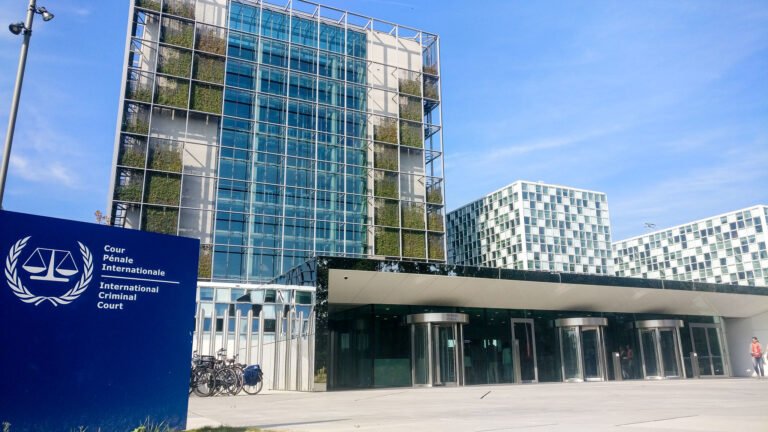
WITH THE SUCCESSFUL arrest of former President Rodrigo R. Duterte in Manila last March 11, 2025, it has recorded and embedded a tangible benchmark within the  portals and chronological history of the Hague’s highest tribunal of the land –The International Criminal Court (ICC). 

The ICC’s successful execution of the arrest, under rule of law, can be  considered an added outstanding global achievements in the face of the Court’s many challenges since the highest tribunal was established in 2002.

In the wake of the arrest and detention in the Hague prison camp, Duterte has become the first Asian former head of state to be taken into custody by the ICC over charges of crimes against humanity for killings linked to his “war on drugs”.

​MONUMENTAL STEP TO JUSTICE

“Rodrigo Duterte’s arrest is a long-awaited and monumental step for justice for the thousands of victims and survivors of his administration’s ‘war on drugs’, which turned much of the Philippines into a nation of mourning. 

“The man who said, ‘my job is to kill’ oversaw the shootings to death of victims – including children – as part of a deliberate, widespread and well-organized campaign of state-sanctioned killings,” Agnes Callamard, Secretary General of Amnesty International, said in a statement.

RESTITUTION AND REPARATIONS

In the light of hope, the family’s cry for true justice will soon be justified and restituted. 

The endless pain of the loss of love ones, who were killed without the due process of law, will hopefully be vindicated with the full weight of the law for all perpetrators who committed human rights violations and crimes against humanity. 

Families of victims and the thousands forcibly taken and executed under Duterte’s drug war seek full reparations and urgent appropriate compensations when the final judgment is handed-down.

All suspected masterminds and perpetrators of the worst crimes, including government leaders, police officials can and will face the full weight of the ICC judgment, wherever they are in the world. 

During the commission of the crimes and in time when too many governments renege on their ICC responsibilities, Duterte’s successful and peaceful arrest is credited to the power of international law and smooth coordination and cooperation of Philippine government authorities.

PH WITHDRAWAL 

Currently, the Philippines is not a member of the ICC. Duterte announced this on March 13, 2018. The country was still an active member of the Rome Statute between 2011 and 2019.

Under the court’s founding 1998 Rome Statute, even if a state withdraws as a member it retains jurisdiction over crimes committed during the membership period.

Duterte’s withdrawal in 2018 was after ICC announced it investigate allegations of systematic murders of drug dealers on his watch, while the country was still an ICC member.

STATUS OF ICC CASES 

To date, ICC have thus far been 32 cases before the Court, with some cases having more than one suspect. ICC judges have issued 60 arrest warrants.

With the cooperation from countries, 21 people have been detained in The Hague detention and have appeared before the Court; 31 remain at large.

Charges have been dropped against seven people, most of who died before the hearings. ICC judges have issued nine summonses to appear, while there had been 11 convictions and 4 acquittals.

The Court has issued its first verdicts and thousands of victims are receiving reparations.

The following ICC’s successful global arrests and cases documented and recorded: 

RODRIGO DUTERTE: Arrested on March 11, 2025, in connection “crimes against humanity, in relation with his drug war in the Philippines; 

LAURENT GBAGBO & CHARLES BLE GOUDE: While initially charged with crimes against humanity, the Trial Chamber I acquitted them all charges in 2019, and the Appeals Chamber confirmed the acquittal in 2021;

THOMAS LUBANGA DYILO: From Democratic Republic of Congo, was convicted of conscripting children under the age of 15 and using them in hostilities. He was sentenced to 14 years in prison.

BOSCO NTAGANDA: From Democratic Republic of Congo, found guilty of 18 counts of war crimes and crimes against humanity. He was sentenced to 30 years in prison;

DOMINIC ONGWEN (UGANDA): Found guilty of 61 crimes including war crimes and crimes against humanity. He was sentenced to 25 years in prison, and 

AHMAD AL FAQI AL MADHI (MALIAN): Found guilty of destroying historical and religious monuments in Tikbuktu.

The most notable suspects still to be arrested and heard are: Israeli Prime Minister Benjamin Netanyahu, accused of being criminally responsible for acts including murder, persecution and using starvation as a weapon of war in the Gaza conflict and Russian President Vladimir Putin, accused of the war crime of illegally deporting hundreds of children from Ukraine. Both Israel and Russia have repeatedly denied that their forces have committed atrocities in Gaza and Ukraine respectively and have argued the ICC has no jurisdiction over them.

To date, ICC is conducting an intensive and continuous investigations from the Palestinian territories to Ukraine and African states such as Uganda, Democratic Republic of Congo and Kenya, to Venezuela in Latin America and Myanmar and the Philippines in Asia. It says there have been 32 cases before the court, with some having more than one suspect. ICC judges have issued at least 60 arrest warrants.

GLOBAL ACHIEVEMENTS 

Among the many global challenges and achievements of the Court to date include the unique mechanisms for providing support to victims and witnesses, the establishment of its vital infrastructure in situation countries and the growing outreach program.

ICC has made significant progress holding high-level suspected perpetrators of atrocities to account.  

One of the main achievements and pillars of the Rome Statute is the independence of the ICC, carrying with it safeguards against politically motivated investigations and prosecutions.

Firing Spree Ain’t Over Yet

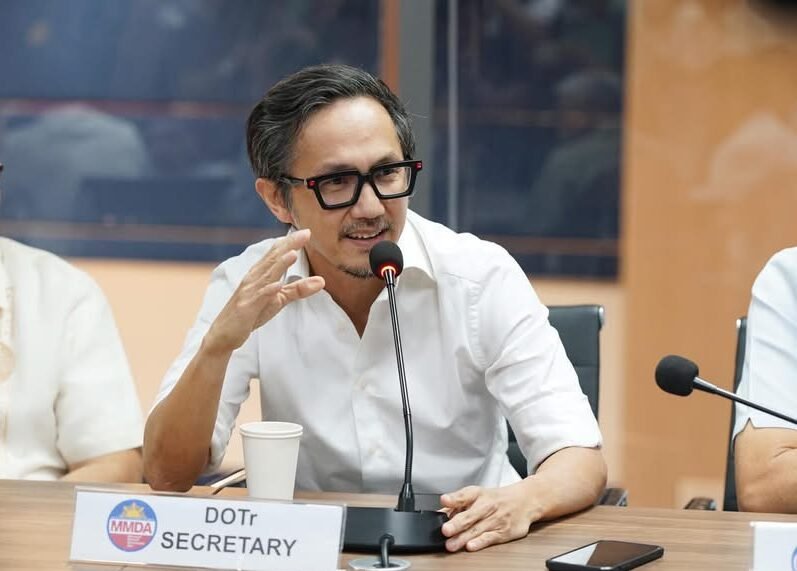
IN WHAT SEEMED more like a continuing saga of a customary purge every time a new boss comes in, no less than Transportation Secretary Vince Dizon announced last month the “departure” of another official under his agency.

DOTr Secretary Vince Dizon

Barely a month  after being appointed as Secretary for the Department of Transportation (DOTr), Dizon replaced almost the entire DOTr structure — from the undersecretaries down to the general managers of agencies under his radar.

The most recent “casualty” — Metro Rail Transit-3 (MRT3) general manager Oscar Bongon. As of this writing, the reason for Bongon’s removal from office has yet to be announced.

Interestingly, a list of names for his possible replacement has already been submitted to the Office of the President in Malacañang even before the Dizon made the announcement on the removal of Bogon.

ESCALATOR INCIDENT

According to DOTr insiders, Bongon’s “departure” from the agency has been decided upon by Dizon even before the escalator incident at the Taft Avenue Station which left at least 10 passengers injured.

The incident was caught on cam by a netizen who posted the video on social media.

The escalator —in ascending direction— was reportedly packed with passengers when it malfunctioned, causing some people to fall on top of each other while a female passenger also hurt her ankle. 

In a statement, the DOTr explained that the primary chain of the escalator broke off, hence causing the accident.

Soon after being sworn in… Dizon sought the courtesy resignation of all officials… His new team is composed of some familiar faces.

TOPSY TURVY TRAINS 

The same insider hinted at the failure of the MRT-3 management to ensure functionality of the mass transportation system complementing the huge passenger volume along EDSA. 

Barely a week after assuming the top DOTr post, Dizon reportedly fumed after an MRT-3 northbound train stopped even before it could reach the Santolan-Annapolis Station. Passengers reportedly smelled smoke before the train abruptly stopped. They also claimed to have heard twice what sounded like blasts.

Previously, passengers nearly lost their balance after another MRT-3 train stalled near the Shaw Boulevard Station.

Stalled trains, though not new as MRT, are notoriously famous for its topsy turvy rail system — non-operational elevators, steep stairs, malfunctioning air conditioning units, to name a few.

FAMILIAR FACES BACK

Soon after being sworn in as DOTr chief, Dizon sought the courtesy resignation of all officials in what he claimed as a common practice in view of leadership changes. 

In a Facebook post on February 27, Dizon personally administered the oath-taking of his new team to ensure delivery of results amid a limited timetable reportedly set by his appointing authority — President Ferdinand Marcos Jr.

His new team is composed of the some familiar faces, like: 

  • Giovanni Lopez, undersecretary for Administration, Finance and Procurement who replaced Jesus Nathaniel Martin Gonzales, previously served as undersecretary and assistant secretary, and was also former transport secretary Arthur Tugade’s chief of staff;
  • Mark Steven Pasto, undersecretary for road transport and infrastructure who served as Tugade’s assistant secretary replaced Jesus Ferdinand Ortega;
  • Jim Sydiongco, undersecretary for aviation and airports, who served as director general of the Civil Aviation Authority of the Philippines (CAAP) during Tugade’s term as DOTr chief, took over Roberto Lim’s post;
  • Ramon Reyes, undersecretary for road transport and non-infrastructure, used to work for the Stradcom Corporation which secured a contract to manage the Land Transportation Office (LTO) portal, and 
  • Teodorico Jose Delfin, undersecretary for Planning and Project Development who was the senior vice president at Lopez-led First Gen Corporation, effectively eased out Timothy John Batan as railways chief.

MORE FAMILIAR FACES

Raul del Rosario, acting director general and acting member of the board of directors of CAAP Del Rosario takes the post of Antonio Tamayo. Del Rosario was appointed by former president Rodrigo Duterte as the administrator for the Office of Transportation Security in 2019.

Del Rosario served as the chief of the Western Command and the Central Command. He is credited as the Air Force pilot who discovered China’s occupation of Mischief Reef in 1994.

Meanwhile, Villamor Ventura Plan, now assistant secretary for maritime, was listed as former deputy administrators of the now defunct Philippine Overseas Employment Administration.

A Not-So-Friendly Ally

FOR more than a century, the Philippines and the United States have been strong allies – come hell or high water. However, US President Donald Trump’s recent pronouncement doesn’t seem reflective of how allies are supposed to treat each other.

Trump, who is in his second term as President of the United States, is known for his hard stance against Asians. In fact, his foreign policy speaks well on what looks more like hatred in the guise of “security concerns.”

On Trump’s list are nationals from 10 Asian countries – China, Iran, Syria, Afghanistan, Pakistan, North Korea, Myanmar, Bangladesh, Indonesia, and the Philippines.

While Trump may have been right on being cautious on countries like China, North Korea, Iran, Afghanistan, Pakistan, and Syria which are deemed in many parts of the world as national security concerns, it is rather absurd for the US to forsake a long-time ally.

From how it looks, Trump doesn’t like countries that do not conform to his foreign policy, for which punitive measures like visa restriction, cancellation and deportation were put in place despite pleas from the international community and offers of asylum by Western countries.

No less than US Secretary of State Marco Rubio said in a statement that visa restrictions would be imposed immediately. The US government likewise issued a security alert to its citizens, which to many, may trigger racist attacks on US-based Asians.

Sanctions, deportations and the sweeping travel restrictions for citizens from 10 Asian countries (including the Philippines), is part of what looks more like a New Order imposed by a not-so-new President.

Since Trump commenced the “purge,” 24 Filipinos have already been deported to the Philippines — and more are expected to be forcibly flown back soon.

As per estimate by the Philippine Embassy in the United States, some 350,000 Filipinos could be deported amid Trump’s harsh foreign policy, concealed as a “crackdown on illegal aliens.”

Most of them, according to Philippine Ambassador to the US Jose Manuel Romualdez, have been there “for many, many years and already have families, jobs, and everything.”

Unplugged Awakening

0

Imagine being thrust into a five-day retreat where every gadget is confiscated at the door. No phone, no laptop, no digital tether to the outside world. For the participants of the Inner Conditioning Workshop facilitated by SEA Inc., this wasn’t just a program—it was a psychological battlefield.

Day one was a meltdown. The group—a mix of business executives, LGU employees, youth participants, solo parents, professors, and social workers—reacted as if they had been asked to amputate a limb. Hands twitched for absent phones, eyes darted to facilitators for mercy, and some even contemplated a dramatic escape.

“I can’t leave my phone—I need to update my child who’s left behind!” one participant exclaimed, panic-stricken.

Another worried aloud, “I need to do online banking! What will happen to my business? My daughter needs money for tuition—how can she take her exam if I can’t send it until the fifth day?”

“My husband will leave me if I don’t update him!” someone declared in exasperation.

“My boyfriend and I will be separated without saying ‘I love you’ every day!” a young woman lamented.

“I can’t play Scatter anymore. I’ll go home if you confiscate my phone!” another insisted, nearly in protest.

One participant’s voice rose above the growing unrest: “I need my phone. I can’t live normally without it.”

But despite the resistance, no one left.

As the hours crawled by, something unexpected happened. Strangers, once glued to screens, started talking. Business professionals engaged in discussions beyond profit margins. LGU workers exchanged ideas on governance without bureaucratic barriers. Solo parents found solace in shared struggles. Despite initial protests, youth participants discovered life beyond the dopamine rush of likes and shares.

“It’s nice not having a cellphone—we can actually talk to each other,” one participant noted, surprised at the depth of face-to-face conversations.

A solo parent reflected, “I was really able to rest from my worries. Turns out, my kids became independent.”

Teachers in the group had their revelation: “Oh, the school understood, and our schedule was cleared.”

The business sector participants found relief: “Our partners can also fill in responsibilities. We don’t need to micromanage everything.”

By day three, the transformation was undeniable. The panic of disconnection gave way to the joy of presence. Minds, once cluttered with digital noise, found space to breathe. Conversations deepened, laughter became more genuine, and silence was no longer terrifying—it was welcome.

When the final day arrived and devices were returned, hesitation filled the room. The urge to switch them on was there, but so was a newfound clarity. Emails could wait. Social media updates felt trivial. The world hadn’t crumbled in their absence—if anything, it had expanded.

The Inner Conditioning Workshop wasn’t about deprivation. It was about rediscovery. Time is a currency, silence is golden, and real connections will always outrank virtual ones. And as they walked away, many realized they weren’t in such a hurry to plug back in.

This transformative workshop serves as the operating system of the IPAT-SIAD program of SEA Inc., which advocates threefolding principles to foster holistic development. The Center for Bayanihan Economics in Angat, Bulacan, provides a space where these principles come to life, helping individuals reconnect with themselves and their communities. For more details, visit www.solutionecosystems.net.

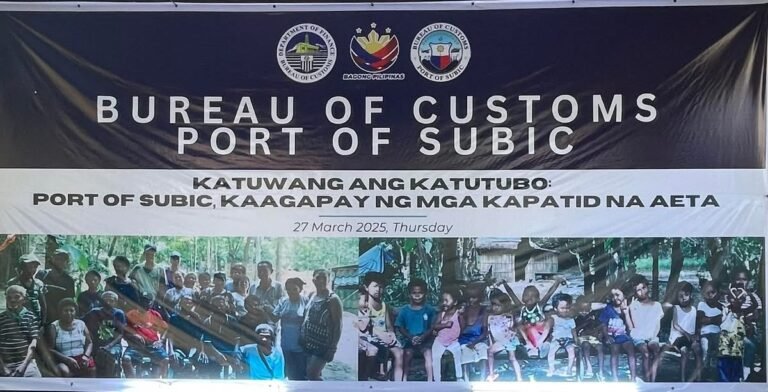
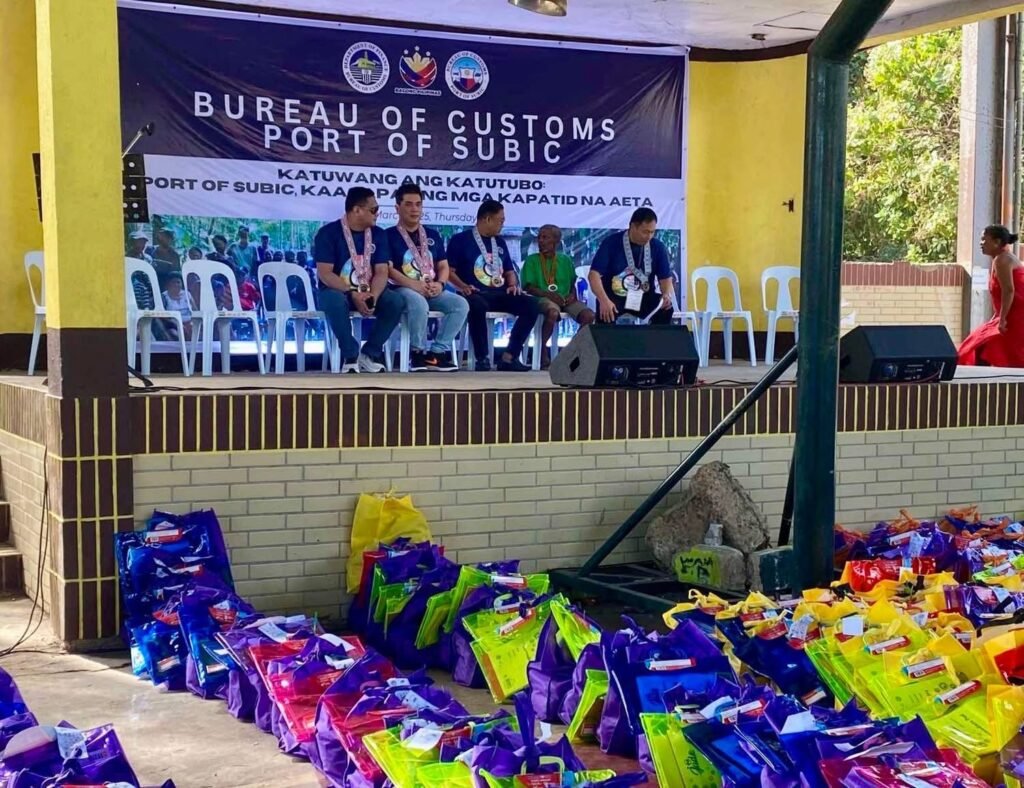
BOC Port of Subic CSR: Empowering Communities, Building Life Winners

Beyond borders, beyond duties—at BOC Port of Subic, we believe in paying it forward. Together with the Aeta Pastolan community, we are not just sharing resources; we are molding character, nurturing dreams, and building life winners.

Every effort, every act of kindness, and every lesson shared is a step toward empowerment. By strengthening relationships, supporting communities, and providing sustainable opportunities, we are shaping a future where resilience triumphs over adversity. True service is not just about trade—it’s about transformation, inclusion, and leaving no one behind.

As we walk alongside the Aeta Pastolan community, we embrace the power of unity, respect, and genuine care. We are not just fostering growth; we are strengthening identities, preserving traditions, and creating pathways for a brighter tomorrow. Together, we build livelihoods and legacies that will inspire future generations.

This meaningful endeavor is made possible through the unwavering support of the Subic Bay Metropolitan Authority (SBMA), Customs Industry Partners, PH Insider, ACEDS, and partner agencies who stand with us in our mission. Their collaboration and commitment bring to fruition initiatives that uplift lives and empower communities, proving that when we work together, we create a lasting impact.

Global oil giants suffer drop in income

Global oil giants, bugged by supply and price issues, suffered a drop in profits in 2024 compared to the previous year.

This, as the combined profits of eight of the world’s largest oil companies went down by 16 percent to $217.65 billion lat year compared to figures in 2023.

And the outlook for the global oil giants is not that bright this year.

Among the losers were US-based ExxonMobil and Chevron, the UK’s bp, France’s TotalEnergies, Italy’s Eni, Norway’s Equinor, Dutch-based Shell, and Saudi Aramco, the state-owned oil giant of Saudi Arabia.

Saudi Aramco posted a 12.4-percent drop in annual earnings to $106.20 billion, ExxonMobil recorded a 6.5-percent decrease to $33.68 billion; Shell’s profits slid by 16 percent to $23.72 billion; and Chevron’s decreased 17.4 percent to $17.66 billion

TotalEnergies logged a bigger decline of 26.3 percent to $15.76 billion in profit; bp showed sharp decrease of 35.6 percent to $8.91 billion; Equinor’s profit fell 25.8 percent to $8.83 billion; and Eni reported the most significant decline with 44.5 percent to $2.89 billion.

Jorge Leon, senior vice president at Norway-based consultancy Rystad Energy, said that oil prices declined in 2024 compared to 2023, specifically in the second half of the year, compounded by weaker margins in refining.

“In 2023, Brent crude averaged $83 per barrel, while in 2024 it fell below $80 per barrel, directly impacting revenues,” he said as quoted by Anadolu.

“For 2025, we expect oil prices to average below 2024 levels—around $75 per barrel—so I would not be surprised if oil giants’ revenues this year are even lower than last year,” he added.

For his part, Homayoun Falakshahi, a senior oil analyst at Kpler, said recent price weakness can be attributed to high production levels and demand that was tepid.

However, Falakshahi said supply management efforts by the OPEC+ supply management effective in stabilizing oil prices.

Geopolitical risks, particularly US sanctions on Iran, also caused pressure on oil prices, according to Falakshahi.

Furthermore, seasonal demand increases over the summer could push oil prices back toward $75 per barrel in the next two to three months, Falakshahi said, but prices are expected to decrese later in the year or to slightly below $70 per barrel.

Why Harry Roque isn’t part of Duterte’s defense team

0

MONTHS before the actual hearing on former President Rodrigo Duterte’s cases at The Hague, Harry Roque was barred from joining the legal defense team in what looks more like an effort to come up with a clean slate deemed as free from “an extra baggage.” 

Roque served as the former president’s mouthpiece, and later on assumed the role of an attack dog targeting the Marcos administration.

Interestingly, the former Palace spokesperson is an international lawyer whose name forms part of the ICC-accredited attorneys. 

However, he, himself is facing legal squabbles — including human trafficking cases filed by the Department of Justice (DOJ) and a warrant of arrest issued by the House of Representatives which earlier cited him in contempt over links to scam-breeding offshore gaming corporations.

Roque has since been hopping from one country to another in an apparent effort to evade arrest.

ULTERIOR MOTIVE

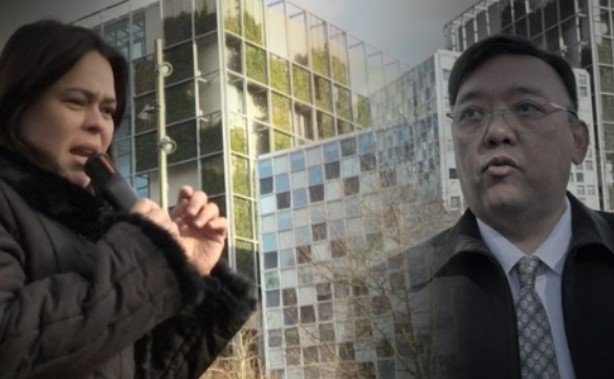
Soon after the former President was arrested in Manila on March 11 – and flown to The Hague shortly before midnight of the same day, Vice President Sara Duterte went to the Netherlands to assist her father.

A lawyer by profession, the younger Duterte wasted no time, buckled down to work and started forming a legal team to defend the former President in court.

It was then that Roque showed up and presented himself as part of the legal defense team. He also announced plans of filing an application for asylum to legitimize his stay in the Netherlands.

The idea however didn’t sit well for Vice President Sara, who like many other pundits, sees Roque’s maneuver as more sinister than sincere. 

For one, Roque himself doesn’t seem bent on returning to the Philippines in view of an imminent arrest over criminal charges and a congressional warrant for his detention.

SARA THE BOSS

In a televised interview at The Hague, Netherlands, VP Sara warded off Roque’s bid to defend the older Duterte. The reason — she doesn’t like the idea of taking in “an extra baggage.”

“Hindi siya kasama sa legal team. This is because the basis of his stay here in the Netherlands has not yet been established and we don’t want complications,” averred Sara, in reference to the congressional arrest order and criminal case against Roque.

Far from the confrontational Sara that she is, the Vice President conveyed her message in a manner politicians do, sharp but subtle. “We want him to focus on his asylum and we want our lawyers to focus on the case,” a visibly pissed off Sara was quoted as saying.

Roque however assured that the Philippine government cannot serve a warrant or file extradition against him. “Because I already filed an application, I cannot be forced to return to the country where I came from because of political persecution and that is the Philippines.” 

PERSISTENT HARRY 

Despite Sara’s pronouncement, Roque said he still wants to be part of the legal team even as he cited court rules requiring a Filipino lawyer for a case involving a former Philippine President. 

“The issue is whether the arrest of [former President] Duterte was legal. There is a need for a Filipino lawyer there,” Roque said on his Facebook page.

By his own admission though, he knew for himself that the final decision rests with Vice President Sara. “Even if president Duterte chooses me but VP Sara does not want me, Ma’am, that’s your call. I will not force myself. It is important that aside from the endorsement of PRRD, the endorsement of VP Sara is important. I will obey her without pretensions.”

Earlier, Atty. Salvador Medialdea, Duterte’s former Executive Secretary, begged off because of health concerns. Medialdea stood as Duterte’s lawyer during the ICC’s pre-trial. 

ASYLUM SEEKERS 

While seeking asylum is nothing new, the last three years saw quite a number of Duterte stalwarts resorting to such to evade arrest and prosecution in court.

Among the prominent personalities closely identified with the former President who sought asylum shortly after sneaking out of the country includes dismissed Negros Oriental Rep. Arnolfo Teves Jr., who is facing a long list of criminal cases, including the murder of then Gov. Roel Degamo.

Teves applied for an asylum in Timor Leste

Another name on the list of Duterte allies who sought asylum is the former president’s rumored girlfriend Royina Garma whom he appointed as general manager of the Philippine Charity Sweepstakes Office (PCSO) during his incumbency. 

Garma applied for an asylum in the US.

Before he was arrested, the former president himself had also reportedly applied but failed to secure an asylum in Hong Kong. 

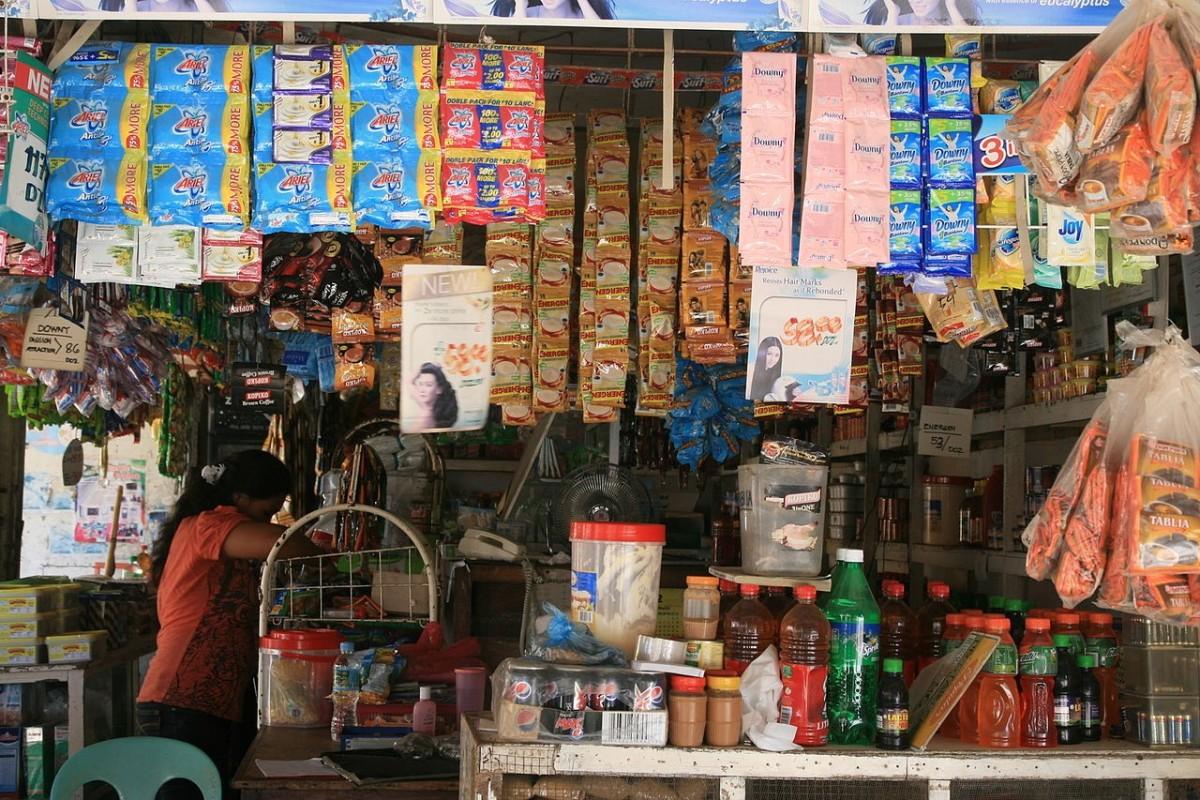
Transforming Value of Sari-Sari Stores On Filipino Women

‘This business provides them a sense of independence, confidence, and fulfillment … managing and operating sari-sari stores gives them a deeper sense of purpose and meaning in their lives.’

SARI-SARI STORES HAVE a way of transforming women into more fulfilled mothers, housewives or individuals, and making gain a higher level of respect in their communities.

This was reflected in a study published by the Philippine Institute for Development Studies (PIDS), in collaboration with tech start-up Packworks titled “Gender, Microentrepreneurship, Human Flourishing: Exploring the Experiences of Women Sari-sari Store Owners toward Inclusive Growth.”

Reinforcing PIDS’ previous findings, this revealed that 75 percent of sari-sari stores are owned by women. 

Through our business intelligence tool Sari IQ, we are able to highlight that Filipinas hold significant control over the local economy through these micro-retail enterprises,” said Packworks Lead Data Scientist Joanne Diaz.

DEEPER SENSE OF PURPOSE

Women owners of sari-sari stores, the study showed, take pride in being considered “entrepreneurs” and “business owners.” This business provides them a sense of independence, confidence, and fulfillment from managing their micro-retail businesses. Survey participants also expressed that managing and operating sari-sari stores gives them a deeper sense of purpose and meaning in their lives.

“I can buy things for myself, my kid, and my family now… I am not just a housewife anymore,” one participant in the study said. “Because of my store, I am now busy with other things apart from taking care of my family. I feel more fulfilled.”

The study also showed that women sari-sari store owners achieve social empowerment by earning higher social status. This is notably observed in their customers addressing them with terms of respect like “ma’am” or “boss,” a cultural marker of their elevated position within the community.

PSYCHOLOGICAL EMPOWERMENT

Women store owners who exhibited characteristics of a “transformational leader,” possessing qualities such as strong empathy, care, and collaboration with the community reported high levels of well-being, empowerment, optimism, and resilience. 

The psychological empowerment and individual well-being the women owners experienced were evidenced by their positive results on happiness and life satisfaction, mental and physical health, meaning and purpose, character and virtue, and sense of agency and autonomy.

This research underscores the resilience and transformative power of women sari-preneurs in the Philippines. They are the heart of their communities, and by supporting them, we are strengthening the social fabric of the nation

said Packworks CEO Bing Tan. 

“At Packworks, we are driven by our mission to provide advanced business tools and services that allow thesewomen to not only succeed in business but also to become leaders and change-makers within their communities,” he added.

The study surveyed hundreds of female sari-sari store owners in Metro Manila, Central Luzon, and Region IV-A (Calabarzon) between May and June 2024. The majority of those surveyed (90 percent) are married with dependents, while smaller percentage are single (7 percent), and the remaining as separated or widowed (3 percent). Additionally, 78 percent of the respondents contribute to their household income, 16 percent serve as breadwinners, and 6 percent are single mothers.

Vloggers vs. Bloggers: The Battle of Hype, Reach, and Relevance

0

Ah, the eternal debate—vloggers vs. bloggers. It’s like comparing a flashy TikTok trend to a well-aged book. One explodes in popularity overnight, while the other quietly sits on the shelf, waiting for a more intellectual audience to appreciate it. But let’s dive into the nitty-gritty of this battle of digital supremacy, shall we?

The Lifespan of Their Hype

Vloggers are like a viral dance challenge—intense, explosive, and forgotten as soon as the next trend rolls in. They thrive on engagement, quick hits, and the dopamine rush of likes, shares, and comments. Their relevance is like a candle in the wind—bright but fleeting. A vlogger who was the talk of the town yesterday can be completely irrelevant tomorrow because, let’s face it, the internet has the attention span of a goldfish.

Bloggers, on the other hand, are the unsung heroes of digital permanence. Their work lives on through SEO, Google rankings, and the desperate 2 AM searches of college students looking for credible sources (spoiler alert: a well-written blog is practically an academic paper compared to a 15-second TikTok rant). While vloggers fade when the algorithm stops favoring them, bloggers continue to thrive because search engines don’t forget.

Content Quality: Quantity vs. Depth

Vloggers are in the business of rapid content production. They shoot, edit, post, repeat. And while some produce high-quality, informative content, the majority rely on jump cuts, clickbait titles, and exaggerated thumbnails with “OMG YOU WON’T BELIEVE THIS!” plastered across their faces. Their goal? Keep you watching, keep you scrolling, keep you addicted.

Bloggers, however, are the artisans of digital content. A proper blogger crafts words with precision writes about issues with depth, and—wait for it—fact-checks. Shocking, right? While vloggers aim for virality, bloggers aim for credibility. And if a blogger has their own website (not a freebie like Blogspot or WordPress.com), then you know they’re serious. A self-hosted blog is like having real estate in the digital world, whereas vlogging is renting a stall in a pop-up market that could disappear overnight.

Reach and Influence

Vloggers undeniably have massive reach. With platforms like YouTube, TikTok, and Instagram, their content spreads like wildfire. A single viral video can skyrocket them to fame, landing them sponsorships, collaborations, and a loyal fanbase of people who enjoy watching them eat noodles in their car or try weird makeup hacks.

Bloggers, on the other hand, attract a different crowd—one that values information, storytelling, and well-structured arguments. While they might not amass millions of subscribers overnight, their influence is stronger in the long run. They become thought leaders, respected voices in their niches, and sources of well-researched content that stands the test of time.

The Validity Factor

Let’s be honest: a vlogger’s main source of credibility is their ability to appear relatable and entertaining. Most of their content is opinion-based, and fact-checking is, at best, optional. Bloggers, however, build authority through research, citations, and well-articulated arguments. If you’re looking for advice on, say, financial investments, who would you trust more? A vlogger who just read a Twitter thread about stocks or a seasoned blogger who has analyzed market trends for years?

So, Who Wins?

If you love quick entertainment, trend-hopping, and content that requires zero critical thinking, vloggers are your champions. They’re fun, engaging, and easy to consume. But if you prefer substance, depth, and credibility, bloggers are the clear winners.

Vloggers may have the hype, but bloggers have the longevity. And while a viral video might get a million views in an hour, a well-written blog post will still be bringing in readers years later. In the end, it’s a matter of preference—would you rather be a digital shooting star or a well-rooted oak tree?

Choose wisely.

Cold Plunging: The Ice-Cold Trend Celebrities Swear By—But Is It for You?

Cold plunging, also known as ice bathing or cold water immersion, has taken the wellness world by storm. From morning wake-up calls to post-workout recovery, this practice involves submerging oneself in water as cold as 8°C for a few invigorating minutes. But is this chilling trend just another celebrity fad, or does it actually live up to the hype?

Stars Who Take the Plunge

A-list celebrities have embraced cold plunging, turning it into a glamorous (albeit shivery) ritual. Kate Middleton, Gwyneth Paltrow, Lady Gaga, and Madonna are all fans, while Bollywood stars like Vidyut Jammwal and Kartik Aaryan have taken ice baths in extreme environments. Their icy dips have helped fuel the popularity of this practice worldwide.

The Cool Benefits

Advocates of cold plunging claim it offers a range of health perks:

  • Boosts Mental Health – Regular exposure to cold water may help reduce anxiety and even combat symptoms of depression.
  • Speeds Up Muscle Recovery – Athletes use ice baths to ease muscle soreness and inflammation after intense workouts.
  • Strengthens Immunity – Some studies suggest that cold exposure can enhance the body’s natural defense mechanisms.

The Icy Risks

Before you dive in, consider the potential downsides:

  • Heart Risks – The shock of cold water can cause a sudden spike in heart rate and blood pressure, which can be dangerous for people with cardiovascular issues.
  • Nerve Responses – Cold immersion triggers the body’s stress response, constricting blood vessels, which could be risky for those with certain medical conditions.

Is It for Everyone?

Not necessarily. People with heart disease, high blood pressure, or diabetes should consult their doctor before attempting a cold plunge. Pregnant women should also seek medical advice before taking the icy dip.

Taking the First (Cold) Step

If you’re eager to give it a try, ease into it safely:

  • Start Small – Limit your first plunge to one or two minutes and gradually increase over time.
  • Listen to Your Body – If you start shivering excessively or feel too cold, get out and warm up immediately.
  • Never Go Solo – Always have someone nearby in case you need assistance.

Final Verdict: Cool or Overhyped?

Cold plunging offers undeniable benefits, from mental clarity to muscle recovery, but it’s not for everyone. If you’re intrigued, approach it with caution, start slow, and consult a professional if you have any health concerns. Whether it’s a game-changer or just a trendy wellness hack, one thing is for sure—this chilly craze isn’t warming up anytime soon!

The People Have Spoken: Duterte, the Drug War, and the Reckoning Ahead

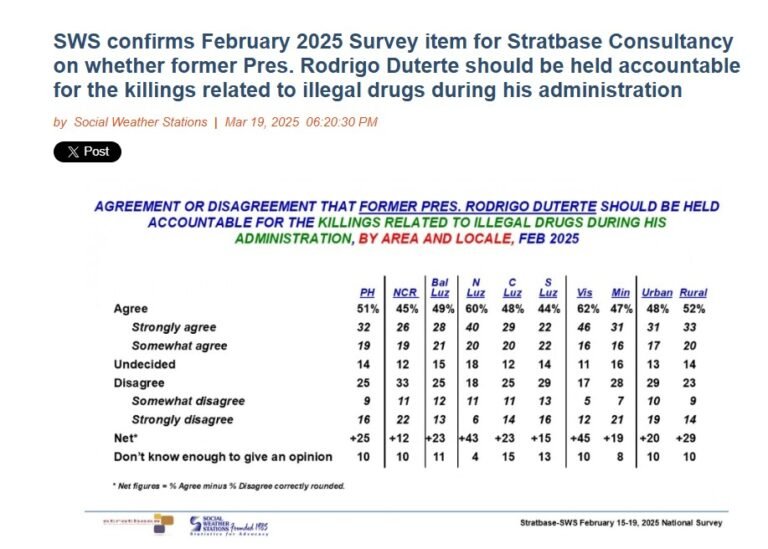
In the latest episode of As the Philippines Turns, the nation’s long-running political drama has taken a gripping new turn. According to a Social Weather Stations (SWS) survey commissioned by Stratbase Consultancy, 51% of Filipinos believe former President Rodrigo Duterte should be held accountable for the drug-related killings during his administration’s notorious war on drugs. The survey, conducted from February 15 to 19, 2025, involved face-to-face interviews with 1,800 registered voters across the country, making it a significant gauge of public sentiment.

The numbers tell a compelling story. While 51% of respondents demand accountability, 25% disagree, 14% remain undecided, and 10% claim they lack enough knowledge to form an opinion. What is even more striking is the regional breakdown: The Visayas leads with 62% in favor of holding Duterte accountable, followed by Northern Luzon at 60%, Balance Luzon at 49%, Central Luzon at 48%, Mindanao at 47%, the National Capital Region at 45%, and Southern Luzon at 44%. These figures dismantle the myth of unwavering nationwide support for Duterte and instead reveal a population increasingly aware that justice must be served, no matter how powerful the accused.

The survey results were released just before Duterte’s arrest on March 11 at Ninoy Aquino International Airport upon his return from Hong Kong. The arrest was executed in response to a warrant from the International Criminal Court (ICC), which is investigating allegations of crimes against humanity in connection with the thousands of extrajudicial killings linked to his drug war. Once an untouchable political titan, Duterte now finds himself at the center of a global legal battle, a far cry from the defiant strongman image he cultivated during his presidency.

This turn of events raises an important question: Are we witnessing a pivotal moment in Philippine history where accountability is no longer reserved for the powerless but extends to those who once wielded the highest authority?

For years, critics and human rights advocates have decried the violent tactics of Duterte’s war on drugs, pointing to thousands of lives lost, families shattered, and a justice system that often looked the other way. Meanwhile, his supporters have justified the bloodshed as a necessary evil to rid the country of its drug problem. But this survey suggests a growing shift in perspective. More and more Filipinos seem to recognize that justice cannot be sacrificed on the altar of political convenience.

This is not just about Duterte. It’s about what kind of country we want to be. A nation that allows its leaders to act with impunity, or one that upholds the rule of law and ensures no one—no matter how powerful—is above it?

The wheels of justice may turn slowly, but they do turn. And as the former president faces his reckoning, one thing is clear: the people are watching, and history is taking notes.

The Dollar Dilemma: How GCash’s Digital Dollars Are Changing the Game

For millions of Filipinos working overseas, sending money home is both a necessity and a financial headache. In 2023 alone, Filipinos lost approximately ₱8.37 billion to hidden foreign exchange (FX) fees, according to research commissioned by Wise. That’s billions of pesos quietly vanishing—money that should have gone to families, savings, or investments.

The Currency Conversion Trap

Traditionally, without a dollar account, remittances sent in foreign currencies are automatically converted to pesos upon receipt—often at unfavorable exchange rates. This double conversion—first from the sender’s currency to USD, then from USD to PHP—can chip away at the actual amount received. For instance, a $10,000 transfer (around ₱578,000) that’s advertised as “fee-free” could cost up to ₱21,187 in hidden FX markups if a 3.6% margin is applied.

It’s not just OFWs feeling the pinch. Businesses dealing with international clients or suppliers face the same dilemma. Without a dollar account, they must convert pesos to dollars for payments, incurring additional costs and making them less competitive in the global market.

Enter GCash’s Digital Dollar Revolution

GCash has partnered with Circle to introduce USD Coin (USDC) on GCrypto, its digital currency platform. USDC is a fully reserved digital dollar, 1:1 redeemable for US dollars, and backed by liquid assets held at regulated financial institutions with monthly third-party attestations.

What does this mean for Filipinos? More financial power and fewer hidden fees.

  • For OFWs and freelancers: Holding digital dollars directly in a GCash wallet eliminates the forced peso conversion, ensuring more money reaches families.
  • For businesses: Transacting internationally becomes easier and more cost-effective, with fewer losses from unfavorable exchange rates.
  • For everyone: With USDC, transactions happen in seconds, anytime, anywhere—unlike traditional banking, which takes hours to process payments.

A New Era of Financial Inclusion

“The integration of USDC is a significant step in enhancing financial inclusion in the Philippines,” said Arjun Varma, GCash Group Head of Wealth Management. “By offering easy access to digital dollars, we empower our users with a stable and globally recognized financial asset.”

Circle’s Vice President for Asia Pacific, Yam Ki Chan, echoes the sentiment: “Expanding access to digital financial tools drives economic empowerment. We are excited that GCash is enabling millions of Filipinos to participate in the digital economy with confidence and security.”

Reclaiming Every Centavo

This shift to digital dollars isn’t just about convenience—it’s a financial revolution. Filipinos can finally take control of their hard-earned money, ensuring that every peso (or dollar) works harder for them. With GCash and USDC, remittances are smarter, businesses are more competitive, and financial transactions are faster and fairer.

In a world where every centavo counts, digital wallets and stablecoins are no longer just tech trends—they’re the future of financial freedom for Filipinos.

Want to start? Simply go to GCrypto in your GCash app, select ‘USDC’, and convert your pesos with ease. There are no more surprises, just seamless, cost-effective transactions.

For more details, visit www.gcash.com or follow GCash on Facebook: @gcashofficial.

Chinese economy showing cracks

The economy of China, an engine of growth globally, is showing cracks as it delivered mixed signals in the first two months of the current year.

This, as retail sales and industrial output showed resilience, but unemployment and the housing market continue to face challenges.

Responding to the challenges from th economy, the Chinese government has readied an economic package. But there are doubts if that could deliver.

Data from China’s National Bureau of Statistics (NBS) showed that retails sales in China rose by 4 percent year-on-year in January and February, up from December’s 3.7-percent growth. This is in line with estimates.

Meanwhile, industrial production went up at an annualized rate of 5.9 percent in the first two months of 2024, slightly down from December’s 6.2-percent growth. However, this still surpassed market forecasts.

As for urban unemployment, this climbed to 5.4 percent in February, which is the highest level in two years.

The property market, a critical pillar of the economy, still faced challenges as new home prices fell by 4.8 percent year-on-year in February. This, however, is a slight improvement from the 5.0-percent decline recorded in January.

5% GROWTH TARGET

The Chinese is government has set an economic growth target of around 5 percent this year, which will be aided by borrowing more money for various measures. These include giving 300 billion yuan ($41.3 billion) in rebates to consumers who trade-in old cars and appliances for new ones.

However, the borrowing will also support the housing market and local governments saddled with debt.

Hence, there is skepticism if the measures will have an impact.

“It is unclear how much of a jolt this budget will provide to underlying domestic demand and reflation efforts, despite the sizeable rise in the deficit,” Jeremy Zook, the lead China analyst for Fitch Ratings, said in a report, as quoted by the Associated Press.

The tariff threat of the Trump administration is also expected to impact various industries in China, as Beijing has shown no signs of giving up without a fight on the issue.

“If the American side goes further down this wrong path, we will fight to the end,” Commerce Minister Wang Wentao told journalists, as quoted by AP. “A big country should honor its international obligations and fulfill its due responsibilities,” he said to journalists at the Congress. “It should not put selfish interests before principles, still less wield its power to bully the weak,” he added.