Thursday, March 26, 2026
Home Blog Page 60

After You, Cristina Pantoja-Hidalgo

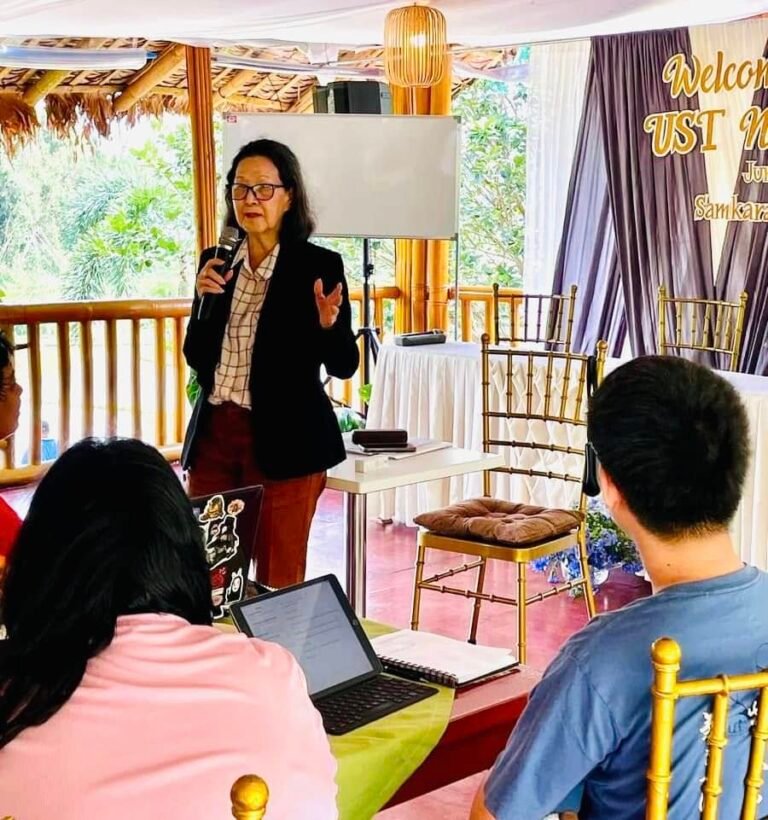
IF YOU ARE looking for an excellent teacher in English and Literature, go for Prof. Cristina Pantoja-Hidalgo.

Am not sure, though, if she still teaches full load and full time at the Faculty of Arts and Letters of the University of Santo Tomas.

What I know is that she’s the current Director of the UST Center for Creative Writing and Literary Studies.

People (that include me sometimes) called her Jing or Ma’am Jing but mostly, I refer to her as Prof. Cristina Pantoja-Hidalgo, a graduate of Ph.B. (Bachelor of Philosophy from the Faculty of Philosophy and Letters (Philets) of the University of Santo Tomas where she graduated with Latin honors.

STRUGGLING IN ENGLISH

I recommend her as an outstanding mentor in English because I learned a lot from her when I took my English under her wings in my freshman years in Artlets.

I vividly remember I attended her daily English classes at the Annex of the Commerce Building of UST along Dapitan.

I was from promdi (from the province), a fresh graduate from the Lopez Provincial High School in Lopez, Quezon who wasn’t attentive in my studies let alone English.

Other high school subjects I didn’t pay attention to many of them although I passed my secondary course.

As a promdi, I was struggling in my English, both spoken and written.

Most of my classmates in the afternoon session—we were blocked section—were either valedictorians or salutatorians in high school, provincial or citified, graduates of exclusive schools for girls or boys and mostly articulate in the King’s language.

[W]e were bombarded with readings which I realized early on as a discipline to enhance not only our vocabulary, apply our English lessons and get exposed to multiculturalism but also to train us in oral and non-verbal communications.

FILM REVIEW, READINGS

But Prof. Pantoja-Hidalgo was a challenge altogether.

I was inspired by her teaching style in English which I learned the hard way.

Imagine, on our first day of classes alone, she would assign each one in our class, novels to read and require us to submit a book review at the end of the semester in between our drills with the English grammar.

I was assigned “Bread and Wine” by Italian novelist Ignazio Seloni.

I enjoyed reading the story of a young revolutionary in an Italian village disguised as a priest who would find it difficult to wage a revolution to topple down fascism and oppression because of the backwardness in beliefs of the peasants.

I was also assigned to review the film “Murders in the Rue Morgue,” adapted from a short story by Edgar Allan Poe.

She would also assign us to review the film “Ryan’s Daughter” directed by David Lean and starred Robert Mitchum and Sarah Miles about an illicit affair of a married woman with a British officer of the World War; to write a review of any TV shows of our choice at the time.

In other words, we were bombarded with readings which I realized early on as a discipline to enhance not only our vocabulary, apply our English lessons and get exposed to multiculturalism but also to train us in oral and non-verbal communications.

I could imagine the mediocre writings I submitted to Prof. Hidalgo. She must have cringed reading them.

Must she be proud or ashamed of me?

She was a liberal teacher so she must be understanding but she taught us freedom and responsibility.

For me, even if I got a passing grade from her, I still cherish and admire her manner of teaching, rubbing off her knowledge and practical lessons in life to us.

WRITING AS A PROFESSION
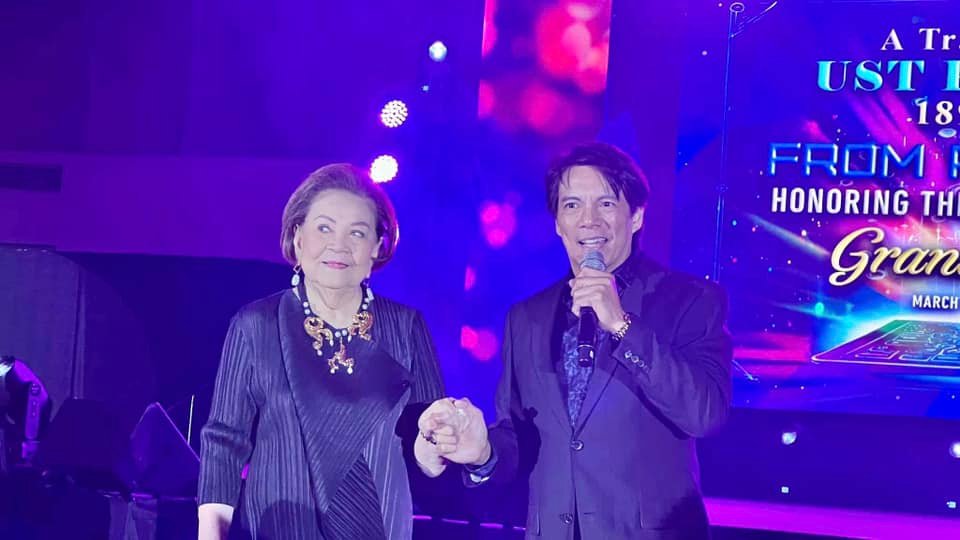
Pacita Syquia-Almario and Jojo Gorospe of Rainmakers (Photo Credit: Joel Macayana/ Facebook)

That’s when I taught at the De La Salle University-Dasmarinas, Cavite, I copied her method of teaching by assigning my Journalism students with readings, written and oral reports, although the sad part, most of them would copy and paste the discussions from Google. I encouraged my students group dynamics and research

In our time at UST was the First Quarter Storm and student activism was at its height.

Pantoja-Hidalgo was no terror teacher, she was lovable, charming and intellectually honest.

She was the one who even encouraged us to join rallies which I heeded and it taught how to understand life better.

I missed Prof. Jing at Artlets when I was in sophomore until graduation but after college, I learned that she was at the University of the Philippines. After her stint at UP, she is back as a Thomasian. 

At the recent celebration of the 60th year of Philets-Artlets at the Mania Hotel, I saw Cristina Pantoja-Hidalgo, my idol, from afar. She was like a star but reachable.

I also saw at the reunion journalist Pacita Syquia-Almario who was also a Philet. Pacita as a writer is vivacious.

Pantoja-Hidalgo and Syquia-Almario are both institutions in the writing profession we must emulate.


How Sugar Steals Your Youth

0

The sweet taste of youth! Or should I say, the sweet taste of… well, not-so-youthful aging? You see, there’s a sneaky little process called glycation that’s like a party crasher, ruining the fun and leaving you with wrinkles, age spots, and a general feeling of, “Wait, where did my youth go?”

Glycation, in a nutshell (or a sugar cube, ha!), is when your blood sugar levels get too high and start sticking to your proteins, like a bad habit. This creates something called Advanced Glycosylation End-products, or AGEs (no, not the kind that come with wisdom and experience, unfortunately!).

Think of AGEs like a sticky, caramel-like substance that glues your proteins together, making them stiff and inflexible. It’s like when you spill honey on your favorite shirt and it becomes all stiff and unusable – except, in this case, it’s your skin, arteries, and organs that are getting all stiff and, well, old.

LIKE A FIRE ALARM

Now, you might be thinking, “But I’m not eating that much sugar!” Ah, my friend, it’s not just about the sugar you eat. It’s about how your body processes it. When your blood sugar levels spike, it’s like a fire alarm going off in your body, triggering a chain reaction of inflammation and oxidative stress.

And that’s when the glycation party really gets started. Your proteins start getting stuck together, your skin starts losing its elasticity, and your arteries start getting all clogged up. It’s like a big, sticky mess!

[I]t’s not just about looking young and beautiful… It’s about keeping your body healthy, strong, and resilient, so you can live your best life, no matter what your age.

LET’S BE REAL

But fear not, dear reader! There are ways to crash this glycation party and keep your body looking and feeling its best. Here are a few tips:

– Keep your blood sugar levels in check by eating a balanced diet that’s low in sugar and refined carbs.

– Exercise regularly to improve your insulin sensitivity and keep those blood sugar levels stable.

– Eat foods that are high in antioxidants, like berries, leafy greens, and other fruits and veggies.

– Consider taking supplements like vitamin D, omega-3 fatty acids, magnesium and antioxidants to help combat inflammation and oxidative stress.

So, there you have it – the sweet (and not-so-sweet) truth about glycation and aging. 

Remember, it’s not just about looking young and beautiful (although, let’s be real, that’s a pretty great perk!). It’s about keeping your body healthy, strong, and resilient, so you can live your best life, no matter what your age.

No More Room For Duterte Stalwarts?

0

THE Marcos administration must have regretted appointing people closely associated with former President Rodrigo Duterte, to sensitive government posts.

This comes as Malacañang opted to call the attention of Solicitor General Menardo Guevarra over his decision not to be dragged and made to defend the government on matters surrounding Duterte’s arrest.

In what appears to be an indirect call for his resignation, Undersecretary Claire Castro in her capacity as Palace Press Officer, asked Guevarra to retrospect whether or not he’s still fit to serve as the government’s top lawyer.

INSUBORDINATION

Castro, a lawyer by profession, particularly took a swipe at Guevarra’s refusal to respond to petitions filed before the Supreme Court by Duterte’s children, seeking the former president’s release and return from The Hague, Netherlands.

“Wala pa pong napag-uusapan diyan dahil napakabago talaga nito. Lumabas lang ‘yata to kagabi,” the feisty lawyer said when asked whether the President would fire Guevarra for insubordination.

Far from the confrontational stance that she has displayed since assuming the Palace post, Castro effectively rephrased a direct call for Guevarra’s resignation.

“Siguro mas maganda kung mismo si SolGen ang mag-assess sa sarili niya kung siya pa po ba ay nararapat na tumayo bilang Solicitor General,” she averred.

NO SIGNS OF QUITTING

Soon after, Guevarra issued a statement in reply to Castro — “I will leave the matter to the President,” adding that the OSG’s position will remain the same “irrespective of the personalities involved.”

Guevarra, who served as Secretary of the Department of Justice (DOJ) during the previous administration, insisted that he has no conflict of interest — “The OSG represents the interest of the republic vis-a-vis the ICC and no other interest. Our recusal is not personal; it is institutional.”

He however clarified that the OSG’s move not to be involved in the petition filed by the family of his former boss, does not necessarily mean he would decline future petitions to the ICC and Duterte.

“It will depend on the nature of the cases that may be filed in the future,” he said

SOLGEN’S POSITION

Guevarra in his manifestation before the Supreme Court explained that the OSG “may not be able to effectively represent Respondents in these cases” in view of its firm stance that the International Criminal Court (ICC) has no jurisdiction over the Philippines.

The OSG particularly begged off from the consolidated habeas corpus petitions filed before the high court by the younger Dutertes.

Signatories in the habeas corpus petitions include Kitty (youngest daughter to common-law-wife Honeylet), Baste (incumbent Davao City Mayor) and Pulong (congressman representing Davao City).

Dizon Sacks MRT Exec

0

IN what seemed more like a continuing saga of a customary purge every time a new boss comes in, no less than Transportation Secretary Vince Dizon announced the “departure” of another official under his agency.

Barely a month  after being appointed as Secretary for the Department of Transportation (DOTr), Dizon replaced almost the entire DOTr structure — from the undersecretaries down to the general managers of agencies under his radar.

The most recent “casualty” — Metro Rail Transit-3 (MRT3) general manager Oscar Bongon. As of this writing, the reason for Bongon’s removal from office has yet to be announced.

Interestingly, a list of names for his possible replacement has already been submitted to the Office of the President in Malacanang even before the Dizon made the announcement on the removal of Bogon.

ESCALATOR INCIDENT

According to DOTr insiders, Bongon’s “departure” from the agency has been decided upon by Dizon even before the escalator incident at the Taft Avenue Station which left at least 10 passengers injured.

The incident was caught on cam by a netizen who posted the video on social media.

The escalator (in ascending direction) was reportedly packed with passengers when it malfunctioned, causing some people to fall on top of each other while a female passenger also hurt her ankle. 

In a statement, the DOTr explained that the primary chain of the escalator broke off, hence causing the accident.

TOPSI TURVY TRAINS 

The same insider hinted at the failure of the MRT-3 management to ensure functionality of the mass transportation system complementing the huge passenger volume along EDSA. 

Barely a week after assuming the top DOTr post, Dizon reportedly fumed after an MRT-3 northbound train stopped even before it could reach the Santolan-Annapolis Station. Passengers reportedly smelled smoke before the train abruptly stopped. They also claimed to have heard twice what sounded like blasts.

Previously, passengers nearly lost their balance after another MRT-3 train stalled near the Shaw Boulevard Station.

Stalled trains though are not new as MRT is notoriously famous for its topsy turvy rail system — non-operational elevators, steep stairs, malfunctioning air conditioning units,, to name a few.

FAMILIAR FACES BACK

Soon after being sworn as DOTr chief, Dizon sought the courtesy resignation of all officials under the radar of the agency in what he claimed as a common practice in view of leadership changes. 

In a Facebook post on February 27, Dizon personally administered the oath-taking of his new team to ensure delivery of results amid a limited timetable reportedly set by his appointing authority — President Ferdinand Marcos Jr.

His new team though, is composed of the same familiar faces. Undersecretary for Administration, Finance and Procurement Giovanni Lopez, who replaced Jesus Nathaniel Martin Gonzales, previously served as undersecretary and assistant secretary, and was also former DOTr Sec. Arthur Tugade’s chief of staff.

Undersecretary for road transport and infrastructure Mark Steven Pasto, who served as Tugade’s Assistant Secretary replaced Jesus Ferdinand Ortega.

Jim Sydiongco, Undersecretary for aviation and airports Jim Sydiongco who served as director general of the Civil Aviation Authority of the Philippines (CAAP) during Tugade’s term as DOTr chief, took over Roberto Lim’s post.

Undersecretary for road transport and non-infrastructure Ramon Reyes used to work for the Stradcom Corporation which secured a contract to manage the Land Transportation Office (LTO) portal.

Undersecretary for Planning and Project Development Teodorico Jose Delfin, who was the senior vice president at Lopez-led First Gen Corporation, effectively eased out Timothy John Batan as railways chief.

MORE FAMILIAR FACES

Raul del Rosario, acting director general and acting member of the board of directors of CAAP Del Rosario takes the post of Antonio Tamayo. Del Rosario was appointed by former president Rodrigo Duterte as the administrator for the Office of Transportation Security in 2019.

He previously served as the chief of the Western Command and the Central Command. He is credited as the Air Force pilot who discovered China’s occupation of Mischief Reef in 1994.

Meanwhile, Villamor Ventura S. Plan is now assistant secretary for maritime. He is listed among the former deputy administrators of the now defunct Philippine Overseas Employment Administration.

Displacement of Local Farmers, IPs

0

THE RECENT ANNOUNCEMENT made by the Department of Environment and Natural Resources (DENR) regarding the Masungi stand-off is with all certainty a welcome development for local farmers and the indigenous people who have been shoved away from their ancestral domain.

According to the DENR, they’re giving Blue Star Construction and Development Corporation (BSCDC) 15 days to pack up and leave a 300-hectare area in Tanay, Rizal where they’re supposed to construct 5,000 townhouses and single-detached homes under an agreement which dates back in 1997. 

But instead of building houses for government employees, BSCDC constructed and operated through a “foundation” what is now referred to as the Masungi Geo-Park, collecting hefty fees to local and foreign tourists wanting to take a glimpse at the magnificent rock formations.

More than entrance fees, the foundation has been collecting as much as P155,000 for an eight-hour use of the Masungi Geopark for events and pictorials and charging P1,800 per head — for a minimum of five persons — as entrance fee to the visitors.

Interestingly, the government doesn’t get a dime out of it.

PERPETUAL AGREEMENT

Worse, the foundation formed by the BSCDC, annexed its area to 2,700-hectares which is almost the size of Pasig City in Metro Manila. 

The expanded “claim” made possible through a “perpetual agreement” entered into by the late Environment Secretary Gina Lopez, effectively shoved away local farmers from an area covered by Presidential Decree 324, and the Dumagat-Remontados tribe from their ancestral homes.

For one, the memorandum of agreement that was signed by Lopez is flawed from the very start. 

Why would the government entrust a state property for an eternity? 

For me, the agreement is grossly disadvantageous to the government, as it effectively ceded the property to the family claiming to be environmental advocates.

Speaking of advocacy, there is no person in a better position to protect the Masungi area but the farmers relying on the land they till for a living and the Dumagat-Remontados in a comfort zone called ancestral domain.

After all, they’ll be the first to suffer if they don’t protect the area where they live and make a living.

Crucial Collaboration For Climate Change

0

‘The tough test indeed lies in infecting a great number of the 110-M population who are both contributors to and victims in the climate crisis and getting them to change environmentally damaging habits.’

IN THIS SEASON of political mudslinging and battle of facts and fakes, among other staple polarities in our plodding nation, it is a whiff of fresh air that a particular issue, global and still conceptually distant as it is, can bring our people to a common ground. Climate change with its existential threat that can deface both planet and humanity a few decades away, what can be more daunting and crushing than that? 

Thanks to Green Convergence for safe food, healthy environment and sustainable economy for convening (along with the Department of Environment and Natural Resources) the 5th Philippine Environment Summit with the theme, Ako ang Bukas: Quantum Leap to Climate Neutrality. 

Held in Iloilo City last February 19 to 21, the biennial event gave a sharp view of both the crisis and strategic solutions to hurdle it – mitigation, adaptation, resiliency building. Government and Civil Society (academe, business, church, communities, civic groups), and likewise inter-generational groupings (senior citizens to youth in senior high school and college) were there to share knowledge, listen, exchange ideas, and be inspired. 

WHOLE-OF-NATION APPROACH

The three whole days demonstrated a collaborative, whole-of-nation approach crucial to face such a crisis, as stressed by both the GC president, Victoria Segovia, a decades-long environment educator and DENR Secretary Antonia Yulo-Loyzaga.

The government agencies present aside from DENR, the departments of Agriculture, Energy, and Transportation, and their key agencies, laid out national plans and program initiatives to protect the country and population from the climate change onslaught. 

The business sector couldn’t have been better represented than by Federico Lopez, chairman and CEO of First Holdings Corporation which is at the forefront of renewable energy production, a key action in mitigating climate change. 

Agnes de Jesus, FHC’s Chief Sustainability Officer, egged the audience to measure their carbon footprint (with a calculator) to lead them to reducing greenhouse gas emissions that contribute sizably to the extreme weather disturbances that mirror climate change. Innovative resiliency projects by environmental scientists and entrepreneurs that consider the state of the environment and climate inspired the youth and entrepreneurial minds.

WE’RE IN THIS TOGETHER

I can breathe better with the mere thought that such collaborations are happening instead of each group waddling on a lonely road or government and civil society clashing at every turn.  Yet wonder how some 700 like-minded people in the room can cascade the knowledge fast enough before floods, droughts, and pollution hit us harder.  

The tough test indeed lies in infecting a great number of the 110-million population who are both contributors to and victims in the climate crisis and getting them to change environmentally damaging habits. Rallying a “we’re all in this together” spirit, sort of. 

Tall order but Green Convergence has shown mission and passion for the environment since 2011 and has resolved to undertake specific actions in collaboration with key sectors in the country. 

Note: Some highlights of select speeches and project presentations at the 5th PES will be featured in a coming series on earth stewardship in a free website of The PH Insider. 

Wanting Reforms At The DA

‘The government can halt this charade and say enough is enough as the interest of the people must take precedence over self-preservation and welfare of a few.’ — Dr. Eliseo Ponce, former head of the Bureau of Agricultural Research

MY FAVORITE COLUMNIST, Cielito Habito, does it again. He wrote about the “dysfunctional” agriculture sector, zeroing in on the bureaucracy that to me is not just over bloated but also directionless, a fact I have been harping on for weeks or months now.

This is evidenced by the almost daily pronouncements or announcements of the top leader, Agriculture Secretary Francisco Tiu Laurel Jr. about his plans, programs and policies that almost always border on the need to import this or that item to ensure that adequate supplies are available to consumers. 

I seldom read or hear of real programs that would directly benefit the farmers and fishermen other than the financial support or ayuda that are given to them in times of natural calamities like last year’s drought and the successive storms in the fourth quarter of 2024. Plans like cold storage facilities and fancy-sounding names are being announced but I don’t know to what extent they are being implemented.

Almost daily, I read in newspapers about the projects of the bureaus and agencies under or attached to the DA who move on their own, but I credit such prominence to the diligence of the reporters covering the DA beat.

SAME AS 14 YEARS AGO

In his column, Habito (who used to head the NEDA) maintained that the dismal failure in agriculture “is not due  to lack of technological knowhow, natural endowments or human power,” which we have plenty of but in the governance and management of the sector.

He cited the views raised 14 years ago by the late Dr. Eliseo Ponce, who headed for five years the Bureau of Agricultural Research, Habito enumerated the DA’s shortcomings as: (1) overcentralization; (2) unstable and politicized budget; (3) unclear communication lines; (4) fragmentation and weak coordination; (5) lack of clear organizational framework; (6) weak technical and managerial capacity; (7) authority without accountability, and (8) graft and corruption and massive waste of public resources. 

Habito said Ponce pushed for reforms like a) function-oriented, rather than commodity-oriented, budgeting (with rice having over half of the budget even if its contribution to agricultural GDP is less than ⅕  and b) eliminating conflict of interest.

DEFINING CORE FUNCTIONS

Ponce, he said,  argued that the DA budget would be better defined according to its core functions, namely: (1) policy, planning, monitoring, and evaluation; (2) standards-setting, regulation, inspection, and quarantine; (3) research and development; (4) information, communication, and supervision of (devolved) extension, and (5) international relations.

“Efforts toward improving commodities should be done through regular line bureaus like the Bureau of Plant Industry (BPI), Bureau of Animal Industry (BAI), Bureau of Fisheries and Aquatic Resources (BFAR), etc., and not through specialized ad hoc commodity programs whose leaders had in the past been endowed with authority and command over substantial resources, without the corresponding accountability,” Habito cited Ponce.

With devolution of functions, LGUs must do the “rowing” while DA must be “steering,” and that “a distinct and significant part of the DA budget (must) be devoted to supporting LGUs, especially on capacity-building. Only through this may the DA truly work through the LGUs, and thereby be more responsive to the needs of its clients on the ground,” Ponce pointed out.

On the conflict of interest, Habito wrote that regulatory functions have traditionally been spread across various DA bureaus and attached agencies, such as the BPI, BAI, BFAR, Philippine Coconut Authority, Sugar Regulatory Administration, National Meat Inspection Service, and Fertilizer and Pesticide Authority. 

CONSOLIDATING FUNCTIONS

Ponce recommended consolidating all DA regulatory functions into one apex regulatory body, and limiting the bureaus to their developmental functions. But his proposal was understandably opposed by the concerned agencies. 

“The government can halt this charade and say enough is enough as the interest of the people must take precedence over self-preservation and welfare of a few.”

A bill for an Agriculture Bureaucracy Restructuring Act was filed to accompany the Agriculture and Fisheries Modernization Act of 1997 (Republic Act 8435) but never saw the light of day. 

Former president Joseph Estrada, in EO No. 338, reorganized the DA before stepping down in 2001 but the DA under Arroyo did not implement the EO in the process, stymying such reforms.

Instead of a bureaucratic reform, the DA pursued only piecemeal changes ending up with a top-heavy organization of 13 USecs and 14 Asecs. It is top heavy, disorganized and directionless, for me.

Habito prescribed an Education Commission or EdCom and the formation of a high-level AgriCom to fix a dysfunctional DA that is holding back the sector and the entire country.

Why Now is the Best Time to Invest in a Home in Visayas and Mindanao

The real estate market in Visayas and Mindanao is booming and is fueled by rapid urbanization, major infrastructure projects, and a growing demand for quality housing. With steady market growth and attractive financing options, now is the perfect time to invest in property for long-term financial security.

A Thriving Real Estate Market

Recent data from the Philippine Statistics Authority (PSA) shows a 7.5% increase in the housing market in 2024, with VisMin cities playing a major role. The Bangko Sentral ng Pilipinas (BSP) also reported a 10% rise in residential real estate loans, reflecting a strong demand for homeownership. Cities like Cebu, Davao, and Iloilo are at the forefront, with developers introducing innovative and sustainable housing solutions.

CLI Homefest 2025: A Prime Opportunity for Buyers

Cebu Landmasters, Inc. (CLI) is leading the charge with CLI Homefest 2025, a premier event offering exclusive homeownership deals in seven key VisMin cities. The event kicks off on March 15 at Davao Global Township and will then stop in Ormoc, Bacolod, Cebu, Iloilo, Dumaguete, and Cagayan de Oro.

To make buying easier, CLI has partnered with top financial institutions like RCBC, BPI, BDO, Chinabank, Security Bank, Union Bank, and more, offering same-day deals and flexible financing options.

Investment-Worthy Properties for Every Buyer

CLI’s diverse residential offerings cater to various needs:

  • Casa Mira – Affordable homes designed for Filipino families, including projects in Mandaue, Bacolod, and Panglao.
  • Garden Series – Nature-inspired living spaces like Mesatierra Garden Residences (Davao) and Mivela Garden Residences (Cebu).
  • Premier Masters – Upscale developments redefining modern urban living, such as One Paragon Place (Davao) and Mandtra Residences (Mandaue).

Why 2025 is the Ideal Year to Invest

The combination of major infrastructure projects, rising property values, and flexible financing makes this the perfect time to buy. Government-backed initiatives like the Cebu-Cordova Link Expressway and Mindanao Railway Project are driving property appreciation, ensuring strong returns on investment.

Secure Your Future with CLI Homefest 2025

Whether you’re a first-time buyer or a seasoned investor, CLI Homefest 2025 offers an unmatched opportunity to own property in VisMin’s thriving market. With exclusive deals, financing options, and a wide selection of homes, securing your dream home has never been easier.

Don’t miss out—reserve your future today with CLI Homefest 2025!

Elections Ph

0

IT’S ELECTIONS SEASON for Filipinos this first half of 2025. While most of the voters believe that their one vote can make a difference in coming up with the right leaders for the country, many concerns occupy their minds. The last elections last May 9, 2022, handled by Comelec headed by Chairman George Erwin Garcia, with Smartmatic, has been found riddled with doubts about its credibility.

Offhand, why was Comelec headed by Atty. George Erwin Garcia, the lawyer of presidential candidate, Ferdinand “Bongbong” R. Marcos? Isn’t this set-up quite suspicious, and the appointing power and Atty. George Erwin Garcia should have had a sense of “delicadeza” about getting personally involved, managing the election exercise? Why did Comelec not disqualify presidential candidate Ferdinand “Bongbong” R. Marcos, who was convicted by the Court of Appeals for non-payment of real estate taxes, worth millions, due in the 1980s? 

IT experts, the TNT trio, composed of former DICT secretary Ret. Brig. Gen. Eliseo Rio, Jr., former Comelec Chair Gus Lagman, and ex-FINEX president banker Franklin Ysaac, and other IT professional groups, had a lot of questions about the results of the election, but so far there has been no satisfactory response from Comelec. 

Why did Comelec publish as early as 7pm, the official closing time of voting, the count of 20 million votes for Ferdinand R. Marcos, when there were administrative tasks to be undertaken only after 7pm? The TNT requested as early as in June 2022 to see the Transmission Logs for perusal, but only after many months did Comelec respond, but gave Reception Logs, which were useless.  Why did Comelec use one mysterious IP address, 192.168.02, to send voting results to many provinces within an hour of ballotings’ end at 7pm? 

With the silence of Comelec in providing satisfactory answers and explanations on the simple questions and requests made, Comelec must be hiding the truth about the May 9, 2022 elections.

Comelec, in an En Banc Resolution dated November 29, 2023, allowed retired Gen. Eli Rio and his team to open ballot boxes of their own choice for examination. But when the TNT chose to open ballot boxes in Sto. Tomas, Batangas, Comelec reversed its own Resolution with another En Banc Resolution, dated July 3, 2024, wherein no ballot boxes would be opened anymore. Why? 

Petitions were filed with the Supreme Court to compel Comelec to give the Transmission Logs to the TNT trio, but no favorable response from Comelec. With the silence of Comelec in providing satisfactory answers and explanations on the simple questions and requests made, Comelec must be hiding the truth about the May 9, 2022 elections. 

Comelec, with Chairman George Erwin Garcia, using a new technology from Korea, Miru, will be handling the May 9, 2025 elections. Smartmatic was discarded, and a Hybrid Election System (HES), as demanded by many reform-oriented-organizations, including the TNT trio, as a guarantee for transparency and fairness, and to prevent any rigging of the elections, was not adopted by Comelec. 

Just lately, a CPA, Atty. Jeryll Harold Respicio, an experienced IT Auditor, wanted to help Comelec about preventing any hacking on its use of the technology in the coming elections this May 2025. But, without giving him any hearing about his concern for a hacking-free election process, he was slapped by Comelec with a possible case of Cyber libel, threatening to disbar him and withdraw his professional standing as a CPA. Why didn’t Chairman George Erwin Garcia simply meet personally with Atty. Harold Respicio and listen to his side before thinking of taking a drastic move. 

Thus, a valid question: Will Comelec manage the 2025 elections with integrity and fairness?

Not All Smugglers Are Traders; Not All Traders Are Smugglers

0

“If you know the enemy and know yourself, you need not fear the result of a hundred battles. If you know yourself but not the enemy, for every victory gained you will also suffer a defeat. If you know neither the enemy nor yourself, you will succumb in every battle,” goes the oft-repeated advice from Sun Tzu’s classic, The Art of War.

UNFORTUNATELY, IT IS the traders —legit or otherwise— more than the probers, who take this caveat to heart. They know the terrain of their trade like the back of their palms. 

The enforcers? Yes, they do; ditto with the country’s regulators at the borders. Yet they are helpless against the menace of smuggling; and it’s not because this illicit trade is plied by legitimate importers, rather because these smugglers are keenly aware of the inadequacies of the laws, the rules, and terrain of their trade.

That is why we cannot abate smuggling. Compounding the situation is the lack of skilled investigators probing smuggling—be it in the Executive or Legislative branch of the bureaucracy. Not even the House of Representatives’ PentaCom seems to hit the nail right on the head! 

SUPPRESSION OF SMUGGLING 

Let me bring you back to a scene in Congress: “Walk us through the importation process, beginning with this Import Commodity Clearance,” a congressional prober asked a former Customs Commissioner during a legislative inquiry with convicted smugglers in attendance.

The lady solon – a former Justice Department investigator and court litigator – was laying the predicate for the more lethal questions she must have prepared for her prey. Essentially, she was trying to check whether the resource person knew one of the main tasks the agency the latter once headed was mandated to do: suppression of smuggling. After all, the committee was investigating illegal drug smuggling. Of course, the solon was not insinuating that an import commodity clearance (ICC) is required in importing illegal drugs. Rather, she was trying to draw everyone, resource persons and probers alike, to a common frame of reference. She wanted everyone to “be on the same page” with her.

Sadly, though, most investigations on smuggling have not been thorough. Some were noted to have failed to tie loose ends and, perforce, accommodated some viruses of reversible errors; in short, the probes weren’t airtight in their investigation for various reasons. Among them, the investigators—including some congressional probers, did not have a common understanding of what constitutes smuggling, who should be investigated, how the act was done, when the act constitutive of smuggling took place, what documents should be reviewed or examined, what to look for in those documents, who should answer their questions, and who should be required to identify signatures and/or authorship of documents, among others.

At times, the probers would pressure—to the extent of shaming—the resource persons, why they are not conversant with what’s happening on the ground. Seemingly, these probers are unmindful of the realities of large bureaucracies where heads of agencies cannot be expected to know every activity that unfolds in the lower level of the organization, say, at the ground zero of smuggling.

Put differently, what happens in the port, the District Collector and her/his officers should be quizzed —not the Commissioner.

NOT THE COMMISSIONER

Put differently, what happens in the port, the District Collector and her/his officers should be quizzed —not the Commissioner. The affairs at the port level are matters under the jurisdiction of the District Collector; ergo, a more responsive answer or information can be better provided by the District Collector, rather than the Commissioner. As lawyers are wont to interject during court proceedings: “Objection, Your Honor, the witness is incompetent!” 

Unfortunately, our congressional probes are not bound by the rules of evidence obtaining in the courts of law. So, they quiz everyone in a manner they like, as if every resource person invited to the inquiry —especially heads of agencies— are expected to know everything that happens in their spheres of influence and should thus provide the answer, data, or information the probe body wants to hear. 

Unreal, impractical and illogical! This assumption is unreasonable, especially in the case of the Bureau of Customs where the District Collectors have exclusive jurisdictions in their geographical areas of operation, that not even their administrative superior—the Customs Commissioner, can unilaterally or summarily disregard. The principle of command responsibility can sometimes be a shaky and undependable assumption. This is the situation at the ground level; this is the situation at the port zones.

To ignore this reality and insist on the flawed assumption that the Customs Commissioner being the head of the agency should know everything that happens in the Bureau is like tasking the President to know everything that happens in every section, division, or unit of the bureaucracy simply because he is the Chief Executive; or, akin to putting to task the Supreme Pontiff for everything that happens in every diocese or parish. Unfair!

ASSUMING IT EXISTS

But, yes, the message is clear: There is a need to have common ground on which the investigation of smuggling cases should start. For instance, what are considered acts of smuggling? What are the types of smuggling? What are the acts complained of and are being probed? Who are the actors in this illegal enterprise? What are the red flags of smuggling? What interventions did the state regulators do—or fail to do, and many more?

Unless we can agree on a common term of reference, not even the newly-minted Anti-Agricultural Economic Sabotage Act (RA 12022) will address the menace.

For one, even the chief weapon that the Anti-Agricultural Economic Sabotage Enforcement Group will have to use, might —assuming it has now come into existence— have to contend with the strictures laid down by the Supreme Court in the case of BI BOC vs. Yuan Wenle, promulgated 28 February 2023. In this case, the High Court imposed eight guidelines for all administrative warrants — like a Letter of Authority (LOA), to observe. It said:

“[F]or all administrative warrants to be valid and justified, all of the following conditions must be present and shall be strictly complied with, to wit: 

“xxxxx. 

“6. The warrant issued must not pertain to a criminal offense or pursued as a precursor for the filing of criminal charges and any object seized pursuant to such writ shall not be admissible in evidence in any criminal proceeding.” [Emphasis in the original text.]

EVIDENCE OBTAINED THROUGH

As the LOA seeks to investigate agricultural smuggling, and smuggling being a criminal offense, the LOA therefore cannot be validly used for the purpose for which it was issued.

And any evidence obtained through the use of that LOA will be inadmissible in evidence for whatever purpose, if the Wenle ruling is to be gauged.

That said, how then can an LOA help in the fight against agricultural smuggling— or all forms of smuggling for that matter, when all the evidence obtained through it can be regarded as fruits of the poisonous tree?
It bears watching! Meanwhile, let’s get grounded: Not all smugglers are traders, and not all traders are smugglers.

Irish Josephine Bracken reunites with Jose Rizal 

0


WHAT could be sweeter than the fulfillment of a broken vow? In what appears to be more like a “déjà vu,” the abruptly-cut romance between two departed souls, Philippine national hero Jose Rizal and Irish descent Josephine Bracken have finally been “reunited” – for good.

In two culminating ceremonies held at the Tejeros Convention in Cavite and the Rizal Shrine in Calamba, the officers and members of the Knights of Rizal (KoR) extolled the bust of Bracken alongside that if Rizal, in an apparent effort “to honor a remarkable woman whose courage, love, and dedication left an indelible mark on Philippine history.”

According to Sir Pieter Nootenboom in his capacity as former Asia Regional Commander of the illustrious Knights of Rizal, the story behind Bracken (Josephine Maria Leopoldine Bracken), “is one of resilience, sacrifice and heroism.”

Bracken, a woman of Irish descent, joined the Filipino revolutionaries as nurse and combatant shortly after Rizal was executed on December 30, 1896 at the age of 35.

“Josephine Bracken’s life was anything but easy. Orphaned at a young age, she was adopted by George Taufer, an American suffering from blindness. It was through her adoptive father’s search for medical treatment that she met Dr. José Rizal in Dapitan, Zamboanga del Norte. Their meeting was fateful not only for the love that blossomed between them but also for the role she would play in supporting Rizal’s work and, ultimately, the Philippine Revolution,” Sir Pieter said in his speech followed by the unveiling of the bust outside the Tejeros Convention site in Rosario, Cavite.

The bust, which is about 24 inches tall, had a marking of its sculptor embossed and read backwards – an artist by the name of “Phantom Sculpture”

“Following the wrongful execution of Dr. José Rizal by the Spanish colonial forces on December 30, 1896, Josephine did not retreat into grief. Instead, she transformed her sorrow into action. She traveled overnight to the Tejeros Convention in Cavite, where she joined the revolutionary forces under General Emilio Aguinaldo. There, she served as both a nurse and a combatant, tending to the sick and wounded at Casa Hacienda de Tejeros, which had been converted into a field hospital,” Nootenboom added. 

“Her bravery knew no bounds; it was reported that she once rode out on horseback with another woman and shot a Spanish officer, a testament to her fearless spirit.”

Later in the afternoon, another Bracken bust was donated at the Rizal Shrine in Calamba, Laguna – but this time Bracken sits alongside Jose Rizal.

KoR officials cited Bracken’s contributions to the Philippine Revolution “were not merely acts of service; they were acts of defiance against oppression and injustice. She stood alongside the revolutionaries not as a bystander but as an active participant in the struggle for freedom. Her story reminds us that heroism knows no gender and that women have always been at the forefront of history, even when their contributions have been overlooked.”

In November 2023, the KoR under Gerardo Calderon who was then the KoR Supreme Commander, issued a posthumous citation to Bracken, recognizing her immense contributions to the life of Rizal and the Philippine Revolution. 

Nootenboom himself received the citation on behalf of the Bracken descendants in Ireland.

Crucial Electoral Management

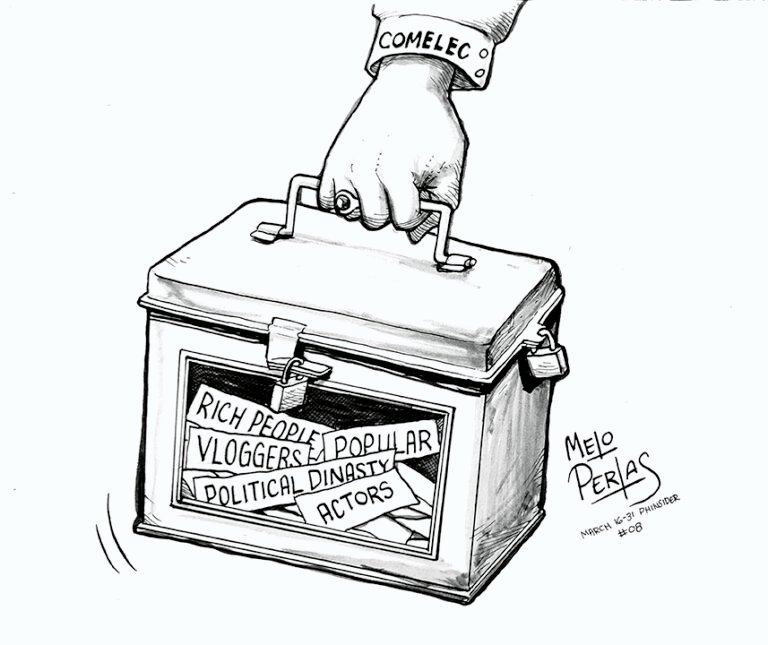
The fundamental principle that sovereignty resides in the people has eroded over the past 50 years, largely due to persistent controversies surrounding the agency tasked with ensuring that the people’s voice is heard through free and fair elections.

The Philippine electoral system has suffered a steady decline, with wealth and popularity increasingly determining election outcomes from the national level down to local politics. The Commission on Elections (Comelec), established 90 years ago, has undergone significant amendments that expanded its role beyond administrative functions. Today, it wields administrative, quasi-judicial, and judicial powers—authority that, while intended to strengthen the institution, has also made it vulnerable to exploitation.

With broader powers at play, unscrupulous individuals have found ways to manipulate the system for financial and political gain, entrenching political dynasties that have ruled for generations.

Amid growing concerns over electoral integrity, some have proposed abolishing Comelec and replacing it with provincial election boards akin to the Federal Electoral Districts of the U.S. and Canada. The rationale is that decentralizing electoral management could minimize large-scale fraud.

However, would such a move truly curb electoral manipulation, or would it merely shift control to political dynasties with deep-rooted influence in their respective territories? After all, many of those in power today are direct descendants of local political kingpins. Would this reform be a genuine solution, or just a superficial fix that ignores the deeper systemic problems?

Comelec’s credibility has been significantly damaged over the years. The game-changing walkout of national tabulators during the 1986 snap elections, the infamous “Hello, Garci” scandal in 2004, and controversies surrounding SmartMatic’s automated election system are just a few instances that have fueled public distrust.

For over two decades, there have been persistent calls to dissolve Comelec and replace it with an interim body. However, such a move would require a constitutional amendment—an enormous challenge in itself.

Despite its tarnished reputation, Comelec has had its moments of integrity and competence, particularly under the leadership of figures like Ramon Felipe, Christian Monsod, Jaime Ferrer, Hilario Davide, Haydee Yorac, and Harriet Demetriou. These examples serve as a reminder that the institution is not beyond redemption.

A viable path forward would be to reform the selection process for Comelec officials, ensuring that only individuals of unquestionable integrity and competence are appointed. One potential approach is to adopt a system similar to that of the Judicial and Bar Council (JBC), which meticulously screens candidates for the Supreme Court.

By implementing a rigorous, transparent, and merit-based selection process, we can move toward an electoral system that truly upholds democracy. The task is daunting, but hope remains. The challenge now is to ensure that reforms go beyond rhetoric and translate into real, meaningful change.

ICC ARREST IRREVERSIBLE

FOLLOWING THE ARREST of former President Rodrigo Duterte by the International Criminal Court (ICC), many must be wondering whether or not the Philippine government did the right thing, for which petitions were filed questioning its constitutionality.

According to former chief presidential legal counsel Salvador Panelo, the arrest that was made by the country’s top generals in itself is illegal even as he claimed that there was no warrant presented when Duterte was accosted at the Ninoy Aquino International Airport (NAIA) Terminal 3 on the morning of March 11.

From NAIA, Duterte was taken to the Villamor Air Base where Criminal Investigation and Detection Group (CIDG) chief Major Gen. Nicolas Torre later in the afternoon officially informed the former President that he is being arrested by virtue of an arrest warrant for crimes against humanity issued by the ICC.

Panelo said what the police did in the morning of March 11 could qualify as “kidnapping,” a serious crime under existing Philippine laws.

Panelo further accused the PNP of depriving Duterte of legal representation as dozens of policemen prevented the former president’s immediate family members and lawyers from seeing him – not even his daughter, Vice President Sara Duterte.

Less than an hour before midnight of the same day, Duterte was flown to The Hague where the ICC headquarters is located. 

LEGAL REPRIEVE 

The following day, Panelo represented the former president’s youngest daughter Kitty at the Supreme Court. He, however, did not file a petition to question the legality of the arrest or the ICC warrant.

He instead filed a petition for “writ of habeas corpus,” before the SC to seek the return of Kitty’s father who was arrested and flown to the ICC in the Netherlands over crimes against humanity.

Habeas corpus is a judicial jargon which means “to produce the body” – a legal remedy usually filed whenever activists are arrested, abducted, or missing.

The petition specifically tagged the likes of Executive Secretary Lucas Bersamin, Justice Secretary Jesus Crispin Remulla, Philippine National Police chief General Rommel Francisco Marbil, and CIDG’s main man, Major General Torre, the same police official who stormed the Kingdom of Jesus Christ compound in Davao City and arrested Duterte’s former presidential spiritual adviser Apollo Quiboloy.

SC TO THE RESCUE

Interestingly, a petition was also filed even before Panelo did. While Duterte was inside the Villamor Air Base, lawyer Israel Torreon, who claims to be the legal representative of the former President, along with Senator Ronald Dela Rosa, asked the Supreme Court to issue an order (TRO) to the PNP to release the former President amid the absence of an arrest warrant.

Torreon insisted that a “red notice” from the International Police Organization (Interpol) where the Philippines remains a member, is not a warrant of arrest – hence, the arrest of the former president is “illegal.”

The petition for certiorari and prohibition filed by Torreon also requested the issuance of a writ of preliminary prohibition and mandatory injunction in relation to Duterte’s arrest.

The petitioners urged the SC to issue a decision declaring and affirming the unconstitutionality of the Philippine government’s cooperation with the ICC, noting the withdrawal of the latter from the Rome Statute, which establishes the ICC, in March 2019.

LEGAL OPINION

Amid doubts on whether or not the arrest was legal or otherwise, no less than former SC Justice Antonio Carpio took upon himself to explain why the Philippine government allowed Duterte to be arrested and flown to The Hague to face an ICC complaint for crimes against humanity even without a trial in his own country.

“Merong batas tayo yung RA 9851, that is the Philippine International Humanitarian Law. Kasi, we adopted the Rome Statute into our law. Nakalagay sa section 17, ‘In the interest of justice the relevant Philippine authorities may dispense with the investigation or prosecution of a crime punishable under its act. If another court or international tribunal is already conducting the investigation or undertaking the prosecution of such crime.’”

“Instead, the authorities may surrender or extradite a suspected or accused person in the PH to the appropriate international court if any or to another state pursuant to the applicable extradition laws and treaties,” said the retired magistrate even as he claimed that the petition for TRO against the arrest warrant is moot and academic since Duterte is already out of the country and under the jurisdiction of the ICC.

LEGAL DOCTRINE

Carpio also cited the legal doctrine of “Male Captus Bene Detentus” (which means “wrongly captured, properly detained”) amid claims that no warrant was served during the ex-president’s arrest.

“The principle says na yung tribunal will have jurisdiction, and will continue to have jurisdiction even if the accused is wrongfully arrested because the arrest has nothing to do with the tribunal.”

“If the accused is surrendered to the ICC, the circumstances of his arrest by the surrendering state will not be inquired into,” he added.

President Ferdinand Marcos Jr’s chief legal counsel Juan Ponce Enrile, for his part, clarified that the current legal problem of Duterte is not caused by the Philippine government.

“The current legal problem of the former president is not caused by Philippine laws. His legal problem is caused by laws enforceable by the ICC. It is not correct to blame the Philippine government for the current legal problem of ex-PRRD,” reads his statement.

“His lawyers should endeavor to secure a copy of the ICC charges against him so that they will know why he was ordered to be arrested by the ICC. Philippine domestic laws  have nothing to do with his current legal problem,” Enrile added.

MOOT AND ACADEMIC

Meanwhile, lawyer Ruben Carranza in his capacity as senior associate at the International Center for Transitional Justice, for his part finds the petitions “moot and academic.”

In an interview with television journalist Karen Davila, Carranza said there’s not much SC can do about something that has already transpired – the arrest.

Carranza also belied claims that the arrest was made before the ICC issued a warrant of arrest – “They arrested Duterte based on a warrant that was issued much, much earlier before the arrest was made.”

Citing obtained copies of the ICC document, Carranza said that the warrant was issued sometime in February. It was, however, kept sealed until the day the arrest would be made — if only to protect the witnesses and the people who’d be asked to serve the warrant.

“ICC unseals warrant once it was about to be served, and that has long been the practice of the ICC in many other cases. ICC does that to protect witnesses, they want to protect people who are serving the warrant, to make sure that the warrant would be served, and prevent the subject from fleeing” he added.

PURGING THE MESSENGERS

SINCE TAKING OVER the country’s top elective post in 2022, President Ferdinand Marcos Jr. can’t seem to find the perfect fit for the Presidential Communications Office (PCO) shoes. In less than three years, PCO has already had four secretaries — and as many purges in the pretext of “reorganization”.

And from how it looks, the turmoil within the PCO shows no signs of settling.

In what appears to be another “cleansing”, no less than Executive Secretary Lucas Bersamin directed all presidential appointees of agencies under the PCO to file courtesy resignations to give the newly-appointed Press Secretary a “free hand” in performing his duties as the government’s top communicator. 

The new presidential appointee, Jay Ruiz, a former ABS-CBN reporter, replaced fellow broadcast journalist Cesar Chavez who tendered his irrevocable resignation after “falling short” of what was expected of him.

PLUG THE LEAKAGE

With a rout out, presidential appointees in the PCO triggered a scramble for survival. Were bureau chiefs pulling strings to retain posts or secure promotions amid a shake-up?

Who are the actual targets of the revamp? Rumor mongers, fake news peddlers and remnants of the previous administration suspected of leaking sensitive information?

By his own admission, Ruiz cited the urgent need to plug the “leakage” of sensitive information — confidential or otherwise — within the PCO. He, however, did not elaborate as to who or what leakages was referred to.

Aside from leaks, the new PCO chief acknowledged intrigues, disintegration, and money-making schemes. Ruiz cited the urgent need to change guards in an apparent effort to ease the instability within the agency mandated to effectively manage the President’s communications strategy.

FRESH MESSAGING STRATEGIES

The President, according to Ruiz, instructed him to ensure that accurate information about the government’s programs and services is conveyed directly to the people. The PCO chief is expected to infuse new messaging strategies.

For one, Ruiz is facing a tall order — managing the administration’s messaging at a critical time — as the President’s approval ratings are rapidly dropping amid political bickerings.

Ruiz is expected to find ways to address deteriorating government reputation in view of persistent issues involving political dynasty, corruption, inflation, pork barrel in the guise of cash assistance programs, insertions in the 2025 national budget, the impeachment of Vice President Sara Duterte, to name a few.

(The new PCO chief) is eyeing censorship in the guise of “regulation” of social media contents to combat fake news and disinformation… considering legal remedies against fake news peddlers…

CENSORSHIP OR REGULATION?

To start with, Ruiz is eyeing censorship in the guise of “regulation” of social media contents to combat fake news and disinformation. He is also considering legal remedies against fake news peddlers, mostly on social media, which the PCO chief claimed doesn’t have any regulation mechanism.

A check on Facebook, which is deemed as the most dominant social media platform in the Philippines, showed otherwise. 

In fact, Facebook has put in place what is aptly referred to as “Community Standards,” repeated violations of which results in content removal, reduced visibility (audience), account restrictions, suspension or dissolving the account.

NOTHING PERSONAL

According to Ruiz, there’s nothing wrong with the directive compelling the PCO officials to submit courtesy resignations, adding that such has been the norm whenever a new leader is appointed.

“Usually, that’s how it is because we’re all presidential appointees here. Just for us, of course, a free hand in choosing our colleagues. As secretary, you should also bring your own people and assess the processes and systems in the office. Nothing personal,” he averred.

Ruiz plans to audit and assess each bureau under the PCO to ensure proper operations.

PREDECESSORS

Prior to his designation were three equally prominent appointees. Marcos’ first Press Secretary was lawyer-vlogger Trixie Cruz-Angeles who served for four months from June to October 2022. She has since been a basher of the administration.

Angeles was replaced by another lawyer Cheloy Velicaria Garafil, a former journalist, who left in 2024 and was appointed chairperson of the Manila Economic and Cultural Office. She was replaced by Chavez, a veteran broadcast journalist, who also resigned six months after “falling short” of what was expected of him.

CONFLICT OF INTEREST

Barely a week after officially taking over the PCO, Ruiz found himself at the receiving end of nasty remarks over reports that he owns a media firm which recently secured two lucrative government contracts with a combined amount of P206 million.

Ruiz, who co-founded media company Digital 8 Inc., should have divested his stakes in private firms before his appointment as PCO Secretary to avoid conflict of interest, as provided for under Section 7 of the Republic Act 6713 embarking on ethical standards and Code of Conduct for public officials.

Conflict of interest arises when a public official or employee is a member of a board, an officer, or a substantial stockholder of a private corporation or owner or has a substantial interest in a business, and the interest of such corporation or business, or his rights or duties therein.

Was There A ‘Design Flaw’ In The Construction Of The Isabela Bridge? 

Old London Bridge painted by Claude de Jongh, 1630

The popular children’s nursery rhyme goes:

“London Bridge is falling down,

Falling down, falling down.

London Bridge is falling down,

My fair lady.

Off to prison you must go,

You must go, you must go;

Off to prison you must go,

My fair lady.” 

THE LYRICS SEEM innocent on the surface, but some scholars believe it’s a reference to immurement, the medieval punishment where a person is locked in a room until his death.

We remember playing the London Bridge game in the schoolyard with our friends, chanting the tune, and trying not to get caught as the “arch” fell down. 

In recent times, some of us are so familiar with the nursery rhyme that some would sing or hum it during situations of failure as it depicts collapse of something or the lack of success in an endeavor or goal. 

Thus the rhyme —this time— seems to be appropriate in describing the collapse of part of the Cabagan-Santa Maria bridge in Isabela. London bridge fell down either because it was decrepit, due to structural failure, or weakened over enviroment or time.  

FLAWED HANGING BRIDGE 

And in the case of the controversial bridge in Isabela, no less than President Ferdinand Marcos Jr. commented that it was the first time he saw a hanging bridge with no cables — triggering speculations that there was corruption or was there a design flaw in its construction? 

However, any defect in the bridge plan has been denied by the engineer who designed it. He maintained that the plan was compliant with the country’s standard guidelines for the construction of bridges.

Engr. Albert Cañete, in a television interview, asserted that his firm’s design of the Isabela bridge was in line with the specifications set by the Department of Public Works and Highways (DPWH), which particularly mandated specifications “for a (minimum) load limit of 27 tons for 10-wheeler (trucks).” 

In the case of the Cabagan-Sta. Maria bridge, which has two lanes, the design was drawn to accommodate up to 54 tons or the equivalent of two trucks weighing 27 tons each. With this in mind, the DPWH in Cagayan Valley reported that trucks weighing 102 tons caused a portion of the bridge to collapse.

FORENSIC ENGINEERING PROBE

Cañete declined to comment on Marcos’ earlier statement that the collapse was due to a “design flaw”, but he enthused that such statements should be based on the results of a “forensic engineering investigation.”

The engineer said he decided to speak up on the matter as his name is already being dragged into the controversy even before the investigation is completed. Declining to comment on the actual construction of the bridge, including the materials used, Cañete said he is not involved in the construction.

But what is significant in Cañete’s reaction was his expression of support for amending the country’s bridge code even as he noted that newer trucks nowadays have higher carrying capacities. 

The engineer recommended that in designing a bridge, consideration should be ready for the possibility that lots of overloaded trucks may pass through since the specified capacity value is only the minimum. 

Why Ilonggos Call Jake Ejercito “Langga”—And Will He Finally Meet “The One” in Iloilo?

What is it about Jake Ejercito that makes Ilonggos collectively sigh, “Ay, langga gid!”? Maybe it’s his effortless charm, his fluency in Ilonggo endearments, or that irresistible way he connects with fans. Whatever the reason, one thing’s for sure—when Jake takes the stage at Crossroads: An USWAG Free Concert on March 14 at La Paz Plaza Football Field, Iloilo will once again welcome him with open arms and loud cheers.

The moment Jake started peppering his social media posts with Ilonggo phrases, netizens knew he was one of us. A certified “palangga,” his playful and affectionate interactions with Ilonggo fans sealed the deal. His previous visit left hearts fluttering and the crowd swooning, but the question remains: Will this be the time he finally meets “the one” he’s been searching for?

With Michael Pangilinan setting the mood with his soulful ballads, Eian Bryle reviving Dante Beriong’s “Hala Bira,” and The Good Days promising an electrifying set, Jake will be in excellent company. Not to mention, the fabulous Uswag Drag QueensSedusam Jaja Collins, Venus Verosika, Jada BV, and Viper—who will add glitz and glamour to the evening.

And let’s not forget The First Edition Band with Angel Villaruel and Richmond Gealon, alongside the ever-engaging Emman Abatayo of Your X Boyfriends. With this star-studded lineup, Iloilo is in for an unforgettable night of music, passion, and pure entertainment.

But back to the real question: Will Langga finally find his Langga?

The city is ready. The stage is set. And somewhere in the crowd, maybe—just maybe—Jake’s “the one” is waiting. Kitaay ta sa Crossroads: An USWAG Free Concert!

When Social Media Kills

Social media connects, informs, and entertains—but beneath its glossy surface lies a darker reality. Cyberbullying, online harassment, and the pursuit of viral fame have led to tragic consequences worldwide.

The Dark Side of Connectivity

While social media fosters instant communication, it also enables relentless cyberbullying, pushing many to their breaking points.

In Australia, 12-year-old Adiel Boyd ended her life on December 29, 2024, after suffering severe online harassment. Her grieving mother warned about social media’s dangers and its impact on mental health.

Similarly, in Taiwan, 24-year-old entertainer Peng Hsin-Yi (Cindy Yang) took her own life in 2015 after enduring continuous online abuse. In South Korea, actor Kim Sae-ron’s suicide in February 2025 reignited concerns about the brutal pressures of online scrutiny.

The Perils of Risky Content Creation

The chase for followers pushes some content creators into dangerous stunts. In Calinog, Iloilo, a content creator took extreme risks for viral fame, raising concerns about the thin line between entertainment and recklessness. This obsession with online validation can have fatal consequences.

Navigating the Digital World Responsibly

Think Before You Post: Avoid oversharing personal details and be mindful of online interactions.

Promote Digital Empathy: Encourage a culture of respect and support to counteract negativity.

Strengthen Cyber Laws: While the Philippines’ Cybercrime Prevention Act of 2012 penalizes cyberbullying, stricter enforcement and content regulation are needed.

A Call to Action

The internet should be a space for connection, not destruction. It’s time for users, platforms, and governments to take responsibility. We must prioritize mental health, set ethical boundaries, and recognize the power our words and actions hold online.

Let’s ensure that social media remains a tool for good—not a weapon of harm.

JUSTICE SERVED OR POLITICAL DRAMA?

In a move that has sent shockwaves through the archipelago, former Philippine President Rodrigo Duterte was arrested upon his return from Hong Kong, based on an International Criminal Court (ICC) warrant alleging crimes against humanity linked to his notorious war on drugs.

The ICC Warrant: A Closer Look

The 15-page ICC arrest warrant accuses Duterte of orchestrating a widespread and systematic attack against alleged drug offenders, resulting in thousands of deaths. It highlights his alleged oversight of the Davao Death Squad prior to his presidency and the brutal anti-drug campaign during his tenure. The warrant details how Duterte allegedly provided weapons, ammunition, and financial incentives to law enforcement and hitmen, fostering a culture of impunity.

For human rights advocates and victims’ families, this arrest is a long-awaited reckoning. Amnesty International hailed it as a “monumental step for justice,” emphasizing the significance for those who suffered under Duterte’s drug war.

Political Intrigue: A Plot Within a Plot?

The timing and execution of Duterte’s arrest have ignited speculation about underlying political motives. Davao City Mayor Sebastian “Baste” Duterte, the former president’s son, lambasted the arrest as a “political maneuver” by President Ferdinand “Bongbong” Marcos Jr.’s administration. He suggested that the arrest serves as a diversion from pressing issues, such as the national budget, labeling it a desperate act.

This perspective isn’t confined to political insiders. A netizen quipped on social media, “Duterte’s arrest feels like the season finale of a political telenovela.” Another remarked, “From punisher to prisoner—this is the plot twist we never saw coming.”

Implications for Philippine Justice and Society

Duterte’s arrest marks a pivotal moment for the Philippine justice system. It underscores the country’s commitment to international legal standards and offers a semblance of accountability for the thousands of lives affected by the drug war. However, the arrest also exposes deep-seated divisions within Philippine society. Supporters of Duterte view the ICC’s intervention as an infringement on national sovereignty, while critics see it as long-overdue justice.

One social media user summed up the national divide: “If this is real justice, why didn’t we see the same outrage when corrupt officials walked free?” Another countered, “Justice delayed is still justice served. The victims deserve this.”

The Road Ahead: Justice or Just Another Drama?

As Duterte awaits potential extradition to The Hague, the nation stands at a crossroads. Will this arrest lead to genuine accountability, or is it merely another chapter in the Philippines’ storied political drama? The outcome will undoubtedly shape the country’s legal landscape and its citizens’ trust in justice.

For now, the former strongman sits behind bars, but the bigger question remains: Is this the beginning of a new era of accountability or just another power play in the grand theater of Philippine politics? As one netizen aptly put it, “In the Philippines, politics is the greatest reality show.”

A Sobering Reality

0

This Gulfstream 550, which left just before midnight last Tuesday (March 11) night, is the first cell former President Rodrigo Duterte has been put in as a prisoner of the International Criminal Court.

Duterte won’t be allowed out of it even when it stops in Dubai to refuel.

The flight from the Villamor Air Base in Pasay City to The Netherlands will take about 20 hours, including the layover at the Dubai airport.

When the jet arrives at the Rotterdam Airport, he will be transferred to a prison van which will take him on a 21 to 24 minutes ride to his cell in Sheveningen in The Hague.

Because ICC trials take long and the court has many other cases, that Sheveningen cell will be his home for at least six years, possibly 12 years.

When convicted, Duterte will not be brought back to the Philippines.

He will be incarcerated in another ICC member country.

For Duterte, the sobering reality is he will not see Davao again. At his age, 79, it is most likely he will die in a foreign prison.

Justice would have been served the more than 7,000 young men and women, and a baby girl, whose murders he is accused of having instigated.

(Text culled from the Facebook wall of Alex Allan, former Journal Editor and the FB photo release is by ABS-CBN.)

Palace confirms arrest of former Pres. Duterte

FORMER President Rodrigo Duterte got what he wished for. 

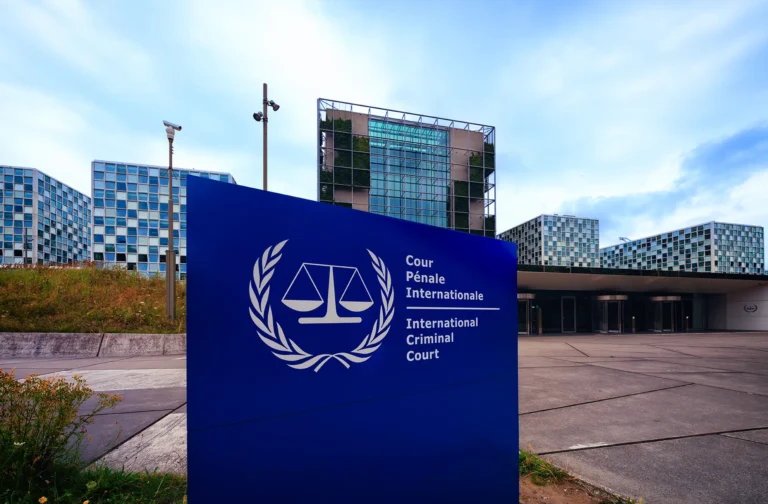
Shortly after his plane landed at the Ninoy Aquino International Airport (NAIA), the International Police Organization (Interpol) through the Philippine National Police (PNP), placed Duterte under police custody in view of an arrest warrant issued by the International Criminal Court (ICC).

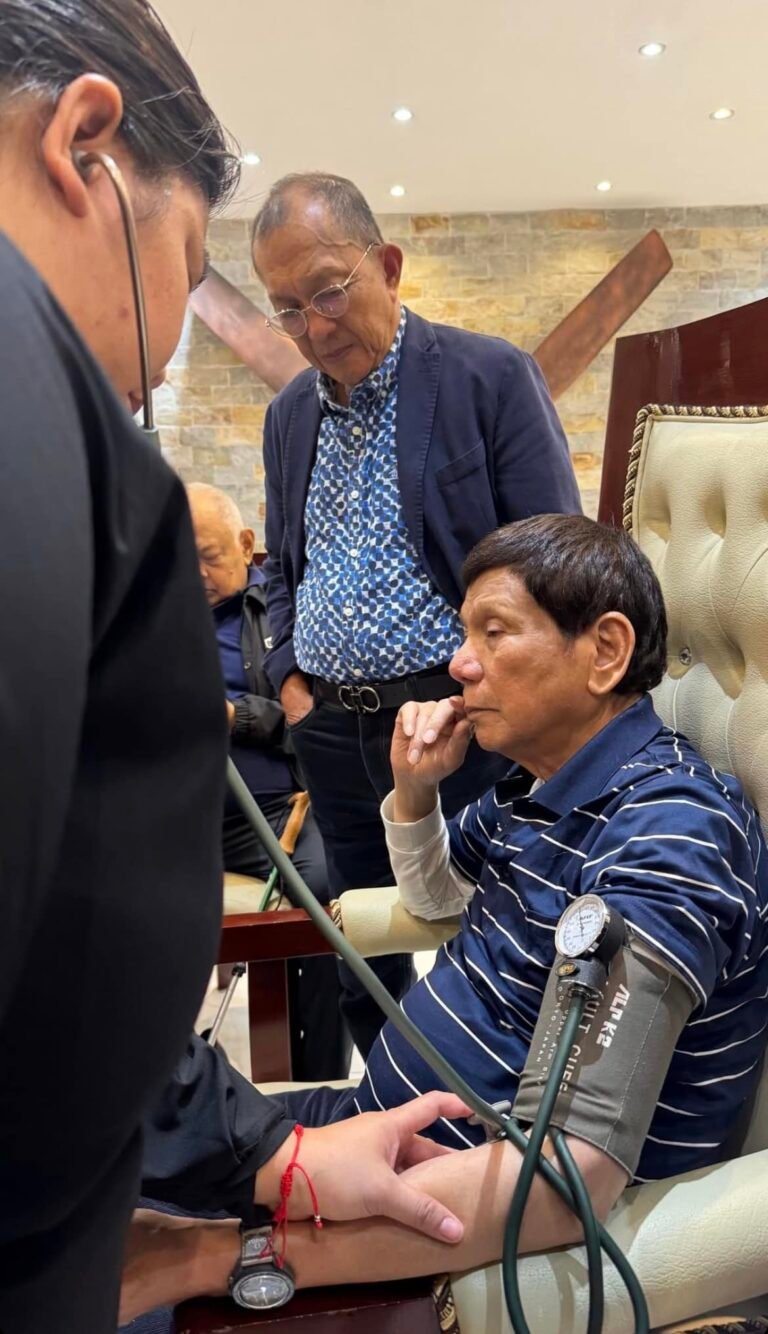
The 79-year old Duterte, according to the Presidential Communications Office (PCO) was “taken into custody” over alleged crimes against humanity filed before the ICC, was taken to the Villamor Air Base for medical check-up before the “booking procedures.”

“Ang dating Pangulo at ang kanyang grupo ay nasa mabuting kalusugan at sinuri ng mga doktor ng gobyerno. Sinigurado na siya ay nasa maayos na kalagayan,” reads part of the PCO statement.

“Ang mga opisyal ng PNP na nagpatupad ng warrant ay tiniyak na may suot na body camera. Sa ngayon, nasa kustodiya na siya ng mga kinauukulan,” the PCO added. 

BRUSQUE AND TOUGH

Prior to the “arrest,” a video shared by ABS-CBN showed Duterte on a confrontational mode before disembarking from the airplane which took him home from a campaign sortie in Hong Kong where he wooed overseas Filipino workers (OFW) to vote for the PDP senatorial bets.

“You will just have to kill me, kung hindi ako papayag kung, kakampi ka d’yan sa mga puti.” 

Duterte has since been denying allegations.The International Criminal Court (ICC) is investigating allegations that the death of around 30 individuals linked to illegal drugs during his stint as President is a state-sanctioned “crime against humanity”.

“Wala akong maalala na ginawa kong kasalanan. Marami akong ginawa na hindi nagustuhan ng iba or maybe lahat but I did it for my country,” Duterte said in an interview on SMNI, a media entity owned by his ally Pastor Apollo Quiboloy.

“Hindi ako yumaman, wala akong nakuha, pobre pa rin ako and wala kayong nakitang nadagdag na ni-isang nipa hut sa bahay ko. Wala kayo nakita na bagong kotse.” 

WELL-PLANNED ARREST

The police force, headed by PNP chief Gen. Rommel Marbil and Criminal Investigation and Detection Group chief Maj. Gen. Nicolas Torre III, earlier mobilized dozens of uniformed men in what appears to be “in anticipation of the arrest.”

PNP deployed hundreds of cops as part of implementing tight security at the NAIA Terminal 3 as early as 5:00 Tuesday morning amid Duterte’s scheduled arrival from Hong Kong.

Aside from Marbil and Torre, likewise present at NAIA Terminal 3 were former Labor Secretary Silvestre Bello, Senator Bong Go and representatives from the Interpol.

Meanwhile, long-time Duterte ally Sen. Christopher Go claimed that their airport pass was cancelled for which they were not able to come close to the former President.

“Hindi kami makapasok di na pinagbawalan lang kami pumasok. Kinansel lahat yung pass namin,” Go told reporters when sought for an update as to what happened to the former President.