Thursday, March 26, 2026
Home Blog Page 13

Winning Arguments: Without the Fight

EVER BEEN RIGHT in an argument… but everything still felt wrong? That’s the moment most people miss — the one that tells you something bigger is going on. Some people live to prove a point. And that’s usually when things quietly fall apart.

The Back Story 

Most arguments don’t start because people hate each other.
They start when everyone wants to be right at the same time.

  • Voices go up. 
  • Listening drops.

And before you know it, the point disappears — but the tension sticks around.

Being Right Isn’t the Same as Winning

Here’s the uncomfortable truth:
You can win the argument and still lose the relationship.

Winning an argument often looks impressive on the surface. 

  • You had facts. Logic. Receipts.

But emotionally? Something breaks.

People don’t walk away thinking, “Wow, great point.”

  • They walk away thinking, “I didn’t feel heard.”

And once someone feels dismissed, defensive walls go up. From there, no amount of logic gets through.

Arguments Are Rarely About the Topic

Most arguments aren’t really about what they seem to be about.

  • It’s not about the email.
  • It’s not about the meeting.
  • It’s not about who said what.

It’s about feeling:

  • Ignored.
  • Overlooked.
  • Disrespected.

The topic is just the delivery system.

That’s why doubling down with more words, louder explanations, or sharper tone almost never helps. 

  • You’re arguing content, while the real issue is connection.

The Quiet Power Move: Pause

Here’s where things shift. The strongest people in conversations know when to stop.

  • They pause.
  • They breathe.
  • They listen — even when they know they’re right.

That pause does something powerful.

  • It lowers the temperature.
  • It signals safety.
  • It tells the other person, “You matter more than my point.”

Ironically, that’s when people become more open to hearing you.

Winning Without the Fight

Winning without the fight isn’t about giving in.

  • It’s about choosing impact over ego.

It sounds like:

  • “Help me understand what you’re seeing.”
  • “That makes sense from your side.”
  • “Let’s slow this down for a second.”

These aren’t weak phrases.
They’re strategic. Human. Effective.

When people feel seen, they soften.
When they soften, real conversation can finally happen.

The Real Win

The real win isn’t proving you’re right.

The real win is:

  • Keeping trust intact
  • Preserving dignity
  • Leaving the conversation better than you found it

Because long after the argument is forgotten, people remember how you made them feel.

Tips And Techniques 

Next time you feel that surge — the need to correct, explain, or dominate the moment — stop.

Think. Then choose connection first.

Try this just once:

  • Win the relationship before you try to win the point.

That’s how arguments end without a fight — and how respect quietly takes the lead. 

Remember: Choose connection first — and win the moment.

One-Man Show In Samar-Leyte Power Coops

0

IN THE ISLAND provinces of Samar and Leyte, power distribution has gone from bad to worse as the National Electrification Administration (NEA) relegated the task of supervising three electric cooperatives to just one person.

In a case filed before the Office of the Ombudsman, the National Association of Electricity Consumers for Reforms (Nasecore) accused NEA administrator Antonio Almeda for illegal interference in the operations of several electric cooperatives.  

Aside from Antonio, likewise named respondents in cases filed by Nasecore President Pete Ilagan are Energy Secretary Sharon Garin, NEA Board of Directors Energy Undersecretary Mario Marasigan, Jovel Ubay-Ubay, Nollie Alamillo and Edgardo Piamonte. 

LOOKING BACK

According to Ilagan, the respondents in December 2024 designated Engr. Fernan Paul Tan as full-time general manager of Leyte Il Electric Cooperative and Northern Samar Electric Cooperative.

Interestingly, the same person was appointed as general manager (in an acting capacity) of the Samar II Electric Cooperative (Samelco II) — “without legal basis, without proper documentation and without the required NEA Board confirmations.

Tan was also designated chairman of Task Force NORSAMELCO exercising the functions of a Board of Directors, which according to Ilagan was without any justification. 

NO LEGAL BASIS

Ilagan categorically described the act of appointing a pointman in three electric cooperatives as illegal even as he claimed that such a maneuver overrides the authority of the EC (electric cooperative) president and board of directors. 

The case claimed that no documents were provided showing the expiration or the lifting of GM Joey Talon’s suspension for three months, hence the designation of Tan at SAMELCO II “is uncertain, unsupported and defective.”  

The appointment of Tan to multiple positions in three ECs, he added, is a clear violation of Presidential Decree 269, PD 1645, Republic Act 10531, RA 6713 and RA 3019 and the Administrative Code of 1987.

NOT A SUPERMAN

“Their actions demonstrate malfeasance, misfeasance, and nonfeasance, warranting administrative and criminal sanctions,” the case said.

For Tan to handle those responsibilities,” it would take superhuman abilities as his GM positions require fulltime work while his chairmanship of EC boards require remedial interventions in emergency situations.”

Tan can’t be in two places at the same time, more so with three responsibilities, the complainants said.

GOVERNING LAWS

Under PD 10531, NEA merely has supervisory, not plenary, control over EC personnel, neither the power to assign or deploy EC employees, nor the authority to appoint acting GMs for private coops or the authority to require ECs to finance NEDA-designated personnel.

Under Section 5 of RA10531, NEA can only “supervise the management and operations of all ECs. For this matter supervision means oversight and not control(which is a broader authority).

Ilaga is seeking that Administrator Almeda and the NEA board members be held liable for  gross and simple neglect of duty; grave abuse of authority; grave misconduct; conduct prejudicial to the best interest of the service; violation of RA 6713 and violation of RA 3019.

CRIMINAL LIABILITIES

Ilagan also prayed that criminal charges be filed against all respondents and that they would also be placed under preventive suspension under RA 6770.

He also asked the Ombudsman to require the production of all missing NEA office orders and resolutions, which NEA excluded from their numerous communications to the ECs.

Ilagan also sought the imposition of appropriate administrative penalties including dismissal from service, forfeiture of benefits and perpetual disqualification from public office.  

Goat-Raising: An Initiative Worth Trying

0

AMIDST THE SEEMING hopelessness rooted on years of poverty, the small village of Dalajican, Concepcion, Romblon has proven that there is still a light at the end of the tunnel as some 25 farmers from the LETS Farmers Association demonstrated the power of determination and teamwork in achieving success and a bright future. 

Among others, their fruit trees are integrated with a goat production project that is supported by the Special Area for Agricultural Development (SAAD) Program of the Department of Agriculture.

But the association’s success didn’t come easy, it first faced immediate obstacles when the project started in 2024. Their goats, initially raised in a communal area, suffered mortalities during a harsh El Niño season and they were only able to recover after the care of the goats were conducted by individual members and their households.

According to LETS president, Augustine Ferranco, “[they] distributed the goats among themselves and the result was good—they were well taken cared of and their numbers increased.” 

Looking back, the shift to individual care of the goats, Ferranco cited, yielded impressive results. LETS now boasts 56 healthy goats, including 24 kids, making it the largest herd among the goat production beneficiaries of the government’s SAAD program in Region 4B (Mimaropa). 

“Our decision to shift to individual care improved goat health and numbers, strengthening their bond and sense of responsibility. We’re grateful to SAAD for their support. We’re determined to keep working hard,” the association’s president enthused.

The Department of Agriculture, implementor of SAAD, lauded LETS initiative and success as a testament to community-driven development that would inspire other farming communities. 

And from this, Ferranco and his group are looking ahead—the association plans to dispose of mature goats, improve health and productivity, expand their fruit tree plantation and explore new markets.

“With our collective efforts, the LETS Farmers Association is poised to become a leading example of sustainable agriculture and community development in the Philippines,” he concluded.

Tough Year Ahead Due to Unresolved Scandal

THE UNRESOLVED flood control scandal coupled by geopolitical and economic uncertainties in the world will continue to drag Philippine economic growth which could fall below 4 percent.

According to Nomura Global Markets, the hundreds of billions flood control scandal alone affected government spending and dampened consumption and sentiment (both business and consumer).

“I think going forward, these spillover effects (from the graft scandal) will also expand,” Business World quoted Nomura ASEAN chief economist Euben Paracuelles in the program Money Talks with Cathy Yang on One News yesterday.

The scandal, which curbed state spending last year, is expected to dampen household consumption and business investment amid weaker sentiment, he added.

“If the drag is now sort of becoming more broad-based, not just the drop in government spending, you’ll see growth coming potentially below 4%, at least in the near term,” he said.

WITHIN THE TARGET

Nomura said it expects the gross domestic product (GDP) to expand by 5.3 percent in 2026 (from 5.6 percent previously) which  is still within the government’s recently-revised 5 to 6 percent target this 2026.

Economic Secretary Arsenio Balisacan earlier said growth targets were lowered through 2027, after GDP growth slowed to 4.8 to 5 percent in 2025 amid the flood control controversy.

The government cut its 2026 projection to 5 to 6 percent and to 5.5 to 6.5 percent for 2027 from the earlier 6 to 7 percent range. The 2028 target was retained at 6 to 7 percent.

Paracuelles anticipates that the government will roll out catch-up spending plans, possibly in the second half of the year.

RATING UPGRADE

Notwithstanding such obstacles, the Philippines may earn a credit rating upgrade if the government manages to resolve the flood control corruption issue within a year, Paracuelles said.

“The key for me is 12 months from here, when they need to decide on whether they need to upgrade the Philippines, I think it’s still quite uncertain,” he said.

“If, at that point there will be some resolution to the corruption scandal, they could potentially upgrade the Philippines to ‘A-,’ right? But on the other hand, if there’s still no clarity, they could potentially — the risk I see is from ‘positive,’ we go back to ‘stable,’” he added.

DERAILED BY FIASCO

Last year, former Finance Secretary Ralph Recto said the multibillion-peso flood control corruption mess may have derailed the country’s chances of earning a credit rating upgrade from S&P Global Ratings.

S&P said it kept its long-term “BBB+” and short-term “A-2” credit ratings on the Philippines, as well as its “positive” outlook.

A positive outlook means the Philippines’ credit rating could be raised over the next two years if improvements are sustained.

MOVING SIDEWAYS

Economic Undersecretary Rosemarie Edillion hinted at the peso moving “sideways” after hitting a fresh low on January 7.

“It really depends on what’s happening in the US as well versus what’s happening with our country. I think right now with the recent move of the US, everybody’s still weighing in. Is this a good or a bad thing?” she said in the same program on Thursday.

“Others will still adopt a wait-and-see attitude over the next few days,” she added.

BIR Assures Crook-Proof LOA In Place

0

TO PREVENT ABUSES like extortion and corruption, the Bureau of Internal Revenue (BIR) adopted a recommendation of its technical working group — to regulate the issuance of Letters of Authority (LOA) to just one for every taxable year.

A month after suspending the issuance of LOAs and mission orders, no less than Revenue Commissioner Charlito Mendoza hinted at the need to keep the only mechanism that would compel businesses to pay the right taxes to the government. 

CHECK AND BALANCE

According to Mendoza, the audit of the LOA system is now nearly complete after a month that the bureau introduced reforms to prevent unscrupulous revenue agents from using the system to harass taxpayers.

Mendoza explained that the review of the LOA system was meant to stop complaints about the issuances of multiple LOAs by different offices and officers within the bureau.

“Our technical working group is already in the advanced stages of the study,” Mendoza told newsmen, saying that “we are moving toward a streamlined, consolidated LOA framework.”

CLEAR PARAMETERS

Under the new system, taxpayers would receive only one LOA per taxable year, covering all internal revenue taxes. The reform has already been backed by Finance Secretary Frederick Go, the Inquirer reported.

“They [taxpayers] will no longer need to file documents repeatedly with different officers. We are also developing clear parameters that revenue officers must follow when issuing LOAs,” Mendoza assured.

He further clarified that while the BIR plans to reduce the number of offices authorized to issue LOAs, it is unlikely to be limited to just one.

Currently, he said, offices that could issue LOAs are: the Value-Added Tax Audit Section;  regional offices; the Large Taxpayer Service; the National Investigation Division for fraud cases and special task forces.” 

“As much as possible, we will reduce the number of offices that can issue LOAs. If we can implement a single LOA per taxable year based on risk-based parameters, it will be better for the taxpayer and easier for us,” he added.

BLOATED ASSESSMENTS

Millions of pesos were allegedly collected through bloated tax assessments conducted by some BIR personnel, who reportedly applied a 70/30 scheme, with the lion’s share pocketed by revenue officers, leaving 30 percent to the government.

Interestingly, Mendoza clarified that only around two to three percent of the agency’s collections come from the issuance of LOAs.

Just last year, a friend of mine, who owns a small resort and a few smaller businesses, was issued a LOA for which the officer demanded from him P5 million to clear him of the investigation. Pressured, he paid the officer concerned so that his business could continue operating without further hassle.

TARGET ALMOST MET

As of January 7, the BIR’s 2025 revenue collections stood at P3.103 trillion, about 3.4 percent shy of its P3.219-trillion target. Mendoza conceded that it is now unlikely for the agency to meet its full-year target.

Mendoza said that for 2026, the tax collection target is possibly around P3.5 trillion, but he is still waiting for the announcement from the Development Budget Coordination Committee. 

“For now, we are setting our goal on that na P3.58 trillion and that will be around 15.5 percent increase from our collection,” he added.

The BIR remains optimistic about a revenue rebound in 2026 after missing its target with a 2025 performance of P3.105 trillion.

AFFECTED BY SCANDAL

Mendoza told Business World that the preliminary figure for 2025 is net of refunds. “The total came in 3.56% below the full-year target but exceeded the 2024 collection total of P2.85 trillion.”

“During the second half, starting July, when the flood control investigations started, our revenue collection efforts were really significantly affected, primarily because of the slowdown in spending,” he intimated to reporters on Thursday.

Mendoza said he remains “very optimistic” that momentum will build following a 7.5% increase in December revenue. “We will do our best to hit the target. The government needs it. We have many projects that need funding,” he said.

NEW LOA FRAMEWORK

The BIR suspended field audit operations in December in the face of allegations the audit process is being used for extortion.

For 2026, the BIR is tasked to collect P3.58 trillion, 11.19% higher than its 2025 target.

Mendoza added that the BIR is moving towards a streamlined, consolidated LoA framework — “We’re looking at the possibility of having just one letter of authority per taxpayer per taxable year, covering all internal revenue taxes,” he said.

NO TO VAT REDUCTION

Insofar as legislative tax-related proposals are concerned, Mendoza expressed apprehensions over a proposal seeking to reduce the value-added tax rates.

Mendoza said a slash in the value-added tax rate will significantly impact collections.

“It’s a policy decision that belongs to Congress. What we do is tax administration. We do our best to maximize collections (by being) efficient… but fair,” he added.

Legislators have proposed to reduce the 12% VAT rate to 10%.

Mahiya Naman Kayo!

0

“Mahiya Naman Kayo!” snugly fits what the Filipino people is telling President Bongbong Marcos and VP Sara Duterte this new year of 2026. 

Actually, “Mahiya Naman Kayo!” is also addressed to the president’s cabinet secretaries, the senators and congressmen. The current crop of the country’s top public officials does not seem to be concerned about moving on to untangle the country’s political, economic and socio-cultural mess left by the bloody reign of the ICC jailbird, the civilian Rodrigo Roa Duterte, when he was a mayor and president in the past.

This “Bagong Pilipinas” administration has not been doing its job, as called for in the Constitution, that is, essentially “to build a just and humane society.”

“[T]he senators who were constitutionally mandated forthwith to serve as an impeachment court, archived the impeachment of VP Sara Duterte. 
It appears the majority of the senators … chose to put aside the interest of justice, and preferred showing their political canine loyalty to the Dutertes.”

Waiting For The Promise

The people are still patiently, although many are now impatiently, waiting for the availability of the promised P20/kg of rice and affordable vegetables, fruits, fish and meat in the market. The laborers, farmers, fishermen and IPs are clamoring for a daily wage of P1200, to afford themselves a life of decency and dignity for themselves and their families. This cry for a decent wage is also an ardent wish for the millions of unemployed working-age Filipinos, that is, once they have been aided, if ever, by the Marcos-Duterte administration to have jobs or livelihoods. 

Millions of Filipinos are homeless and/or landless, but this so-called “Bagong Pilipinas” administration has so far neglected them.

This leadership tandem somehow does not see the need for millions of Filipinos to be given opportunities to enjoy decent lives for themselves. This tandem has broken up. VP Sara Duterte chose to go on a warpath, publicly criticizing President Bongbong for his failings, as if she were not a part of the administration. The truth is she has been shameless and hypocritical with her sound bites. She failed to improve the country’s education system even a bit, when she served concurrently as secretary of the Department of Education (DepED). 

On the contrary, she took advantage of her stint at the DepEd stealing the people’s money by spending in only 11 days P215 million, a part of her department’s budget.

Along with this sin against the people, VP Sara Duterte has been charged for violation of the Constitution, betrayal of public trust, and other crimes, meriting her impeachment, as called for by the House of Representatives.

Political Canine Loyalty

Unfortunately, the senators who were constitutionally mandated forthwith to serve as an impeachment court, archived the impeachment of VP Sara Duterte.

It appears the majority of the senators, led by SenatorChiz Escudero, chose to put aside the interest of justice, and preferred showing their political canine loyalty to the Dutertes.

The ICC jailbird Rodrigo’s record of about 30,000 EJKs has been practically adopted by the Bongbong-Sara administration. It is into EJKs, courtesy of the notorious NTF-ELCAC’s red-tagging and terrorist-tagging operations, as documented by the Human Rights defender KARAPATAN.                   

What is also “nakakahiya” about this Bongbong-Sara regime, sadly for the Filipino people, and perhaps forthe international community as well, is the clear lack of basic management guidelines and protocols to ensure that key government officials do their jobs responsibly with integrity, and to prevent any leeway for them to be corrupted. 

Billions Of People’s Money

As the congressional investigations of the DPWH projects have shown, billions of the people’s money was stolen by senators, congressmen, cabinet officialsand private contractors of flood-control and other infrastructure projects nationwide.

As of January 2, 2026, no senator, congressman or cabinet official has been charged and jailed for corruption. Will the people enjoy a Happy New Year? 

Or, per SOP, only the corrupt top leadership, and their crony-politicians?!

Colonel Sacked For Dumping Marcos Jr.

0

DAYS AFTER POLICE operatives from the Criminal Investigation and Detection Group (CIDG) arrested a retired army general for calling for the ouster of President Ferdinand Marcos Jr., the Armed Forces of the Philippines (AFP) relieved an army colonel for withdrawing his support for the commander-in-chief.

Army Colonel Audie Mongao, a commissioned officer with 34 years of active service, went to the social media reaffirming support for the AFP and the Constitution – but not for the President.

“He has lost his moral ascendancy to lead the Armed Forces as Commander in Chief and govern the Filipino people as President of the Republic,” Mongao declared. He concluded his message with the emphatic phrase, “Sobra na, tama na!” and the rallying cry, “The Filipino people are worth fighting for… Mabuhay ang Pilipinas!”

According to Philippine Army spokesperson Colonel Louie Dema-ala, he has already been relieved as Director of the Training Development Center where new soldiers are honed.

“By the direction of the Commanding General, PA, Col. Mongao was immediately relieved from post and put into A/U status to give way for a thorough investigation by Training Command,” Dema-ala said.

Interestingly, Dema-ala said that a probe team has been formed to check whether it was really Mongao himself who posted the alleged withdrawal of support. 

According to Army Training Command chief Major Michael Logico, Mongao, who is on New Year’s break, has been “out of reach” since the social media post came out.

“Investigation is underway to determine possible administrative and legal charges that may be imposed upon him in relation to his online statement,” Logico said.

Despite this, he said that the Army is still trying to reach Mongao to offer “emotional support,” adding that Mongao remains his responsibility.

Photojourno Dies In Line Of Work

0

ALIENATED LABOR. That’s what being a journalist is all about. Loose change for a lot of life-threatening occupational hazards.

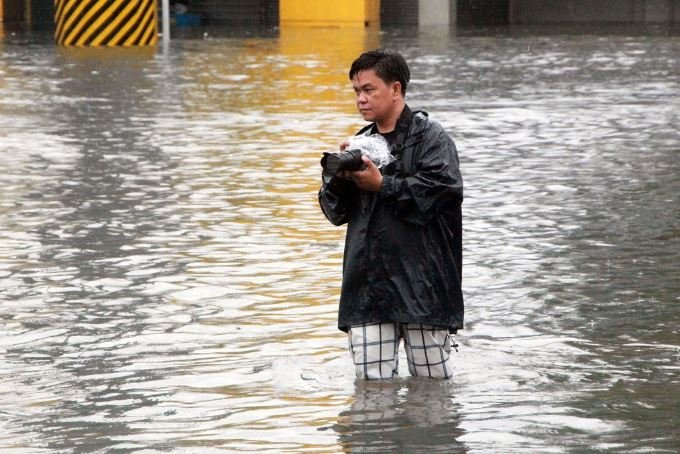
This comes as Sonny Fernandez, former director of the National Union of Journalists in the Philippines (NUJP), called on media entities to seriously consider the welfare of media workers — like Itoh Son, a photojournalist who died early today while covering the Traslacion at the Quirino Grandstand in Manila.

Son, who comes from a family of mediamen, worked as news photographer of Saksi Ngayon, a daily tabloid notoriously famous in the media industry for non-payment of reporters, correspondents and contributors.

For the longest time, NUJP has been advocating for the safety and welfare of Filipino journalists. 

According to fellow journalists covering the Traslacion, Son suffered a heart attack early Friday morning near the Quirino Grandstand.

Prior to his death, peers at the Manila beat claimed that he had been sick for days but continued covering pre-Traslacion events, including the “Pahalik.”

Cebu Trashlide Buries Workers

1

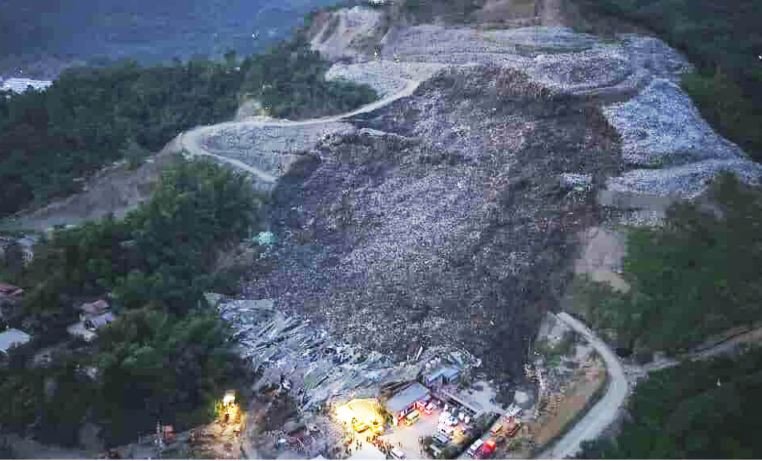
AT LEAST 38 workers were buried under hazardous waste following a collapse of a privately-owned and operated landfill in Barangay Binaliw, Cebu City.

According to the local government, a woman died even before reaching the hospital, while 38 other individuals have yet to be found by the search and rescue teams. Twelve were injured.

Local media reported that the workers were trapped in an avalanche of garbage and debris from a waste management facility owned by Prime Waste Solutions Cebu.

The rescuers deployed by the Cebu City government, however, admitted difficulties in searching for the missing individuals in view of “hazardous conditions.” 

In a report which appeared on Sky News, Councillor Joel Garganera, chair of the city council’s environment committee, expressed serious concern on the search and rescue operation.

“The steel trusses are massive, the garbage is soft, and there is a constant risk of movement… there is also a serious concern about toxic air, which could endanger anyone trapped for too long,” Garganera was quoted as saying.

One of the injured landfill workers named Joey Boy Gealon, recounted hearing screams and loud crashing sounds.

According to Gealon, they have long been warning Prime Waste Solutions Cebu about the formation of a trashhill at the dumpsite. 

In a statement, Prime Waste Solutions Cebu said: “The safety and wellbeing of our employees, contractors, and neighbouring communities remain our top priority.”

One of the buildings hit by the wall of debris which cascaded down in the landfill was a warehouse where workers separate recyclable waste and rubbish, said Central Visayas regional police command Brig. Gen. Redrico Maranan.

PH Peso’s Record Lows Keep Falling

0

THE PHILIPPINE PESO is no longer merely hitting record lows; it is breaking them so frequently that each new “all-time low” feels less like a shock and more like a pattern.

On January 7, 2026, the Philippine peso sank to a fresh historic low against the U.S. dollar, closing at P59.355 to $1, surpassing its previous all-time record set in December 2025.

FURTHER RATE CUTS

Rizal Commercial Banking Corp. Chief Economist Michael Ricafort pointed to dovish signals from the Bangko Sentral ng Pilipinas (BSP), particularly the possibility of another 0.25 percentage-point rate cut, which could further narrow the interest rate differential with the U.S. Federal Reserve.

The BSP had already cut its benchmark interest rate by a quarter point to 4.5 percent in December, while economists are expecting another 0.25 percent cut in the first quarter of 2026.

BSP Governor Eli Remolona Jr. had earlier signaled that the central bank’s easing cycle could end with just one more rate cut, unless “bad surprises” emerge that would justify further reductions.

The government has also remained firm in allowing market forces to determine the exchange rate.

WORSENING CLIMATE

Ricafort also cited other factors, such as higher unemployment and mounting national government debt, as contributors to the peso’s weakness.

“On external developments, the dollar-peso rate also moved higher after the U.S. dollar index climbed to near one-month highs, amid a shift toward safe-haven assets such as gold and the U.S. dollar, as investors turned risk-averse,” he said.

Reyes Tacandong & Co. senior adviser Jonathan Ravelas echoed this view, describing the peso’s slide as a “knee-jerk, risk-off reaction.”

NOTHING NEW

While this new record—and the broader peso trend—is alarming, it is not an isolated event but the latest in a series of all-time lows stretching from 2025 into 2026.

In October 2025, the peso first breached the P59-to-$1 level, closing at P59.13, then a historic low.

Notably, the cited causes are also not new.

The decline was largely attributed to the flood control scandal, which involved trillions allegedly lost to substandard and ghost projects.

OUTLOOK DOWNGRADES 

The controversy dented investor confidence and prompted growth outlook downgrades from institutions such as the International Monetary Fund (IMF), Asian Development Bank (ADB), and the ASEAN+3 Macroeconomic Research Office (AMRO).

The currency continued to weaken in early December 2025, hitting P59.22 as markets braced for another BSP rate cut.

Philippine Institute for Development Studies (PIDS) Senior Research Fellow John Paolo Rivera said that, aside from a strong dollar, “weak third-quarter growth, delayed government spending, and lingering confidence issues have made investors more cautious, reducing foreign inflows and putting additional pressure on the peso.”

POOR GOVERNANCE

Former BSP Deputy Governor Diwa Guinigundo earlier remarked during the October peso drop that political uncertainty and poor governance were driving investors away, citing a growing “culture of impunity.”

Entering 2026, justice remains elusive, as public attention faded over the holidays and accountability stalled.

Economists have been consistent in warning that the massive corruption scandal in infrastructure projects and the slow, selective pace of investigations continue to weigh on economic confidence.

TRUST FACTOR 

Ricafort said potential positives for the peso include “some progress in the judicial process related to the anomalous or controversial flood-control infrastructure projects, such as arrests, cases filed, asset freezes, and other enforcement actions.”

But if the peso’s trajectory is any indication, trust and confidence in the economy are also at record lows.

Both Ricafort and Ravelas believe the peso could soon breach the P60 mark and slide toward P61 by the end of the year.

Ricafort added that the peso’s ability to avoid the P60 threshold in the near term will depend heavily on whether the BSP intervenes in the foreign exchange market to smooth volatility.

13th Tax Case: BIR Sues Wawao Builders

0

THE BUREAU OF Internal Revenue filed today its 13th tax fraud case against those involved in anomalous flood control projects, this time involving Wawao Builders owner, Mark Allan Arevalo.

Arevalo is the owner and general manager of Wawao Builders, a major construction firm that received numerous government contracts, including high profile ghost and substandard flood control projects in Bulacan and other areas, which led to a Senate investigation and criminal charges and now, the tax fraud cases by the BIR.

P48.39M TAX DEFICIENCY

The BIR filed before the Department of Justice (DOJ) a P48.39 million tax deficiency case against Arevalo arising from a ghost flood-control project in Malolos City, Bulacan.

The complaint was filed by Revenue Commissioner Charlito Mendoza over Arevalo’s riverbank protection in Malolos, which was found to be non-existent despite his claims of full completion.

“He (Arevalo) received the money, but no flood control project was actually made. So, it’s a ghost project, and then when he filed his returns, he declared costs for the alleged construction of the project,” Mendoza told newsmen.

INTERNAL REVENUE CODE

The BIR said Wawao Builders violated Sections 254 and 255 of the National Internal Revenue Code, accused of tax evasion and failing to provide accurate information in its income tax and value-added tax (VAT) returns for the first two quarters of 2024.

The bureau’s investigations revealed that Wawao Builders was awarded a P77.20 million contract for a riverbank protection structure in Barangay Caingin, Malolos, and collected P72.37 million net of withholding tax in three tranches from March to April 2025, but no such structure was ever built.

Physical verifications by the BIR and reviews by the Commission on Audit confirmed the project site remained untouched, despite reports indicating 100% completion.

“He (Arevalo) received the money, but no flood control project was actually made. It’s a ghost project,” Mendoza said.

And when Arevalo filed his returns, he declared a cost for the alleged construction of the project. But since wala naman proyektong ginawa, so yung mga dineclare niya na deductions, operating costs are fictitious,” he said.

WAWAO NOT THE LAST

Mendoza said they were reviewing more individuals linked to the flood control controversy.

“This is already the 13th case the BIR has filed. And the aggregated tax liability is now close to P9 billion na. And more cases are expected to be filed,” the official said.

BIR filed last year similar complaints against Sarah Discaya, Curlee Discaya for over P7.1 billion and other officials of contractor firms linked to the flood control issue.

In addition to the Discayas, the BIR is also preparing similar tax evasion charges against former Public Works and Highways engineers Henry Alcantara, Brice Hernandez, and Jaypee Mendoza.

P6 BILLION IN 3 YEARS

Reports said Wawao Builders has received over 85 contracts from the DPWH worth nearly P6 billion in Bulacan alone between 2022 and 2025.

During the Senate hearings, Arevalo repeatedly invoked his right against self-incrimination when asked direct questions about “ghost projects” or potential payoffs to lawmakers, which drew the ire of senators and public scrutiny.

Arevalo claimed that his company’s contractor license was “forcibly used” in a scheme to corner infrastructure projects, suggesting he may have been a “dummy” owner or involved in a broader syndicate.

Every Peso Is A Promise

AS OUR NATION prepares to implement the 2026 National Budget of 6.793 trillion pesos, we do so at a time when the Filipino people are grappling not only with economic pressures but also with a deep erosion of trust in public institutions. 

The recent revelations about nonexistent projects—allocations released, but no work done; funds spent, but no communities served—have shaken our collective conscience.

Corruption of this kind is not merely a technical failure. It is a moral failure, a betrayal of the people’s trust, and a grave injustice against the poor who rely most on government services. 

When projects exist only on paper, it is the ordinary Filipino who pays the price: the farmer waiting for irrigation, the student needing a classroom, the patient hoping for a functioning health center.

This moment must serve as a wake-up call for our nation.

A wake-up call to those in power—to lead with integrity, to reject the culture of impunity, to remember that public office is a sacred stewardship, not a personal entitlement.

Let it be said clearly: The national budget is not your personal wallet. It is not meant for signature bags, lavish trips, fine dining, nor for sending your children to study abroad at the expense of the poor. It is entrusted to you for the common good of your constituents.

This is also a wake-up call to the Filipino people—to be more vigilant, to demand transparency, to participate actively in safeguarding the nation’s resources.

A national budget is not simply a financial plan. It is a moral document that reveals our priorities and values. 

May this year’s budget become an instrument of renewal—an opportunity to rebuild trust, restore accountability, and ensure that every peso truly serves the common good.

Prayer for the Philippines, Our Leaders, and the 2026 National Budget

God of truth, justice, and mercy, We come before You carrying the burdens of our nation. You see the wounds caused by corruption,the disappointment of broken promises, and the pain of communities left behind by projects that never existed.

Lord, heal our land. Awaken the hearts of our leaders. Give them the courage to confront wrongdoing, the humility to correct past failures, and the integrity to serve with honesty and compassion.

May this moment of national reckoning be a turning point— a call to become better leaders, faithful stewards of the resources entrusted to them. 

Awaken also the hearts of Your people. Teach us to be vigilant and discerning, to speak the truth with love, and to participate actively in building a society where justice prevails and where no one is left behind.

Bless the 2026 National Budget, O Lord. Purify its intentions, guide its implementation, and protect it from corruption and misuse. 

May every peso reach the communities it is meant to uplift— the poor, the workers, the farmers, the youth, the elderly, and all who long for a better future.

Under the mantle of Nuestra Señora de la Paz y Buen Viaje, guide our nation toward peace, integrity, and renewal. 

May Your Spirit restore trust where it has been broken and lead us toward a future where justice and compassion reign. We ask this through Christ our Lord. Amen.

(Editor’s Note: Ruperto Cruz Santos is the Bishop of Antipolo and currently CBCP Bishop Promoter of Stella Maris-Philippines.) 

Lawmakers Face Raps, Martin Not On The List

0

SOON enough, criminal charges will be filed against Senators Jinggoy Estrada and Joel Villanueva, former senator Bong Revilla and three  congressmen over the so-called flood control corruption scandal.

Citing information from her own sources, Sen. Imee Marcos tagged CWS partylist Rep. Edwin Gardiola, Benguet Rep. Eric Yap and ACT-CIS partylist Rep. Edvic Yap among those who’ll be charged come January 15.

However, Imee finds it rather strange that her cousin — former House Speaker Martin Romualdez is not on the list of legislators who will be made accountable for the biggest fund scandal ever to rock the government.

“It makes me sad that only senators are being targeted even if it’s Bonjing and the speaker’s office that were the sources of corruption in flood control,” a sarcastic Imee said in reference to Romualdez.

IMEE’S PREDICTION

Sometime in November last year, the senator hinted at the possibility of  Senate witness Orly Guteza recanting his testimony linking Romualdez and former Ako Bicol partylist congressman Zaldy Co to the flood control controversy.

Imee likewise claimed that there was, so far, no direct evidence linking Senators Francis Escudero and Mark Villar, and former senators Nancy Binay and Grace Poe, to so-called “ghost” or substandard flood control projects.

Escudero, Villar, Binay and Poe denied involvement in the flood control scandal which triggered large-scale protests calling for accountability among government officials.

PROTECTING MARTIN

She also claimed that her peers at the Senate Blue Ribbon committee members were being prevented from linking certain administration personalities from a fund mess that saw limited government funds wasted in view of kickbacks via ghost projects.

Senate President Vicente Sotto III  and Senate President Pro Tempore Panfilo Lacson however denied Imee’s sweeping allegations.

“That’s impossible. Nobody’s preventing anyone from doing anything. Sen Lacson might get mad at such an accusation. Imbento,” Sotto said.

“Out of respect for all the senators of the 20th Congress and the hardworking staff of the Blue Ribbon committee, I choose not to dignify Sen Marcos’ unfair, untruthful and baseless accusations,” Lacson, for his part, said.

TOKEN INVESTIGATION

In an earlier zoom press briefing, Imee wished that Senator Rodante Marcoleta be reinstalled as chairman of the Senate Blue Ribbon committee.

According to the presidential sister, such a move would allow the August Chamber to regain public trust, citing survey results which saw the Senate numbers plunging to a record-low.

Imee also took a swipe at the Department of Justice’s selective policy in its investigation, which according to the senator has been limited to senators both former and current.

Timeless Escapes In An Island Where Sun Never Sets

FAR FROM ABOVE the Arctic Circle, off the northern coast of Norway, lies Sommarøy—a small island that captured global attention for an unusual idea: living without time. 

In this remote community, daily life appears to flow not by clocks or schedules, but by nature itself. The reason is simple yet extraordinary—here, the sun does not set for more than two months.

MIDNIGHT SUN

During summer, Sommarøy experiences the Midnight Sun, a natural phenomenon in which daylight lasts 24 hours a day for about 69 consecutive days, from mid-May to late July. 

In winter, the opposite occurs. The island endures nearly 70 days of polar night, when the sun never rises above the horizon. 

With such extreme cycles of light and darkness, conventional timekeeping often feels irrelevant.

TIME-FREE ZONE

This unique rhythm sparked worldwide fascination in 2019, when reports emerged that Sommarøy had declared itself a “time-free zone.” 

According to early accounts, residents had abandoned clocks, removed watches, and even hung them on the bridge connecting the island to the mainland as a symbol of leaving time behind. Shops, schools, and daily activities were said to operate freely, guided only by human energy and natural light.

Images and videos spread rapidly on social media. One widely shared post asked: “Would you live in a place without time?” The story resonated deeply in a fast-paced world exhausted by deadlines and alarms.

However, the truth later emerged. The “time-free” concept was not a legal or permanent change, but a tourism promotion campaign initiated by Innovation Norway, the country’s tourism board. 

While the idea reflected the island’s real lifestyle flexibility, the abolition of time was symbolic rather than official.

ARCTIC WAY OF LIFE

Innovation Norway’s director later issued a public apology, acknowledging that the campaign had been misleading. 

Reports revealed the project cost roughly 50,000 euros, spent on public relations agencies in Norway and abroad. 

Though controversial, the campaign succeeded in drawing global attention to Sommarøy’s extraordinary Arctic way of life.

CARIBBEAN OF THE NORTH

Beyond the headlines, Sommarøy remains a place where nature truly shapes daily living. Located about 36 kilometers west of Tromsø, the island is home to just over 300 residents. 

It is famous for its white sand beaches and turquoise waters—earning it the nickname “the Caribbean of the North.”

Life on the island continues normally, but with a distinctive twist. During summer, it is common to see people mowing lawns, painting houses, kayaking, or children playing football at two or three in the morning—under full daylight. 

Many residents install blackout curtains to sleep, while others simply adapt their routines to when they feel tired or energized.

EARTH’S TILTED AXIS 

The science behind this phenomenon is well established. Earth’s axis is tilted at approximately 23.5 degrees, causing regions above the Arctic Circle to remain within the sun’s path during summer months. 

As a result, the sun never dips below the horizon. During winter, the tilt creates prolonged darkness.

Sommarøy is not alone in experiencing this phenomenon. Other Arctic regions—including Svalbard, Greenland, northern Iceland, Alaska, and Canada’s Arctic Archipelago—also witness the Midnight Sun. Yet Sommarøy stands out for how visibly it embraces this natural rhythm.

DISORIENTED SLEEP

For travelers, visiting the island is often described as surreal and liberating. Many report a sense of freedom from schedules, a deeper calm, and a renewed connection with nature. 

Others admit initial disorientation and difficulty sleeping due to constant daylight, but most adjust within days.

In the end, Sommarøy is not truly an island without time—but it is a place where time loosens its grip. 

Here, the sun dictates the rhythm, reminding the modern world that life does not always need to move by the clock.

Hyundai IONIC 9 Shifts Fundamentals For Electric Mobility

THE HYUNDAI IONIQ 9 has arrived in Singapore, showcasing fundamentally shifts on what families can expect from electric mobility. 

Hyundai’s new flagship SUV, a fully electric vehicle (EV), will set the brand as the “Master of Space,” with the largest range of 7-seater options coming into 2026. The IONIQ 9 addresses the final frontier: a spacious, luxury option for the multi-generational household that refuses to compromise on style or range. 

“IONIQ 9 is a three-row SUV that accommodates up to seven occupants, providing impressive space and features that cater to individuals’ needs whilst offering a sense of togetherness — it is truly a ‘Master of Space’,” Hyundai said in a statement.

The vehicle features generous space and impressive interior flexibility, with technologically advanced features and a lounge-like atmosphere that encourages connection among passengers.

A Sanctuary in Motion

The IONIQ 9 embodies Hyundai’s philosophy of “Progress for Humanity,” shaping a vehicle that caters directly to Singapore’s culture of providing multi-generational comfort. This principle shifts the interior experience away from a utilitarian “cabin” to a holistic “lounge.” The interior uses elliptical design elements and calming nature-inspired tones to present a calming atmosphere the moment you close the door.

“We’ve seen generations of families come to trust Hyundai over the years, because that’s what Hyundai stands for. The IONIQ 9 is no different — built on trusted technologies and safety standards that have kept our Hyundai families safe for decades,” said Teo Hock Seng, Executive Chairman of Komoco Motors, the distributor of the brand in Singapore.

“This 7-seater doesn’t compromise, you have the space and luxuries for every adventure.”

The interior of the Flagship EV SUV is designed to enhance the quality of living space, and Hyundai’s new 7-seater builds on that idea with the Universal Island 2.0 — a sliding console that moves 190mm backwards, extending the lounge space to second-row passengers and offering easy-to-access controls for climate and seat ventilation. Three-zone climate control and roof-mounted air vents ensure the third row doesn’t feel like a sauna during midday drives.

IONIQ 9 is built on Hyundai Motor’s dedicated E-GMP architecture, featuring an enhanced power electronics (PE) system that gives drivers confidence on any terrain through its optimized gear ratio for hill climbing and an advanced two-stage inverter for improved efficiency.

Innovative Platform

This innovative platform delivers what matters most to electric SUV owners: exceptional range from its high-capacity battery, a flat floor that maximizes interior space for both passengers and luggage, and outstanding safety through its robust body structure engineered for optimal collision protection.

Energy efficiency is further enhanced by smoothing and balancing airflow under the vehicle’s body, as well as achieving reduced wheel and tire resistance. A new dual-motion active air flap (AAF) system has been applied for the first time, designed to enhance aerodynamic efficiency by allowing cooling air for the drive system and battery to flow through only when necessary. When this level of cooling is not required, the flaps close to minimise air resistance.

Other aerodynamically optimized solutions on the IONIQ 9 include a 3D-shaped underbody cover, aerodynamic wheel designs and hidden antennas.

World’s 1st Solar Nation Exploring More RE Sources

0

IN TODAY’S GLOBAL crisis, energy security remains a fragile balancing act for many island communities. Geographic isolation, heavy dependence on imported fuel, and growing climate threats make fossil fuels both costly and unsustainable. 

Yet in 2012, a tiny Pacific territory quietly rewrote global energy history. Tokelau became the world’s first nation to generate nearly 100 percent of its electricity from solar power—proving that even the most remote places can lead the renewable energy revolution.

As of 2026, Tokelau continues to be recognized globally as a pioneer in clean energy. It first achieved its status as a “100% solar-powered nation” in November 2012, setting a benchmark that remains unmatched in political history.

LATEST DEVELOPMENTS

More than a decade after its historic transition, Tokelau’s focus has shifted to modernization and long-term sustainability. Tropical heat, salt corrosion, and rising electricity demand have prompted system upgrades to ensure reliability.

By late 2025, older lead-acid batteries were replaced with advanced lithium-ion storage systems, delivering double the energy capacity within a smaller footprint. 

Additional solar arrays—totaling approximately 210 kilowatts—were installed across the three atolls of Atafu, Fakaofo, and Nukunonu to help meet growing demand.

While solar remains the backbone of Tokelau’s energy supply, authorities are now exploring a diversified renewable mix, including wind power and coconut-derived biofuels, to supplement generation during extended periods of low sunlight.

A strategic evaluation of the Tokelau Country Plan is scheduled for 2026, supported by New Zealand’s Ministry of Foreign Affairs and Trade (MFAT). The review will assess grid sustainability and outline future pathways for energy security.

ENERGY PERFORMANCE

Despite its pioneering status, Tokelau faces challenges common to remote microgrids. 

While the system was originally designed for full solar capacity, rapid growth in electricity consumption means solar currently supplies about 75 to 80 percent of total demand. Even so, diesel fuel use has dropped dramatically—by nearly 80 percent compared to pre-solar levels.

Local capacity building remains a priority. Tokelauan technicians have undergone specialized training to manage inverters and battery systems, ensuring long-term self-reliance. 

Ongoing funding and technical support from New Zealand continue to reinforce Tokelau’s role as a global benchmark for renewable energy independence.

NATION AT RISK

Tokelau is a non-self-governing territory of New Zealand composed of three low-lying coral atolls with a combined land area of just 10 square kilometers and a population of around 1,500. Located some 500 kilometers north of Samoa and accessible only by sea, the islands have no airport and remain among the world’s most climate-vulnerable communities.

For decades, Tokelau relied entirely on imported diesel fuel. Deliveries were expensive, unreliable, and environmentally damaging. Rising oil prices strained public finances, while carbon emissions threatened the very survival of these low-lying islands.

Faced with these risks, Tokelau made an unprecedented decision: to abandon fossil fuels altogether.

SOLAR TRANSITION

In 2012, with funding from the New Zealand Aid Programme, Tokelau launched an ambitious renewable energy project implemented by PowerSmart Solar in partnership with IT Power Australia. Approximately 4,000 solar panels, hundreds of inverters, and more than 1,300 heavy-duty batteries were installed across all three atolls.

By October 2012, the systems were fully operational. Instead of supplying the expected 90 percent of electricity needs, the solar grids delivered up to 150 percent of demand—creating a reliable surplus.

Overnight, Tokelau became the first political entity in modern history to achieve near-total electricity self-sufficiency using solar power alone.

GLOBAL TEMPLATE

Tokelau’s success resonated far beyond the Pacific. It became a powerful symbol at international climate forums, proving that political will, community commitment, and smart technology can drive transformative change.

In choosing sunlight over diesel, Tokelau did more than power its homes. It illuminated a global path toward a cleaner, more resilient future.

FMJ To PCG: Board Ships, Spot Aliens

0

THE PRESIDENT must have learned a lot from the manner in which the Americans pulled an amazing stunt that caught Venezuela by surprise.

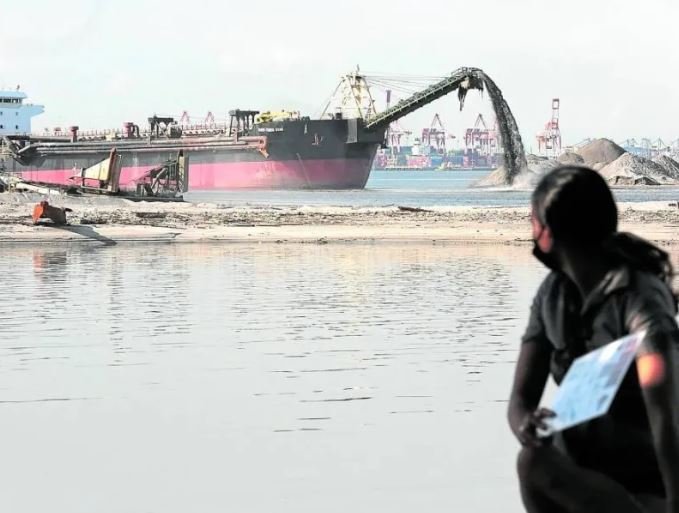
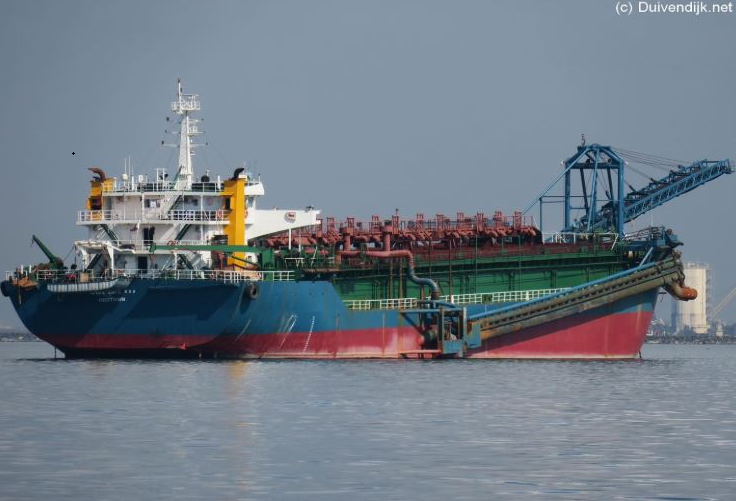
This comes as President Ferdinand Marcos Jr. ordered the Philippine Coast Guard to board and inspect all registry and AIS (automatic identification systems) of vessels operating within the Manila Bay reclamation sites following reports that a Chinese-made dredging ship – Kang Ling 539– has worked under six different country flags – the Philippines, Sierra Leone, China, São Tomé and Príncipe, and Panama, while doing dredging work.

THANKS TO POWELL 

Taking cue from a January 5 article published by renowned security analyst Ray Powell, that the China-made vessel had used many different identities while travelling between Manila and a dredging site in Zambales for over two years.

Citing a PCH statement, Palace Press Officer Claire Castro on Tuesday said the ship stopped showing its Philippine identity while it dredged four hours at the mouth of the Sto. Tomas River in Zambales.

After returning to Manila Bay, it reverted to its Philippine identity, Powell wrote.

Powell, director of Sealight, found the vessel simultaneously broadcasts multiple identities through its Automatic Identification System, switching between Philippine and Sierra Leone flags depending on its location. 

PRESIDENTIAL ORDER

The presidential order came two days after Powell’s story was published showing how a single Chinese-origin dredger has broadcast at least 30 different identities while shuttling between Manila Bay and a dredging site in Zambales for over two years.

Last weekend, the ship dropped its Philippine identity while conducting a four-hour dredging operation at the mouth of Santo Tomas River, then reverted to its Philippine identity upon re-entering Manila Bay.

Philippine law requires dredgers moving sand between Philippine points to be at least 60% Filipino-owned, Philippine-flagged and registered, and crewed by Filipinos. 

Foreign-owned or foreign-flagged dredgers cannot legally perform routine dredging operations unless reflagged and placed under qualified domestic ownership, the Philippine Star reported.

DREDGING OPERATIONS

To recall, last May Marcos ordered a probe of all dredging operations nationwide amid mounting environmental concerns and reports that Philippine sand was being diverted to Chinese land reclamation projects.  
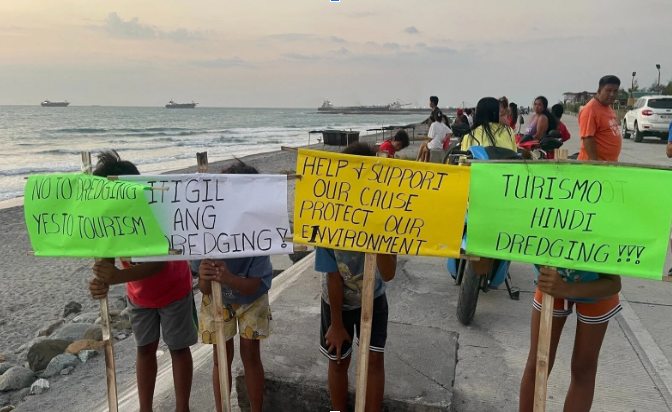
During World Fisheries Day in November 2025, fisherfolk and coastal residents from Zambales and Ilocos Sur marched to the Department of Environment and Natural Resources in Quezon City.

They demanded accountability for what they described as the “continued corporate plunder” of the country’s marine and aquatic resources through dredging and reclamation.

The protest, led by the Pambansang Lakas ng Kilusang Mamamalakaya ng Pilipinas (Pamalakaya), targeted dredging operations in Zambales and Ilocos Sur, which are reportedly supplying materials for the reclamation project in Manila Bay.

BAY UNDER THREAT

Manila Bay, which borders coastal cities in the National Capital Region as well as the provinces of Bataan, Pampanga, Bulacan in Region 3, and Cavite in Region 4, may be under threat from 21 land reclamation projects.
These activities cover an area almost twice as large as Metro Manila.

These data are based on the key findings from a study by the Marine Environment and Resources Foundation Inc. The study warned that these projects could result in massive flooding, water contamination, and the loss of fishing grounds.

MASSIVE EXTRACTION

Pamalakaya has also flagged an alleged massive sand extraction in the guise of a dredging project by a Chinese company on the shores of San Felipe, Zambales.

In a statement, the group alleged that the firm behind the dredging project is the China Harbour Engineering Company Ltd. 

“This unregulated sands extraction has resulted in significant losses to daily income of coastal residents, and worsened the vulnerability of fishing communities to erosion, sea-level rise, among other geological hazards,” said Pamalakaya Secretary General Salvador France in a statement. 

”The Chinese company, the local and provincial government, as well as government agencies that approved this project are accountable to the affected residents and the environment,” he added. 

CHINESE DREDGERS

The Chinese firm in question is a subsidiary of state-owned China Communications Construction Coorporation (CCCC), which had been placed in the US Department of Commerce’s Entity List for its construction of artificial islands in the West Philippine Sea. 

The fisherfolk group said that the dredged materials will be transported to Manila Bay in Pasay City. 

Together with environmental group Zambales Ecological Network, Pamalakaya said that it will file a formal complaint at the House Committees on Natural Resources, and Aquatic and Fisheries Resources over the destructive activities. 

The groups are seeking a probe into the environmental and socio-economic impacts of dredging. 

IMMINENT DESTRUCTION

The United States National Oceanic and Atmospheric Administration earlier explained that dredging is the removal of sediments and debris from the bottom of water bodies. 

Several circumstances necessitate dredging, including the maintenance of waterways for ships, as well as the cleaning of pollutants in bodies of water surrounding cities. 

But environmental groups have flagged that excessive dredging can lead to environmental harm, particularly the destruction of marine life. 

The Department of Environment and Natural Resources-Mines and Geosciences Bureau also said that dredging could lead to changes in water depth, thereby altering the strength of waves. This means that coastlines affected by dredging could experience higher waves over time.

RELATED ARTICLE:

Reforestation Fails Despite Billions Spent

0

IF MORE THAN a decade was not enough for the Department of Environment and Natural Resources (DENR) to make the P5 billion Forestland Management Project (FMP) a success, then perhaps the problem was never about time at all.

As the project concluded in 2024, the Commission on Audit (COA) assessed and evaluated its implementation, and what came out of it was nothing short of a disaster.

COA flagged the project for delayed downloading of funds, an agroforestry site that was converted into a vegetable garden, agroforestry products that went to waste, and the non-completion of two targeted outputs despite the project’s official completion.

P5-BILLION PROJECT

In a nutshell, the FMP is a reforestation effort aimed at increasing forest cover in the country by providing beneficiaries, known as People’s Organizations (POs), with training and orientation to strengthen forest management, while also establishing local enterprises to generate household income.

It also includes the construction of farm-to-market roads, pathways, bridges, tramlines, and irrigation pipeline systems to support forest conservation efforts of upland communities, collectively referred to as Agroforestry Support Facilities (ASF).

The project was a 12-year collaboration between the DENR and the Japan International Cooperation Agency (JICA), which began in 2012. JICA provided P4.53 billion through a loan, while the Philippine government contributed P1.34 billion.

DELAYED FUNDS

COA selected only two locations, Kayapa, Nueva Vizcaya, and Lagawe, Ifugao, for inspection, yet already found numerous deficiencies.

According to the audit report, a common sentiment among the POs was the delayed release of funds, especially during the early stages of the project, which triggered a series of problems.

Most POs were organized only during project implementation and were therefore dependent on funds that were supposed to be released to them.

This resulted in difficulties in recruiting members because funds intended as payment for labor were unavailable, while existing members were hesitant to participate.

Some chose to work without pay, while others sought loans from credit facilities to sustain operations.

DOMINO EFFECT

Because of delayed funding, project implementation also suffered, creating a domino effect of largely avoidable problems.

According to the POs, it took several months to nearly two years before they could proceed with implementation, as that was the only time funds were eventually released.

The project’s delayed execution prevented targets from being met, forcing the compression of activities simply to catch up with commitments under the agreement with JICA.

Since validation activities were scheduled, POs had no choice but to proceed with plantation activities even during the dry season, despite knowing that most seedlings would likely not survive due to unfavorable weather conditions.

Another consequence of delayed fund downloading was the late provision of seed capital intended for enterprise development.

One PO reported incurring losses because the proposed product was no longer in season by the time funds were released.

NO MONITORING

COA also found that after project completion, portions of a 100-hectare agroforestry site in Nueva Vizcaya that was awarded to the Tuppan-Balisyon Upland Farmers Association Inc. (TBUFAI) were converted into vegetable plantations.

A third-party validation team reported an 88.60 percent survival rate as of April 1, 2024, three months before project conclusion, suggesting that the conversion occurred after validation.

Further investigation revealed limited monitoring of FMP sites after project completion.

WASTING FUNDS

No additional appropriations were received for the FMP during the year, and allocations from the DENR Central and Regional Offices were primarily used to pay outstanding project obligations.

However, eight POs were granted financial assistance through a separate DENR program, the Community-Based Forest Protection and Monitoring (CFPM).

“If the insufficient monitoring of turned-over FMP sites continues, there is a high probability that the established plantations may be mismanaged, undermining the accomplishments of the FMP and ultimately wasting the funds utilized therefore,” the COA report stated.

WRONG VARIETY

Meanwhile, even in sites where agroforestry plantations remained intact, such as in Lagawe, Ifugao, the products planted became waste.

Validators found that cacao fruits, the most widely planted crop at the site, were not harvested and were left to rot on the trees.

PO members explained that harvesting was not worth the effort due to low demand and very low selling prices within their community, while other POs reported a lack of cacao supply.

What was intended to generate benefits and additional income for beneficiaries instead resulted in losses.

Compounding the issue was the presence of pests and diseases in plantations, which POs were unwilling to address using pesticides, as the added cost was seen as unjustifiable given the low demand and poor market prices.

CLOSE BUT NO CIGAR

On top of these issues, COA noted the non-completion of two project targets: the issuance of 149 Land Tenure Instruments (LTIs) to POs and the construction of 102 ASF projects.

Only 102 LTIs were issued, while one ASF project, an access road in Lambunao, Iloilo, remained unfinished.

Most ASF projects were funded and implemented with JICA support, which may partly explain the high completion rate.

However, with the contract already terminated, the contractor will be paid based on completed work, while the local government of Lambunao will shoulder the cost of completing the remaining portion.

As for the LTIs, DENR stated that it will continue processing applications even after project closure.

THE OTHER STORY

Notably, a January 2025 article by the Philippine Information Agency presents a contrasting narrative, quoting a beneficiary who expressed positive outcomes from the project.

“The FMP has improved my income and enabled me to send my three sons to university. My sons also want to be involved in forest conservation,” said Jimmy Rapista, a resident of Panuran, Janiuay.

Meanwhile, the DENR Forest Management Bureau highlighted what it described as major accomplishments of the project, including management plans for 24 sub-watersheds, the organization and strengthening of 149 POs, 71,300 hectares of tree and agroforestry plantations, 102 ASF units, five watershed management councils, and 149 microenterprises along with four pilot agroforestry value chain areas.

The bureau also claimed that the FMP contributed to at least a six percent increase in forest cover across all 24 sub-watersheds, with potential for further increases as plantation growth becomes more visible in satellite imagery.

It added that increased production volumes were observed from agroforestry plantations developed under the project.

Hisense Showcases ‘Smart Home Ecosystem’ At CES 2026

0

HISENSE IS SHOWCASING its full-scenario smart home ecosystem at the ongoing CES 2026 in Las Vegas, demonstrating how advanced display technologies and AI-powered home appliances come together to enhance everyday life.

“Designed around real-life home scenarios, Hisense’s CES booth brings premium large-screen entertainment together with intelligent kitchen, air, and laundry solutions. Large-screen TVs anchor shared family moments, while AI (artificial intelligence)-enabled appliances demonstrate how technology integrates seamlessly into everyday living,” the company said.

Also making its debut is the Humanoid Service Robot Harley. With 31 degrees of freedom, Harley delivers lifelike gestures and interactions to boost engaging and enhancing on-site experiences. Alongside this, the humanoid robot R1 (A2) and the home companion robot Beta are also on display.

As part of its long-standing engagement with global sports events, Hisense also demonstrated how its display technologies extend beyond consumer entertainment to professional applications. During CES 2026, the Hisense booth welcomed a visiting delegation led by the FIFA President, who toured the exhibition and expressed strong recognition of the Hisense Elite Collection for FIFA World Cup 2026, which includes RGB MiniLED TVs for clearer visualization of key match moments.

In displays, Hisense highlights RGB MiniLED evo, a true system-level evolution in large-screen TV technology, led by the debut of the 116UXS RGB MiniLED TV, the first product powered by this platform. RGB MiniLED evo introduces an industry-first Sky Blue–Cyan fourth LED into the backlight, expanding color coverage to up to 110 percent of BT.2020 while delivering more natural color expression and improved viewing comfort through genuine system-level evolution.

Hisense also globally debuts the Laser Projector XR10, delivering 6,000 ANSI lumens to create a professional-grade home cinema experience. Designed for immersive viewing up to 300 inches, XR10 brings enhanced brightness and rich color performance to dedicated home theater environments. Together with RGB MiniLED TVs, TriChroma Laser extends Hisense’s large-screen display offering from premium living-room viewing to dedicated home cinema environments.

Building on the evolution of the VIDAA OS, Hisense announced a strategic collaboration with Microsoft to integrate Copilot’s generative AI capabilities into its new platform, advancing next-generation TV experiences for large-screen home environments. The collaboration also extends to Xbox cloud gaming, bringing world-class game titles directly to Hisense TVs—no console required.

Beyond displays, Hisense showcases a range of smart home innovations. The X-zone Master, the world’s first X-in-one heat pump washer-dryer, introduces a modular multi-drum system that allows users to configure flexible layouts while enabling more precise, fabric-specific care. Complementing this, Hisense’s premium U Series is designed to deliver a fresher and softer laundry solution with ultimate filtration, ventilation, and static removal technology.

Hisense is dedicated to enhancing everyday life with a range of AI-powered home appliances. The PUREFLAT SMART SERIES refrigerator features an integrated large smart display with a built-in ConnectLife Hub, delivering a modern, connected kitchen experience by streamlining appliance interaction and smart home control. Meanwhile, the Red Dot Award winning Air Conditioner Air Master features high-precision sensing system that can adjust airflow, temperature and humidity for perfect air. Its intelligence is further demonstrated by the smart voice assistant and the automatic energy-saving mode, while its HI-NANO technology further ensures indoor comfort.

Hisense’s presence at CES 2026 is further underscored by four CES Innovation Awards. Among the winners, 163 MX and the X-zone Master each received the CES 2026 Best of Innovation Award in their respective fields, recognizing Hisense’s leadership across display and home appliance categories.

“Through ‘Innovating a Brighter Life,’Hisense continues to demonstrate how human-centered innovation can transform advanced technology into more comfortable, connected, and meaningful home experiences,” the company said.

China Still Constructing Artificial Islands In WPS? 

0

DEECOY IS THE name of the game insofar as China’s continuing claim over the entire South China Sea.

While all eyes are closely watching Chinese vessels loitering in the 200-nautical mile Philippine exclusive economic zone, China is busy constructing more artificial islands.

Worse, the filling materials used to create islands in the West Philippine Sea are being drawn from the Philippines where Chinese companies have been commissioned to undertake dredging operations.

NOTORIOUSLY FAMOUS

There are also instances when China Communications Construction Company (CCCC), through its subsidiary China Harbor Engineering Corp. (CHEC) would use filling materials from coastal communities constantly facing floods through flood mitigation efforts.

Previous reports tagged CCCC behind the reclamation in several areas at the West Philippine Sea.

The subsidiary operates the vessels transporting dredged sand and their presence in Philippine waters — very close to the disputed areas of the West Philippine Sea — has raised national security concerns. 

After all, CCCC constructed, at Beijing’s behest, artificial islands in the Mischief Reef, within the Philippines’ exclusive economic zone, reported the Philippine Center for Investigative Journalism.

CCCC DEFIES MARCOS

The dredging and reclamation has been going on despite the President’s investigation order into these activities last May with the dredged sand being used in reclaiming lands in the disputed body of water, rightfully awarded to the Philippines by the UN Convention on the Law of the Sea.

During the Senate Special Committee on Philippine Maritime and Admiralty Zones, the National Intelligence Coordinating Agency said it is looking into the possible involvement of China’s People’s Liberation Army in such operations.

The PCIJ mapped dredging operations across the country and  identified at least 12 large-scale dredging projects implemented under river restoration and flood control programs. 

USE OF LOCAL SAND

These projects are spread across several provinces where flooding has become a recurring concern. The dredged sand for these projects is also being used for two ongoing reclamation projects in the Manila Bay.

In Zambales, there are four dredging operations in major river systems that flow into the WPS; in Oriental Mindoro, following the suspension of two dredging projects, Governor Bonz Dolor signed an ordinance banning large-scale dredging in the province and in Occidental Mindoro, two dredging operations have been temporarily suspended following community complaints over possible environmental effects, livelihood disruption, and safety issues, the PCIJ reported.

In 2009, the World Bank banned CCCC from bidding for public works projects in the Philippines because of allegations of fraud and corruption the same month.

INVOLVEMENT OF CPLA

The National Intelligence Coordinating Agency (NICA) previously told the Senate Special Committee on Philippine Maritime and Admiralty Zones that it is probing possible involvement of China’s People’s Liberation Army in these operations. 

Of the 98 vessels being used to transport the sand, 60 are operated by CHEC, based on data from the Philippine Coast Guard (PCG) and the Maritime Industry Authority (MARINA). 

In addition, four ships  operated by local company, Ben Line Agencies Philippines Inc., were given special permits to conduct dredging operations for CHEC.

DU30’S PIVOT TO CHINA

The dredging and reclamation projects began under the administration of former President Rodrigo Duterte, when he signed Executive Order No. 74 placing the Philippine Reclamation Authority under his office and delegating to its Governing Board the power to approve all reclamation projects. 
Duterte later signed AI No. 16 creating the Manila Bay Task Force to oversee and expedite the rehabilitation of Manila Bay. The task force was mandated to implement the Supreme Court’s 2008 Writ of Continuing Mandamus directing government agencies to clean up and restore the bay.

Despite Duterte’s public objection to reclamation and avowal that no such projects would take place during his term, PRA records show that his administration greenlighted 22 reclamation projects nationwide, 13 of them in Manila Bay. 

PH NATIONAL SECURITY 

His successor, President Marcos allowed a review of their environmental and national security implications with former DENR Secretary Ma. Antonia Yulo-Loyzaga claimed the suspension would allow the conduct of “cumulative impact assessment.”

Fishermen under the  Pambansang Lakas ng Kilusang Mamamalakaya ng Pilipinas(Pamalakaya) voiced concern over the adverse effects of the reclamation projects on the livelihood of Filipino fishermen in over 32,000 hectares of fishing waters. 

The US Embassy in Manila also raised concern over the participation of CCCC and CHEC in Manila Bay reclamation projects, citing its role in helping the Chinese military construct and militarize artificial islands in the South China Sea. 

CARPIO’S STERN WARNING 

Retired Senior Associate Justice Antonio Carpio also warned officials not to engage with these Chinese state enterprises because “they helped China seize Philippine island territories and maritime zones” by creating artificial islands that are now used as Chinese military outposts, the PCIJ said. 

While most reclamation projects were ordered suspended, two projects– the 360 hectare Pasay Reclamation and Development Project of the Pasay City government in joint venture with SM Prime Holdings Inc. and the 260 hectare Pasay Harbor City Reclamation Project of Pasay City government in JV with Pasay Harbor City Corporation continued.

The Pasay Harbor City Corporation,  a subsidiary of Ulticon Builders Incorporation of Charlie Gonzalez , a general contractor based in Davao City, and one of the top contractors of both the Duterte and Aquino administrations.

CHEC’S MONOPOLY 

Coast Guard data show that CHEC operates mostly near coastal provinces adjacent to the WPS, according to PCG spokesman, Commodore Jay Tarriela, who told PCIJ that the WPS covers the country’s western seaboard, stretching from Batanes, Ilocos, Pangasinan, Bataan, and Zambales, down to Mindoro and Palawan, as defined under the 2013 administrative order signed by President Benigno Aquino III.

CHEC remains the dominant operator in the transport of dredged sand from coastal areas to Manila Bay. Most of its vessels are registered in the Philippines, except for 12  that were granted special permits to operate here. 

MARINA allows foreign-flagged vessels to operate in Philippine territorial waters if they are under government contract or when no suitable domestic vessel is available.

MORE DREDGING SHIPS 

In addition to the above, four more ships operated by  Ben Line Agencies Philippines Inc. dredged for CHEC. These ships were registered in Sierra Leone, Belize, Sierra Leone, and China. 

The presence of all these ships has raised red flags because both CCCC and CHEC have been involved in big construction projects that have been or may be used for military purposes. 

According to the Council for Foreign Relations, 14 of the 77 China-funded port projects worldwide are potentially “dual-use.” These include CCCC-built Hambantota Port in Sri Lanka. In 2022, a Chinese satellite  monitoring ship docked at the port, causing concerns that it was being used to gather intelligence on Indian missile launches.   

MILITARY PURPOSES

In 2021, the US–China Economic and Security Review Commission warned of China’s construction projects on the Panama Canal, noting that these “could be turned quickly toward military capabilities” and that the People’s Liberation Army could eventually secure naval access there. CCCC and CHEC have projects on the Canal.

In the Philippines, recent events have made those concerns more urgent. 

In November 2024, the Philippine Coast Guard arrested 13 undocumented Chinese nationals aboard the dredging vessel MV Harvest 89 operated by CHEC in Mariveles, Bataan, and were reportedly in possession of PLA uniforms.

SPOOFING TACTICS 

Tarriela explained that some dredging vessels may be involved in AIS (Automatic Identification System) spoofing, a tactic used by the Chinese government to disguise vessels under different identities or flags, sometimes making them appear as China Coast Guard ships. 

He said this is done to confuse authorities and create intimidation along coastal areas. Tarriela added that when the Philippine Coast Guard confirms that a dredger is being used for spoofing, the operator is required to explain or face suspension of operations, especially within Manila Bay.

Tarriela said, however, that as long as a company has complete permits, the Coast Guard does not look into the operator’s background; it only assesses the  seaworthiness of a vessel, its compliance with the rules, and its crew, regardless of their nationality. 

GAPS IN MONITORING 

Alien seafarers must be certified by the Bureau of Immigration or the Department of Labor and Employment. “As long as they don’t violate any of our laws, we don’t really care,” he said.  

While MARINA has not received reports of violations, MARINA Spokesman Director Luisito Delos Santos also acknowledged gaps in monitoring, stating that it’s possible some Chinese vessels are operating without proper permits, the PCIJ said.

Delos Santos also emphasized the need for a whole-of-government approach, saying that  before a reclamation project is implemented, there should be an assessment of what vessels are needed and which ones carry risks so that MARINA can decide on whether or not to issue them permits. 

RIVER RESTORATION

River restoration projects are part of the government’s flood mitigation efforts. These are implemented at no direct cost to the government, as private contractors are allowed to extract sand in exchange for desilting riverbeds. 

In 2017, Duterte allowed dredging of heavily-silted rivers across the country to address recurring floods. He instructed the DENR and the DA to work with the Department of Public Works and Highways in carrying out dredging operations in four major rivers — Agusan River, Rio Grande de Mindanao, Pampanga River, and Cagayan River. 

Under DENR Administrative Order No. 2020-07, signed by former DENR Secretary Roy Cimatu, private contractors must shoulder all expenses for dredging operations within designated river dredging zones identified by a provincial inter-agency committee. 

NO GOVERNMENT COST

The order states that no government funds shall be used, and only companies with the technical and financial capacity to undertake large-scale dredging may apply for clearance through the DPWH.

The PRA told PCIJ that project proponents at the dredging sites sell sand to Manila Bay reclamation project proponents. 

Contractors may recover and sell minerals obtained from dredging, provided they pay the required national and local taxes.

The order also created a provincial inter-agency committee chaired by the governor to oversee implementation, with the DENR, DPWH, MGB, and EMB as members.

NO PROBE RESULTS

Seven months after President Marcos ordered an investigation of coastal dredging activities in May 2025, no public findings have been released. NICA’s probe into possible PLA involvement, announced to the Senate, has not produced public results.

Tarriela said he was uncertain whether NICA had completed its investigation. 

He however confirmed that reports exist suggesting sand extracted from Philippine coastal municipalities is being used for island reclamation in the South China Sea, but said these findings have not been publicly confirmed and he was unaware of substantial evidence supporting the claims.

Investigation is still ongoing. 

SUSTAINED OPERATIONS

As of December 2025, the 60 vessels linked to CHEC continue operations.

Tarriela said the continued presence of Chinese nationals and vessels despite ongoing WPS  tensions, the PCG, together with the Bureau of Fisheries and Aquatic Resources and the Armed Forces of the Philippines, continues to resist illegal activities in disputed waters. 

He said the government’s commitment to protecting national sovereignty remains unchanged regardless of Chinese involvement in domestic dredging or reclamation projects.