DIRECTOR AND PRODUCER Ben Yalung was the first producer to have paid actress Snooky Serna a whopping one-million-peso talent fee in her entire career as a movie star.
“Si Direk Ben po ang nakapagbigay sa akin ng isang milyong pisong (He was the only one who was able to pay me one- million-peso) talent fee,” said Snooky as echoed by entertainment writer Mell T. Navarro during the 80th birthday bash of Ben at the Rockwell Events Hall in Makati City recently.
Snooky was one of the special guests in the event as a former star of Cine Suerte, Inc., the movie outfit of Yalung who was and still referred to as M-7, his business code name.
The movie Serna did for Ben was “Zuma,” a 1985 genre film adapted from comics or Filipino komiks authored by Jim Fernandez which no-nonsense and award-winning Jun Raquiza directed.
The fantasy outing was topbilled by action star Max Laurel.
Snooky has so many unforgettable experiences filming the action caper. “Noon, parang hindi lang isa ang ginagawa kong pelikula na tungkol sa ahas (That time, I think I was doing a lot of movies about snakes),” chuckled Kookie, Snooky’s pet name.
The actress was the titular lead in another supernatural film, “Madonna Ang Babaing Ahas (The Snakewoman)” (1991) for Regal Films.
During its shoots Kookie would recall that she was like bitten by a snake or she was feeling almost dizzy and breathless one night after scenes with the small reptiles slithering, climbing and descending a well was shot with her in the middle of these venomous although cultured creatures. “Ewan ko, baka nakagat talaga ako ng ahas. Hindi ko alam, ang dami nila (I didn’t know if I was really bitten by a snake. I really don’t know, there were plenty of them),” she quipped.
Serna appeared in the M-7 affair with her hair fixed in a “fly away” style, not unlike the snake-like curled coiffures.
In the same occasion, actress and TV personality Louella de Cordova who was also part of “Zuma” narrated her memorable experience in another Cine Suerte, Inc., “Basag ang Pula,” an action movie that starred the late Original Bad Boy of Philippine Cinema, Ace Vergel.
“Ang eksena kasi, sasampalin ko si Kuya (a term of endearment to an older brother or man by blood or by affinity) Ace. Ang sabi sa akin ni Direk Ben, totohanin ko ang sampal! Nang take na, talagang sinampal ko nang todo so Kuya Ace. Naku, pagkatapos ng take, ipinatawag ako ni Kuya Ace. ‘Naku, lagot, sabi ko.’ Nang humarap ako sa kanya, takot na takot ako. Tapos, sinabi niya, ‘halika.’ So, lumapit naman ako. ‘Yong lapit ko, nakayuko ako, nanginginig ako sa takot. Tapos, hinila niya ako at niyakap. Sabi niya, ‘okay lang ‘yon (The scene was that I would slap Ace. Director Ben, I should make it realistic! During the take, I really slapped him hard. Oh! After the take, I was summoned by Kuya Ace. ‘Oh, I’m in trouble,’ I told myself. When I came face-to-face with him, I was very afraid. Then, he dragged me slightly as he said, ‘come here.’ Of course, I went near him. While I was approaching him, my head was bowed, I was trembling out of fear. Then, he pulled me to his side and he hugged me. He said, ‘it’s okay),” recalled Louella.
Other stars who were around to greet Ben were director Jose “Kaka” Balagtas, Dindo Arroyo, Lloyd Samartino, Rey “PJ” Abellana, Giselle Sanchez, Sheena Abellana, Lindsay Custodio, Monsour del Rosario, Amanda Amores, Myrna Castillo, Aris Adina, among others.
The event was supposed to be a surprise party for the celebrator.
It was entertainment writer Navarro who sent us an invitation. “Hi, you’re warmly invited to the “SURPRISE”/secret 80th Birthday celebration of Direk BEN ‘M7’ YALUNG, one of our legendary movie producers and directors! This is a ‘super secret invitation’ that Direk Ben has NO idea at all, planned and organized by his loving Yalung family,” the invite delineated.
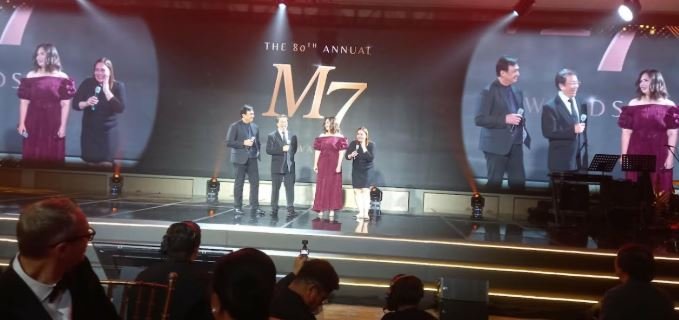
It was an awards-night-themed b-day event titled “The 80th Annual M-7 Awards” at the Rockwell Events Center in Makati City.
I was advised to come in my best semi formal or formal attire of Filipiniana motif. But since it was raining hard at the time, I settled to put on my Muslim-inspired Barong on top of my brown demin pants.
I also brought along a blazer that made my own concoction of my outfit eclectic.
At the fourth floor of the building, a red carpet was rolled out at the elevator step.
On both sides of the panel aligned on the opposite sides of the wall were tacked with posters or mini-sized reproductions of ad layouts of some Cine Suerte, Inc.’s movie productions like “Partida” (1985), “Target Sparrow” (1987), “Anak ni Zuma” (1987), “Kristo” (1996), “Divine Mercy sa Buhay ni Sister Faustina” (1993), among others.
I wondered why films like Lino Brocka’s “Cain at Abel” (1982, Marilou Diaz-Abaya’s “Karnal” (1983) and other titles were not displayed when they were also made by the outfit.
I realized soon enough that the films posted on the wall were only that of M-7’s directorial works.
Before the event, an emcee was reminding the guests to please refrain from applauding when M-7 was introduced as part of the surprise gig while there was an image of him in tuxedo talking with a woman in an adjacent chamber.
M-7 was oriented all along that he would be a guest speaker in a gathering of film professionals and film buffs on a given topic.
He was ready, after all, to speak before the crowd.
When M-7 was introduced, apparently, there was no deafening applause, only a handful who clapped, obviously the ones who didn’t get the advisory earlier although it was still a surprise party until he was greeted in unison.
It was the emcee and the family of M-7 who rolled in the party which he didn’t notice as he spoke to the audience after he was called as the main man of the celebration.
“This is the best ever surprise party I experienced. Before, I could easily sense. But this one, I didn’t have an inkling. Pagdating ko rito, akala ko, mag-i-speech lang ako (When I arrived, I thought I would just deliver a speech. This one, hindi nabuko (was not easily discerned). I want to impart this message soon! Sorpresa (Surprised). Loko kayo, ha (You’re playful, huh),” chuckled M-7 onstage.
As the birthday bash was like an awards night, this time the entire production of M-7 made the night more interesting with the handing out of awards, not to the stars of Cine Suerte, Inc. but the people from the ranks off-screen instead.
Some of the recipients of the awards were The Golden Friendship Award given to Josefino Yuson “M-9” de Guzman; The Best Friend Award bestowed to the late Melo Alcantara and received personally by his wife Mrs. Dolores Alcantara who travelled all the way from the US; The Outstanding Collaboration Award presented to M-7’s secretary Evelyn de Ramos; The Behind-the-Scenes Hero Award awarded to Frances Rachel Yalung; The Producer of the Year Award given to Benedict Yalung; The Beacon of Light Award handed in to Bro. Jay Gatchalian; The Faith in Action Award conferred to Most Reverend Teodoro C. Bacani, Jr., D.D.; The Lifetime of Love Award bestowed to Elizabeth Yalung and The Bishop Ted Bacani, Lifetime Achievement Award unanimously given to Ben Yalung.
Most of M-7’s children and grandchildren were around and they made their patriarch very happy on his day.