


THE HUGELY ELITE-dominated and illusionary partylist system must be amended as it has drifted far from its democratic foundations owing to flaws in electoral design and the controversial Supreme Court ruling in the case Banat v Comelec.
Banat is the acronym of Barangay Association for National Advancement and Transparency.
Behind the call for amendments to the flawed partylist system is a group which calls itself the Center for People Empowerment in Governance (CenPEG) recently.
Felix P. Muga II, a CenPEG fellow and associate professor of Mathematics at Ateneo de Manila University, warned that judicial interventions and legislative weaknesses have undermined the original constitutional intent of giving marginalized sectors meaningful representation in Congress.
“The partylist system was envisioned as a mechanism for empowering marginalized and underrepresented sectors. Instead, it has become vulnerable to elite capture, political dynasties and judicially-created distortions that have weakened democratic representation,” Muga said.
Citing recent studies, Muga argued that the Supreme Court essentially killed the two percent vote requirement for partylist groups. By analyzing the Banat ruling, Muga showed how organizations that failed to hit the minimum vote threshold under Republic Act 7941 were still able to win seats in Congress.
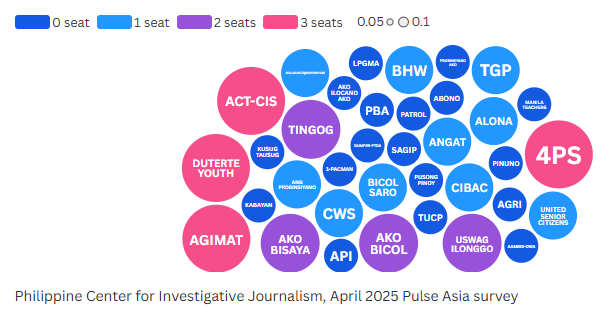
“The 2 percent threshold was intended to serve as a democratic qualifier – a minimum test of public support. By allowing non-qualifying groups to receive seats, the Court transformed a clear statutory gatekeeper into an optional rule,” he explained.
Muga pointed out that the decision produced unintended consequences that hastened the proliferation of party-list organizations and lowered barriers to entry for political interests that were never meant to benefit from the system.
“The Banat ruling opened the gate that Congress deliberately established. Once that gate was weakened, the party-list system became increasingly susceptible to manipulation by well-funded political actors and entrenched elites,” he said.
Banat vs. Comelec
The case arose after the 2007 elections when the Commission on Elections (Comelec) applied the formula from Veterans Federation Party v Comelec, resulting in only a portion of the available partylist seats being filled.

Banat challenged the Comelec formula, arguing that it unfairly limited representation.
Critics emphasized that the Banat ruling diluted the significance of the two percent threshold by allowing groups with very small vote shares to enter Congress. They argued that it encouraged the expansion of partylist organizations and fractured representation.
Supporters, however, say the ruling expanded participation and better reflected the constitutional goal of the partylist system.
Muga challenged the Court’s justification that bypassing the threshold was necessary to avoid vacant seats. Utilizing a mathematical model he developed in 2005, Muga argued that the Largest Remainder Method (LRM) offers a superior alternative.
He said that the method successfully allocates all congressional seats among legally qualifying parties without sacrificing proportional representation.
“The solution was never to abandon the threshold. The solution was to use a mathematically sound seat-allocation method that respects both proportional representation and democratic qualification standards,” he noted.
Muga further blamed the three-seat cap imposed under the partylist law as a major source of systemic dysfunction. “The three-seat cap distorts proportional representation and incentivizes political fragmentation. It encourages powerful interests to create multiple party-list organizations rather than compete fairly under a truly representative system,” he said.
Pro-Elite, Pro-Dynasty
Muga cited recent studies showing the proliferation of political dynasties and business-linked interests in the partylist bloc system has increasingly diverted from its constitutional purpose.
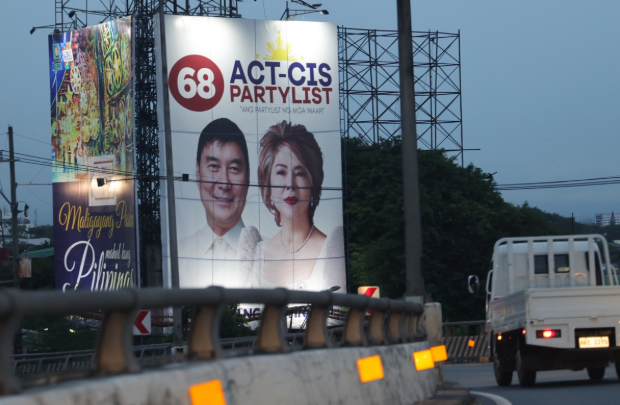
“What was intended as a vehicle for marginalized representation has, in many cases, become an additional avenue for elite political participation. Unless reforms are undertaken, the partylist system risks losing public legitimacy altogether,” he added.
To restore the integrity of the system, Muga proposed a comprehensive reform agenda to restore the integrity of the system.
- Restoring the 2 percent vote threshold as a strict qualification requirement, with the vote percentage rounded to six decimal places to ensure mathematical precision and eliminate ambiguity in borderline cases;
- Institutionalizing into law the rounding up of a party’s computed seat allocation whenever the decimal remainder is sufficient to reach at least 20 percent, ensuring that no qualifying party is arbitrarily denied representation due to fractional truncation;
- Repealing the Banat mechanism that allows sub-threshold groups to receive seats;
- Adopting the Largest Remainder Method for seat allocation;
- Removing the three-seat cap to achieve genuine proportional representation;
- Strengthening safeguards against political dynasties and vested interests in party-list nominations; and
- Clarifying constitutional and statutory rules governing party-list seat allocation.
For CenPEG, the partylist reform debate is beyond electoral mathematics.
“The issue is fundamentally democratic,” Muga stressed. “The rules of representation determine whose voices are heard.”
Speaker Dy’s Bill
Last June 24, Speaker Faustino Dy III filed a partylist reform bill so that the system will reflect genuine representation of marginalized sectors in the House of Representatives, Inquirer reported.
The proposed New PartyList System Act (House Bill 9906), which Dy filed, seeks to replace Republic Act 7941, introducing reforms to ensure that partylist groups will adhere to the constitutional vision of broadening democratic participation.
“Through the passing of years, it has become clear to us what the weaknesses of the party-list system are, which have caused it to stray from its original intent. Through this bill, we want to return the system to its true aim — to become a way for marginalized sectors to be heard and participate,” Dy said.
The partylist system was created to open the doors of Congress to Filipinos and communities whose voices are not always heard in traditional politics,” he added.
The explanatory note of the bill noted that the party-list system has expanded participation in the legislative process over the past three decades, but questions have emerged regarding the authenticity of some organizations claiming to represent sectors, advocacies, or communities.
To address these concerns, the bill establishes three categories of party-list representation:
- sectoral representation for marginalized and underrepresented sectors
- advocacy representation for civic and public policy organizations
- regional representation for geographic regions and ethno-linguistic communities
The other provisions in the bill include a call for genuine representation requirement and verification process by requiring party-list organizations to prove that they genuinely represent their sectors. It also:
- Advocates that organizations must demonstrate a verifiable record of civic or policy work.
- For the regional organizations to prove sustained presence within the regions or ethno-linguistic communities they seek to represent.
- Requires partylist organizations to maintain continuing public service, advocacy, and constituency engagement, and to submit regular reports documenting their activities and outreach efforts.
- Empowers the Comelec to evaluate an organization’s membership base, leadership participation, advocacy record, and organizational presence in the communities concerned.
- Requires organizations claiming sectoral representation to show genuine affiliation with the sector they represent.
“It’s our goal to ensure that representatives truly originate from, participate in, and have a deep interaction with the communities or sectors that they represent,” Dy said.
The measure, he added, is part of a broader package of electoral and political reforms being advanced by the House “to strengthen democratic institutions, improve public trust in government, and expand opportunities for meaningful participation in governance.”
He stressed that ensuring that party-list organizations maintain genuine links with the communities they represent is essential to preserving public confidence in the system.
“When the interaction of party-list organizations with their sectors and communities becomes stronger, their representation will become more meaningful, and our democracy will be more stable,” he said.
The bill is a Legislative-Executive Development Advisory Council (LEDAC) priority measure.