IT ALL STARTED with a memory.
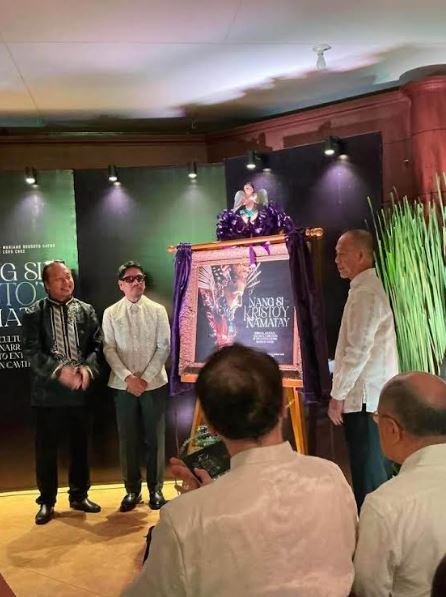
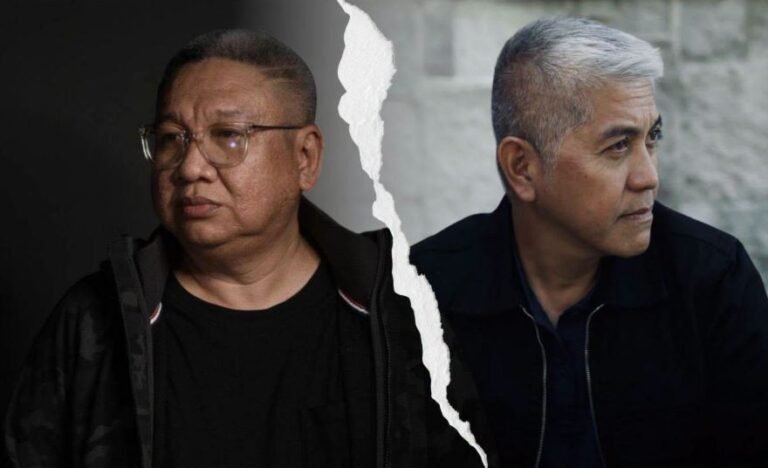
This coffee table book its main title in bold letters “Nang Si Kristo’y Namatay,” roughly translated in English as “When Christ Died,” with a subtitle “Spiritual, Cultural and Visual Narratives of the Santo Entierro Images in Cavite” written by erudite author Jeffrey Lubang and creative photo artist Marboy Sayno.
“Natatandaan ko, tuwing Biyernes Santo, isinasama ako ng tatay ko sa prusisyon ng Santo Entierro (I remember that every Good Friday, my father would tag me along the procession of the Holy Burial),” recalled Lubang, a Doctor of Philosophy (PhD) graduate.
“I was about seven or eight years old when my father, who was an OFW (Overseas Filipino Worker), was a clarinetist of the band that was an accompanying dirge behind the carriage of the Santo Entierro. I would hold the arms of my dad tightly during the procession,” said Dr. Lubang.
“Kaya lagi kong inaabangan ang pag-uwi ng tatay ko (I would, therefore, always look forward to the homecoming of my dad),” the author added, chuckling.
He said that he was, at one time, asleep while clasped in his father’s chest in some parts of the religious exercise.
“These are my inspirations in doing the book project,” he smiled.
HOLY RELIC
These memories live in the book however the overpowering and omnipresent images of the Santo Entierro (Holy Burial) in its pages hide the fragments and even the fullness of the author’s personal life although his soul and inner sanctum easily manifested in the outward appearances, shades of truths, signifiers, meanings, connotations and other inferences in the multi-layered definitions of the Holy Relic revealed in his mortal self.
Surely, Jeffrey lives in each and every fiber and grain of the artefacts, the semiotics of the divine and the magnanimity of his faith—an exude of his kindness, thoughtfulness, discernment, judgement, idealism etc.
Truly, men are created in the image of God.
These scenes are always etched in Jeffrey’s mind which inspired him to write the book.
Year in, year out, Jeffrey was witness, in his youth and adolescence, and still is in his maturity, to the general mournful religious activities on Good Fridays in his town in General Trias—the cortege of people following their respective saint-images perched on andas (portable or motorized platform, carriage or float).
General Trias is the bedrock and origin of Jeffrey’s spiritual journey in looking at the unique cultural heritage of Santo Entierro, a bequest of history from the four hundred years or so of Spanish colonialism, particularly conversion of the land into Christianity.
He might not be a very religious person (just a presumption or observation) but his authoritativeness and attentiveness in the anthropological materials of the historical significance of the Santo Entierro in the lives not only of his fellow Cavitenos but Catholics or non-Catholic Filipinos in the catholicity of the values which the Holy Burial signifies like sacrifice, wisdom, understanding, love, redemption, compassion etc. cannot be denied.
At first glance, the image of the Holy Burial was just a sculpted dead body of Jesus Christ lying in the bier but the more Jeff looked closely it is also the social interaction of the quotidian from all walks of life gathered in the patio of St. Francis of Assisi Parish Church, formerly San Francisco de Malabon Parish Church, that he saw and has been seeing until now.
UNIQUE NARRATIVE
Asked what would make the compilation of Santos Entierros in the municipalities and cities of Cavite different from the rest of the religious practices in the entire country, Jeffrey, without batting an eyelash, said that aside from his being a Caviteno, he believes that each Santo Entierro has its own unique narrative.
“I know that there are so many Santo Entierros all over the country but each of them has its own stories worth telling,” he shared.
These artefacts of the Santo Entierros might be similar to one another but there are diverse customs and traditions, inherent or acquired, that make them distinct yet akin to each other.
All towns and cities in the Province of Cavite—from Tanza to Kawit to Dasmarinas to Silang to Tarnate to Imus to Bacoor to Indang etc. are represented in varying looks and designs of their Santo Entierros if only the carving of Christ’s faces identical especially His pious and compassionate countenance in His moments of torture and death.
Meanwhile, like in General Trias and other municipalities and cities nationwide, Good Fridays are generally observed as sacred and sublime; it is also an acknowledgement of the way Jesus Christ suffered in the hands of His enemies just to save the world and humankind from sins.
People milled around the various saints (all main supporters in the story of the Santo Entierro, decked with flowers of all colors, varieties and sizes), stationed if not lined up in practically all sides of the churchyard.
To say the least, the observance in the ceremony of Santo Entierro is a melting pot where the community is reduced to a fellowship and worship of all believers coming together to share His agony.
Conversations, in whispers or otherwise, no matter in the middle of the piety and solemnity of the occasion, mark the socialization of the parishioners participating in the preparation and dispatch of the procession.
It must also be the socio-political atmosphere merging religion and spirituality together in the presence of community leaders, followers and subordinates in various fields—business, education, health, arts and culture etc. like local governance or public service mingling with the rest of the townspeople.
While they might shed off their official functions, their faith is an expression of remorse—in silence, especially, if any, as imperfect human beings or an embrace of the God-fearing nature of a person.
Once the parade kicks off, the sea of faithful is an extension of humanity, not necessarily the kind of phalanx of escapists saying hollow prayers but true, committed churchgoers as well.
ST. VERONICA
Mostly, the images being paraded during Good Fridays are Biblical personages during the life and the Crucifixion of Jesus Christ or the Passion of Christ and all the characters who navigated around Him like St. Veronica, St. John the Baptist, Virgin Mary, St. Joseph, St. Jude Thaddeus, St. Peter, among others.
In its graphic formation of a religious street tableaux, a Good Friday procession almost always follows a blocking which is usually guided by a priest and his acolytes bearing tall liturgical torches leading the flock while the images represented in the Passion of Christ alternately parading as muses with group of devotees or family hosts trailing after them.
To be more authentic in the interpretation and representation of the Passion of Christ, though, centurions who are farmed out in the procession, vigorously walking back and forth, pounding their spears intimidatingly among the marchers, to illustrate the antagonists in the narrative.
CAMAREROS, CAMARERAS
The last to pull off in the train of devout Catholics and the images of saints and martyrs is the Santo Entierro which is the most anticipated finale of the event sent to the church by the camareros and camareras (male and female caretakers) shortly before the start of the religious walk.
It is so because of its rarity and security as it is considered risky not to guard the Santo Entierro from larceny and sacrilege.
Being the final act, the Santo Entierro is the “star” of the ritual in the religious real-life dramaturgy which goes, literally, around town.
After the procession, each Santo Entierro is sent to their respective camareros and camareras (caretakers) who have designated a special place in their houses or a separate storage for the relic.
Get-togethers privately follow the processions.
In Tanza town, the Bobadilla family still hosts a post-procession gathering of Santo Entierro and serves the famous pancit estacion (roughly translated as noodle station), a native concoction of togue (mongo or bean sprouts), salted egg, tofu and sauce ala-pancit palabok which was whipped up by Nanay (Mother) Heleng Bobadilla in 1934.
Why was it called pancit estacion?
“At the time, that certain menu ran out of noodles so they used “togue” as replacement,” said Ahnnie Sarile, a Cavite cultural historian.
It’s a Good Friday party and most of the food being served during the post-processions which are still within hours of fasting are pork-free as a Catholic tradition but mainly veggies and native delicacies.
And as obscurantism still dominates many mindsets, the Santo Entierro is believed to be the wellspring of miracles if not superstitious beliefs.
According to Jeffrey, the possessions from head to toe of the Holy Burial connote powerful objects that are subjects of supernatural pursuits like an eternal life or invincibility from bullets or sickness that any part of the artefact can offer.
“May naniniwala na pag nakuha mo ang isang hibla ng buhok ng Santo Entierro, maliligtas ka sa lahat ng panganib (There are those who believe that when you are able to pull out a strand of hair from the Santo Entierro, you are saved from all dangers),” Jeffrey informed.
Or even a remnant ripped off from Santo Entierro’s vestment, he said, is believed to cure diseases.
LIVE THEATER OF LIFE
In this live theater of life, the Santo Entierros, in Cavite and elsewhere, are artistic creations.
Aside from religion, the way the book presented it, the Santo Entierros are works of sculpture to their most meticulous craftsmanship.
Jesus Christ might have hailed the carvers, cutters and designers of His images.
Meanwhile, the sharp, glossy and revealing photographs of Mariano Brosoto Sayno lend the fine artistry and deep religiosity of the people the Santo Entierros espouse.
The launching of “Nang Si Kristo’y Namatay Spiritual, Cultural and Visual Narratives of the Santo Entierro Images in Cavite” which was recently held at the Casas Hall Bishop House, Imus Cathedral Compound in Imus City was a resounding success with most of Cavite’s who’s who in arts and culture were around, some of them, Rosanni Sarile, also known as Ahnnie Sarile, a professor of Communication Arts at the De La Salle University-Dasmarinas City who multitasked as the director, scriptwriter, floor director, traffic and production manager of the event; Most Rev. Reynaldo Gonda Evangelista, Bishop of Imus, who delivered the invocation; Dr. Jan Philip David Mallari, Director, Cavite Studies Center, DLSU-Dasmarinas who was proxied by Prof. Jigs Medina who gave the opening remarks; Imus City Librarian Rocena Roman who represented Hon. Alex Lacson Advincula, Mayor of Imus who spoke about the inspiration of writing a book like “Nang Si Kristo’y Namatay”; Hon. Regalado Trota Jose, Chair, National Historical Commission of the Philippines who delivered an inspirational message; Architect Romeo Sayoc Cord Cruz, the publisher of the coffee table book who talked about the labor pains he experienced in publishing the book; Prof. Phillip Norbert Ahmed Lacson Medina, President, Silang Historical Society who talked about the significance of the book; Br. Normandy Co Dujungco, FSC, D. Theol, Director, Museo De La Salle who delivered an inspirational speech; Most Rev. Virgilio Saenz Mendoza, Priest-Animator of the Ministry on the Cultural Heritage of the Church for Diocese of Imus who blessed the unveiling of the book and Felice Prudente Sta. Maria, an independent scholar and a multi-awarded book author who remarked about the book.
The musical numbers were rendered by violinist Roi Aldric Montaos Trawon and pianist Gabriel Allan Ferros Paguirigan from the classic masterpieces of Antonio Vivaldi.